







Question: Read the above article of Playing to Win Folder. Based on this information, write a short paper on the topic of how Trader Joe's answers
Read the above article of Playing to Win Folder.
Based on this information, write a short paper on the topic of how Trader Joe's answers the 5 questions in the Playing to Win framework. (Word Limit = 500 words).
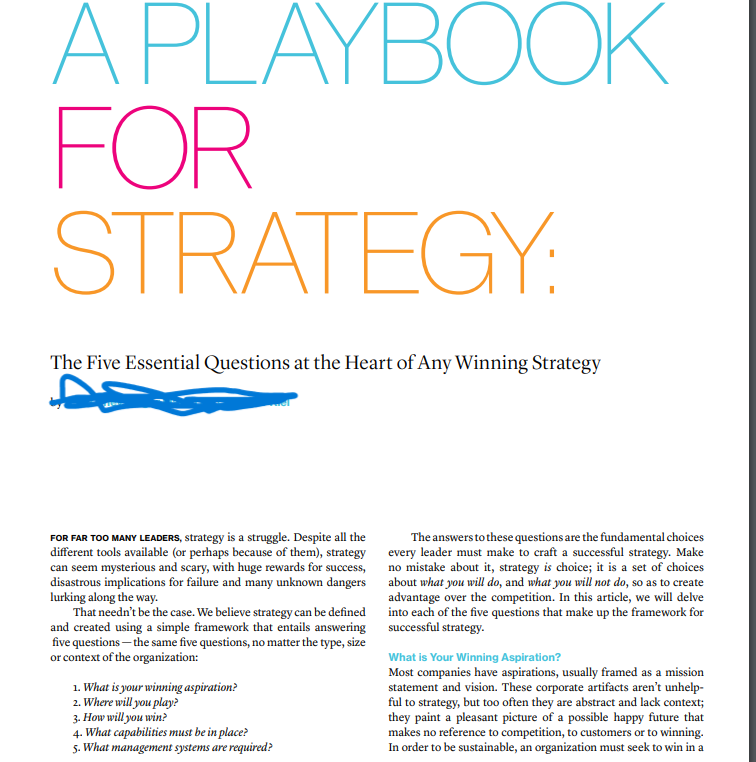
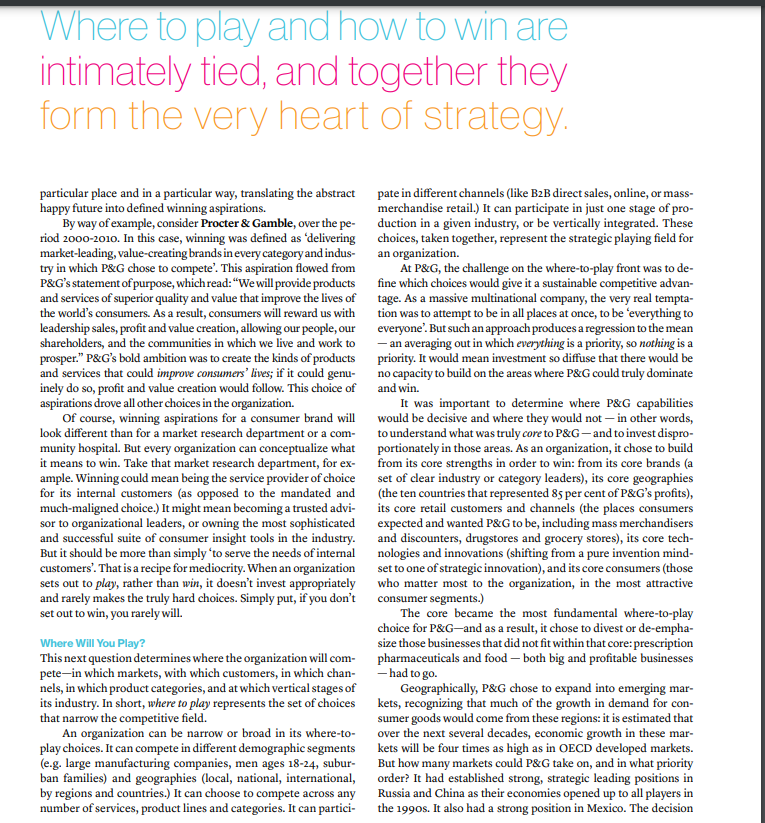
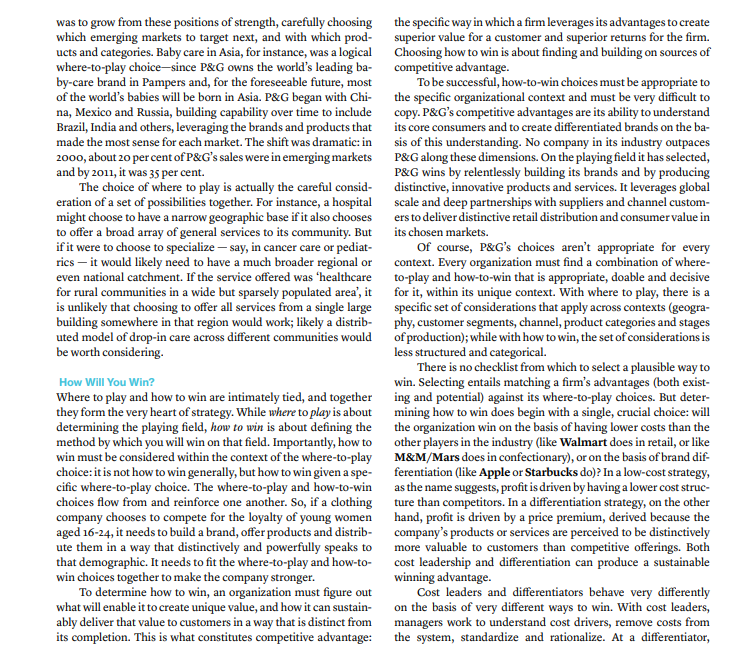
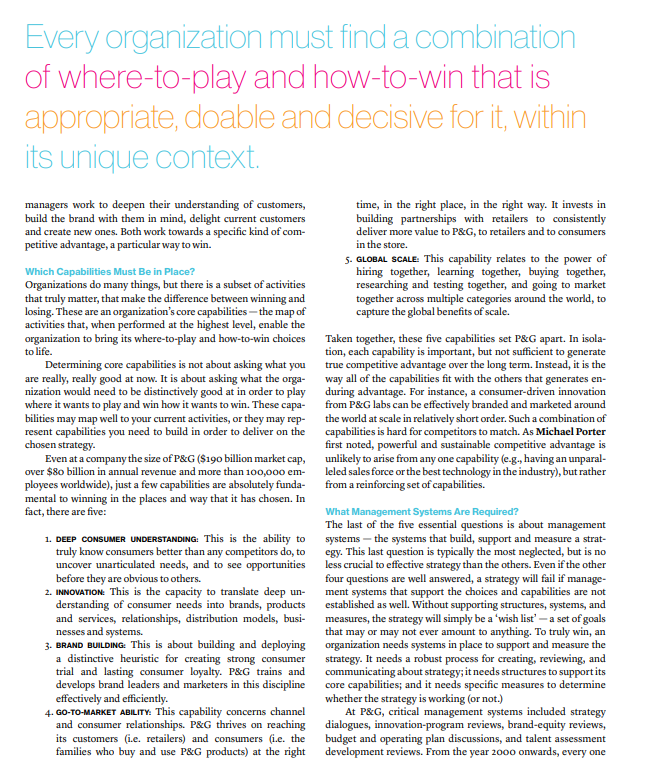
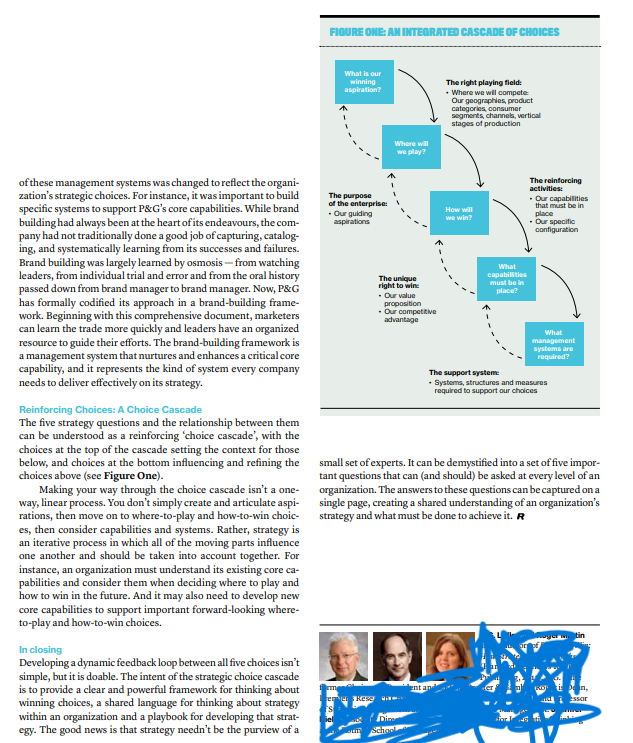
The Five Essential Questions at the Heart of Any Winning Strategy FOR FAR TOO MANY LEADERS, strategy is a struggle. Despite all the The answers to these questionsare the fundamental choices different tools available (or perhaps because of them), strategy every leader must make to craft a successful strategy. Make can seem mysterious and scary, with huge rewards for success, no mistake about it, strategy is choice; it is a set of choices disastrous implications for failure and many unknown dangers about what you will do, and what you will not do, so as to create lurking along the way. advantage over the competition. In this article, we will delve That needn't be the case. We believe strategy can be defined into each of the five questions that make up the framework for and created using a simple framework that entails answering successful strategy. five questions - the same five questions, no matter the type, size or context of the organization: What is Your Winning Aspiration? 1.Whatisyourwinningaspiration?statementandvision.Thesecorporateartifactsarentunhelp-Mostcompanieshaveaspirations,usuallyframedasamission 2. Where will you play? ful to strategy, but too often they are abstract and lack context; 3. How willyou win? they paint a pleasant picture of a possible happy future that 4.Whatcapabilitiesmustbeinplace?5.Whatmanagementsystemsarerequired?makesnoreferencetocompetition,tocustomersortowinning.Inordertobesustainable,anorganizationmustseektowinina particular place and in a particular way, translating the abstract pate in different channels (like B2B direct sales, online, or masshappy future into defined winning aspirations. merchandise retail.) It can participate in just one stage of proBy way of example, consider Procter \& Gamble, over the pe- duction in a given industry, or be vertically integrated. These riod 2000-2010. In this case, winning was defined as 'delivering choices, taken together, represent the strategic playing field for market-leading, value-creating brands in every category and indus- an organization. try in which P\&G chose to compete'. This aspiration flowed from At P\&G, the challenge on the where-to-play front was to deP\&G's statement of purpose, which read: "We will provide products fine which choices would give it a sustainable competitive advanand services of superior quality and value that improve the lives of tage. As a massive multinational company, the very real temptathe world's consumers. As a result, consumers will reward us with tion was to attempt to be in all places at once, to be 'everything to leadership sales, profit and value creation, allowing our people, our everyone'. But such an approach produces a regression to the mean shareholders, and the communities in which we live and work to an averaging out in which everything is a priority, so nothing is a prosper." P\&G's bold ambition was to create the kinds of products priority. It would mean investment so diffuse that there would be and services that could improve consumers' lives; if it could genu- no capacity to build on the areas where P\&G could truly dominate inely do so, profit and value creation would follow. This choice of and win. aspirations drove all other choices in the organization. It was important to determine where P\&G capabilities Of course, winning aspirations for a consumer brand will would be decisive and where they would not - in other words, look different than for a market research department or a com- to understand what was truly core to P\&G - and to invest dispromunity hospital. But every organization can conceptualize what portionately in those areas. As an organization, it chose to build it means to win. Take that market research department, for ex- from its core strengths in order to win: from its core brands (a ample. Winning could mean being the service provider of choice set of clear industry or category leaders), its core geographies for its internal customers (as opposed to the mandated and (the ten countries that represented 85 per cent of P\&G's profits), much-maligned choice.) It might mean becoming a trusted advi- its core retail customers and channels (the places consumers sor to organizational leaders, or owning the most sophisticated expected and wanted P\&G to be, including mass merchandisers and successful suite of consumer insight tools in the industry. and discounters, drugstores and grocery stores), its core techBut it should be more than simply 'to serve the needs of internal nologies and innovations (shifting from a pure invention mindcustomers'. That is a recipe for mediocrity. When an organization set to one of strategic innovation), and its core consumers (those sets out to play, rather than win, it doesn't invest appropriately who matter most to the organization, in the most attractive and rarely makes the truly hard choices. Simply put, if you don't consumer segments.) set out to win, you rarely will. The core became the most fundamental where-to-play choice for P&G - and as a result, it chose to divest or de-emphaWhere Will You Play? size those businesses that did not fit within that core: prescription This next question determines where the organization will com- pharmaceuticals and food - both big and profitable businesses pete-in which markets, with which customers, in which chan- _ had to go. nels, in which product categories, and at which vertical stages of Geographically, P\&G chose to expand into emerging marits industry. In short, where to play represents the set of choices kets, recognizing that much of the growth in demand for conthat narrow the competitive field. sumer goods would come from these regions: it is estimated that An organization can be narrow or broad in its where-to- over the next several decades, economic growth in these marplay choices. It can compete in different demographic segments kets will be four times as high as in OECD developed markets. (e.g. large manufacturing companies, men ages 18-24, subur- But how many markets could P\&G take on, and in what priority ban families) and geographies (local, national, international, order? It had established strong, strategic leading positions in by regions and countries.) It can choose to compete across any Russia and China as their economies opened up to all players in number of services, product lines and categories. It can partici- the 1990 . It also had a strong position in Mexico. The decision was to grow from these positions of strength, carefully choosing the specific way in which a firm leverages its advantages to create which emerging markets to target next, and with which prod- superior value for a customer and superior returns for the firm. ucts and categories. Baby care in Asia, for instance, was a logical Choosing how to win is about finding and building on sources of where-to-play choice-since P\&G owns the world's leading ba- competitive advantage. by-care brand in Pampers and, for the foreseeable future, most To be successful, how-to-win choices must be appropriate to of the world's babies will be born in Asia. P\&G began with Chi- the specific organizational context and must be very difficult to na, Mexico and Russia, building capability over time to include copy. P\&G's competitive advantages are its ability to understand Brazil, India and others, leveraging the brands and products that its core consumers and to create differentiated brands on the bamade the most sense for each market. The shift was dramatic: in sis of this understanding. No company in its industry outpaces 2000, about 2o per cent of P\&G's sales were in emerging markets P&G along these dimensions. On the playing field it has selected, and by 2011 , it was 35 per cent. P\&G wins by relentlessly building its brands and by producing The choice of where to play is actually the careful consid- distinctive, innovative products and services. It leverages global eration of a set of possibilities together. For instance, a hospital scale and deep partnerships with suppliers and channel custommight choose to have a narrow geographic base if it also chooses ers to deliver distinctive retail distribution and consumer value in to offer a broad array of general services to its community. But its chosen markets. if it were to choose to specialize - say, in cancer care or pediat- Of course, P\&G's choices aren't appropriate for every rics - it would likely need to have a much broader regional or context. Every organization must find a combination of whereeven national catchment. If the service offered was 'healthcare to-play and how-to-win that is appropriate, doable and decisive for rural communities in a wide but sparsely populated area', it for it, within its unique context. With where to play, there is a is unlikely that choosing to offer all services from a single large specific set of considerations that apply across contexts (geograbuilding somewhere in that region would work; likely a distrib- phy, customer segments, channel, product categories and stages uted model of drop-in care across different communities would of production); while with how to win, the set of considerations is be worth considering. less structured and categorical. There is no checklist from which to select a plausible way to How Will You Win? win. Selecting entails matching a firm's advantages (both existWhere to play and how to win are intimately tied, and together ing and potential) against its where-to-play choices. But deterthey form the very heart of strategy. While where to play is about mining how to win does begin with a single, crucial choice: will determining the playing field, how to win is about defining the the organization win on the basis of having lower costs than the method by which you will win on that field. Importantly, how to other players in the industry (like Walmart does in retail, or like win must be considered within the context of the where-to-play M\&M/Mars does in confectionary), or on the basis of brand difchoice: it is not how to win generally, but how to win given a spe- ferentiation (like Apple or Starbucks do)? In a low-cost strategy, cific where-to-play choice. The where-to-play and how-to-win as the name suggests, profit is driven by having a lower cost strucchoices flow from and reinforce one another. So, if a clothing ture than competitors. In a differentiation strategy, on the other company chooses to compete for the loyalty of young women hand, profit is driven by a price premium, derived because the aged 16-24, it needs to build a brand, offer products and distrib- company's products or services are perceived to be distinctively ute them in a way that distinctively and powerfully speaks to more valuable to customers than competitive offerings. Both that demographic. It needs to fit the where-to-play and how-to- cost leadership and differentiation can produce a sustainable win choices together to make the company stronger. winning advantage. To determine how to win, an organization must figure out Cost leaders and differentiators behave very differently what will enable it to create unique value, and how it can sustain- on the basis of very different ways to win. With cost leaders, ably deliver that value to customers in a way that is distinct from managers work to understand cost drivers, remove costs from its completion. This is what constitutes competitive advantage: the system, standardize and rationalize. At a differentiator, managers work to deepen their understanding of customers, time, in the right place, in the right way. It invests in build the brand with them in mind, delight current customers building partnerships with retailers to consistently and create new ones. Both work towards a specific kind of com- deliver more value to P\&G, to retailers and to consumers petitive advantage, a particular way to win. in the store. 5. GLOBAL SCALE: This capability relates to the power of Which Capabilities Must Be in Place? that truly matter, that make the difference between winning and together across multiple categories around the world, to losing. These are an organization's core capabilities - the map of capture the global benefits of scale. activities that, when performed at the highest level, enable the organization to bring its where-to-play and how-to-win choices Taken together, these five capabilities set P\&G apart. In isolato life. tion, each capability is important, but not sufficient to generate Determining core capabilities is not about asking what you true competitive advantage over the long term. Instead, it is the are really, really good at now. It is about asking what the orga- way all of the capabilities fit with the others that generates ennization would need to be distinctively good at in order to play during advantage. For instance, a consumer-driven innovation where it wants to play and win how it wants to win. These capa- from P\&G labs can be effectively branded and marketed around bilities may map well to your current activities, or they may rep- the world at scale in relatively short order. Such a combination of resent capabilities you need to build in order to deliver on the capabilities is hard for competitors to match. As Michael Porter chosen strategy. first noted, powerful and sustainable competitive advantage is Even at a company the size of P\&G (\$19o billion market cap, unlikely to arise from any one capability (e.g., having an unparalover $80 billion in annual revenue and more than 100,000 em- leled sales force or the best technology in the industry), but rather ployees worldwide), just a few capabilities are absolutely funda- from a reinforcing set of capabilities. mental to winning in the places and way that it has chosen. In fact, there are five: What Management Systems Are Required? The last of the five essential questions is about management 1. DEEP CONSUMER UNDERSTANDiNG: This is the ability to systems - the systems that build, support and measure a strattruly know consumers better than any competitors do, to egy. This last question is typically the most neglected, but is no uncover unarticulated needs, and to see opportunities less crucial to effective strategy than the others. Even if the other before they are obvious to others. four questions are well answered, a strategy will fail if manage- 2. INNovaton: This is the capacity to translate deep un- ment systems that support the choices and capabilities are not derstanding of consumer needs into brands, products established as well. Without supporting structures, systems, and and services, relationships, distribution models, busi- measures, the strategy will simply be a 'wish list' - a set of goals nesses and systems. that may or may not ever amount to anything. To truly win, an 3. BRAND BUILDING: This is about building and deploying organization needs systems in place to support and measure the a distinctive heuristic for creating strong consumer strategy. It needs a robust process for creating, reviewing, and trial and lasting consumer loyalty. P&G trains and communicatingabout strategy; it needs structures to supportits develops brand leaders and marketers in this discipline core capabilities; and it needs specific measures to determine effectively and efficiently. Whether the strategy is working (or not.) 4. GO-TO-MARKET ABILITY: This capability concerns channel At P&G, critical management systems included strategy and consumer relationships. P&G thrives on reaching dialogues, innovation-program reviews, brand-equity reviews, its customers (i.e. retailers) and consumers (i.e. the budget and operating plan discussions, and talent assessment of these management systems was changed to reflect the organization's strategic choices. For instance, it was important to build specific systems to support P\&G's core capabilities. While brand building had always been at the heart of its endeavours, the company had not traditionally done a good job of capturing, cataloging, and systematically learning from its successes and failures. Brand building was largely learned by osmosis - from watching leaders, from individual trial and error and from the oral history passed down from brand manager to brand manager. Now, P\&G has formally codified its approach in a brand-building framework. Beginning with this comprehensive document, marketers can learn the trade more quickly and leaders have an organized resource to guide their efforts. The brand-building framework is a management system that nurtures and enhances a critical core capability, and it represents the kind of system every company needs to deliver effectively on its strategy. Reinforcing Choices: A Choice Cascade The five strategy questions and the relationship between them can be understood as a reinforcing 'choice cascade', with the choices at the top of the cascade setting the context for those below, and choices at the bottom influencing and refining the small set of experts. It can be demystified into a set of five imporchoices above (see Figure One). tant questions that can (and should) be asked at every level of an Making your way through the choice cascade isn't a one- organization. The answers to these questions can be captured on a way, linear process. You don't simply create and articulate aspi- single page, creating a shared understanding of an organization's rations, then move on to where-to-play and how-to-win choic- strategy and what must be done to achieve it. R es, then consider capabilities and systems. Rather, strategy is an iterative process in which all of the moving parts influence one another and should be taken into account together. For instance, an organization must understand its existing core capabilities and consider them when deciding where to play and how to win in the future. And it may also need to develop new core capabilities to support important forward-looking whereto-play and how-to-win choices. In closing Developing a dynamic feedback loop between all five choices isn't simple, but it is doable. The intent of the strategic choice cascade is to provide a clear and powerful framework for thinking about winning choices, a shared language for thinking about strategy within an organization and a playbook for developing that strategy. The good news is that strategy needn't be the purview of a
Step by Step Solution
There are 3 Steps involved in it

Get step-by-step solutions from verified subject matter experts
 Study Help