







Question: REFERENCE: https://phet.colorado.edu/sims/html/capacitor-lab-basics/latest/capacitor-lab-basics_en.html Part 1: Parallel Plate Capacitor - Battery Connected 1. Choose Capacitance tab in the Capacitor Lab: Basics simulation. 2. Select all four options
REFERENCE: https://phet.colorado.edu/sims/html/capacitor-lab-basics/latest/capacitor-lab-basics_en.html
Part 1: Parallel Plate Capacitor - Battery Connected
1. Choose "Capacitance" tab in the "Capacitor Lab: Basics" simulation.
2. Select all four options in top right corner (Plate Charges, Bar Graph, Electric Field, Current Direction). 3. Note the Capacitance(C), Plates separation(d) and Plates Area(A).
4. UsingdandA, compute the capacitance. Write the solution.
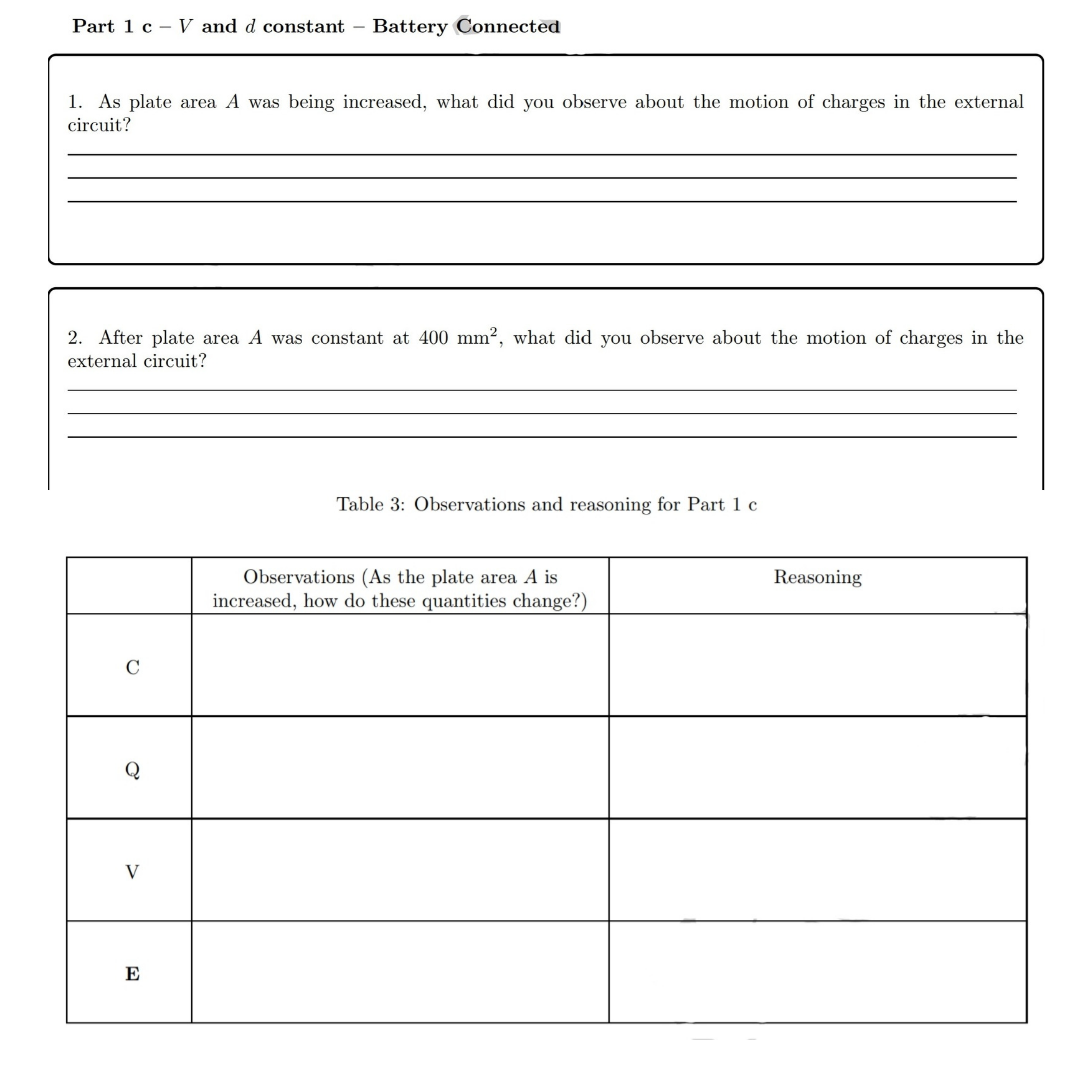
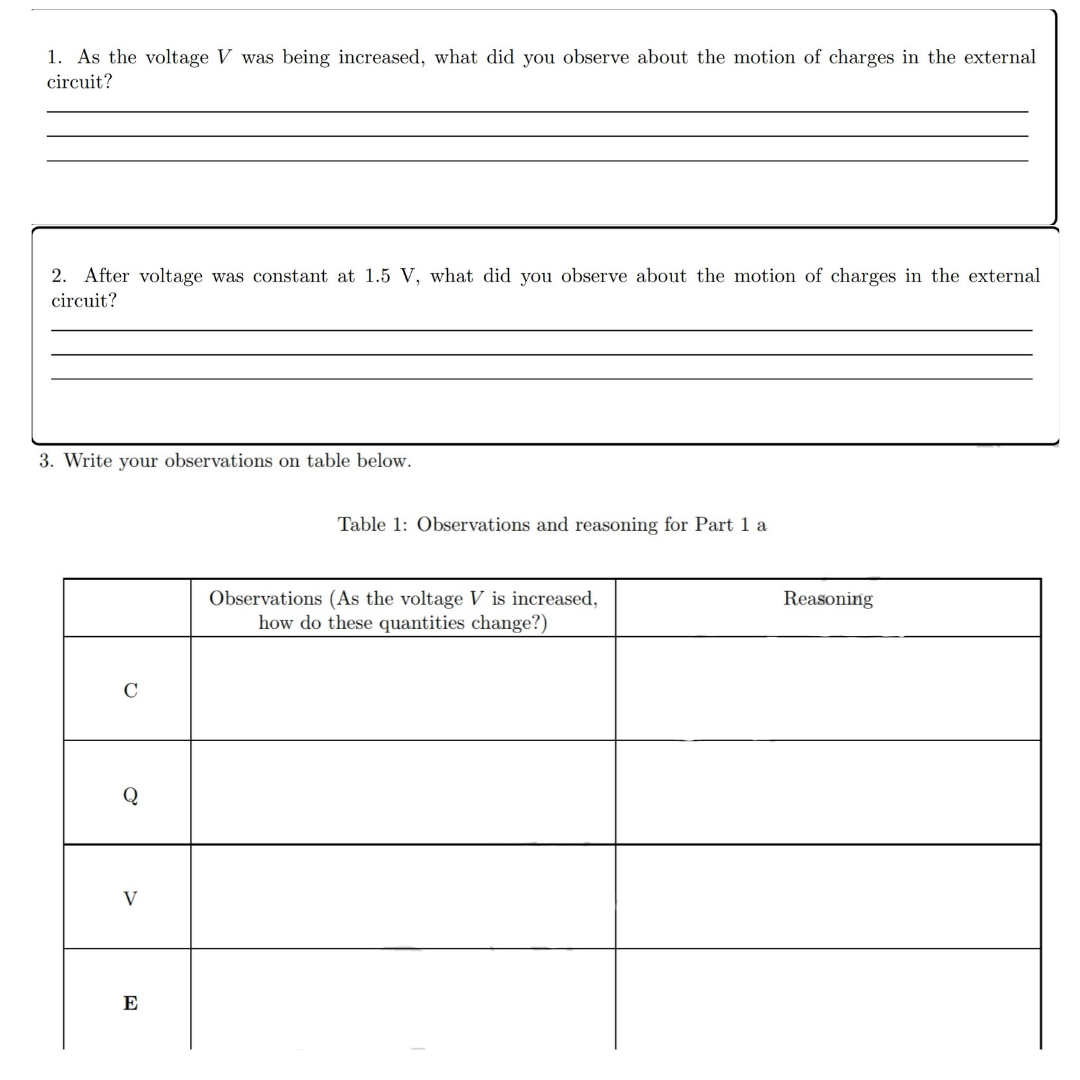
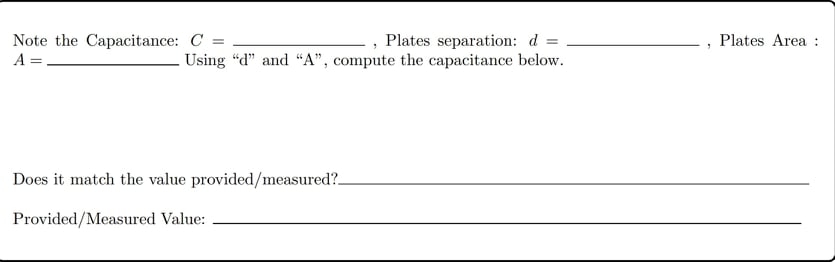
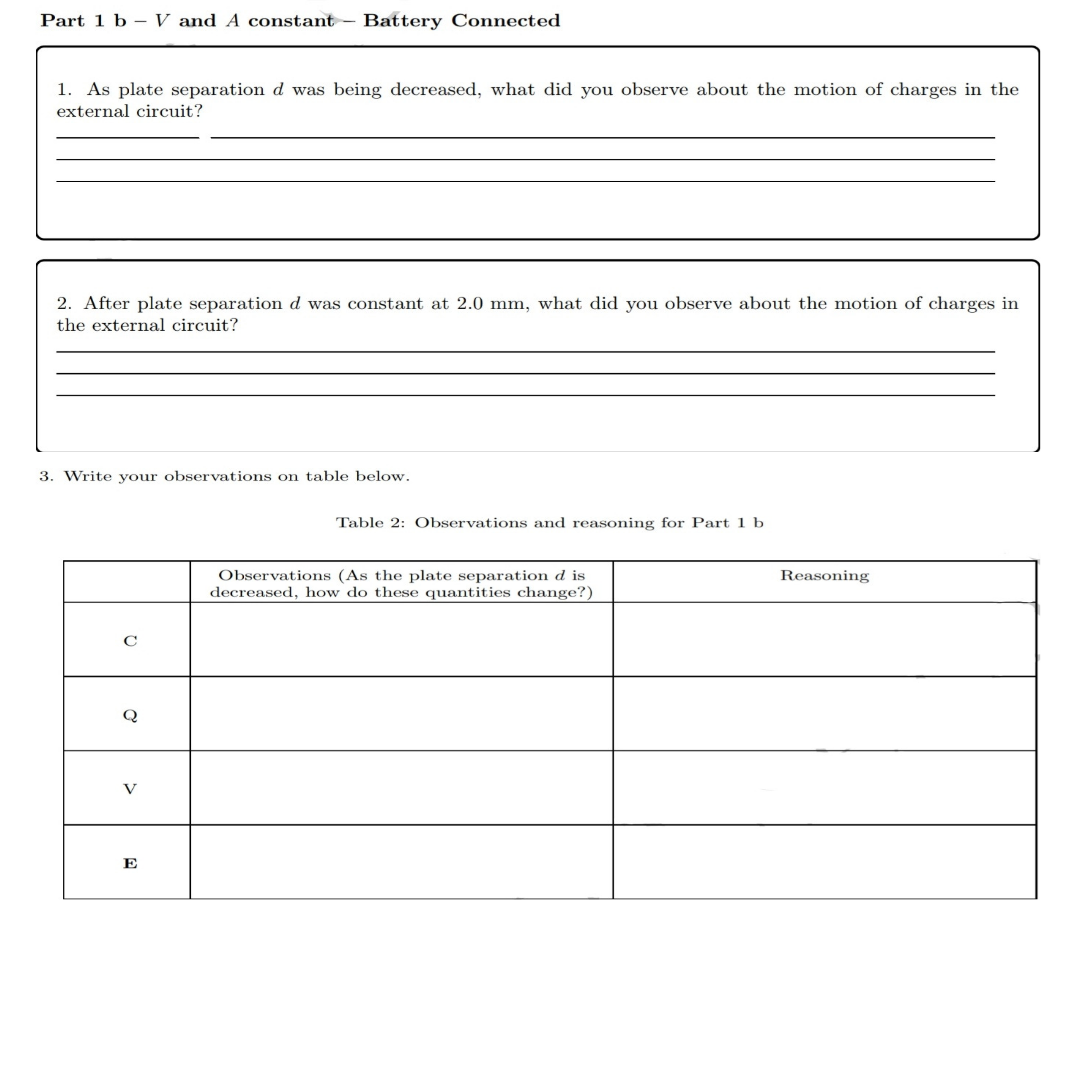
Part 1 e V and d constant Battery Connected 1. As plate area A was being increased, what did you observe about the motion of charges in the external circuit? 2. After plate area A was constant at 400 1111112. what did you observe about the motion of charges in the external circuit? Table 3: Observations and reasoning for Part 1 c Observations (As the plate area. A is Reasoning increased, how do these quantitieschang 1. As the voltage V was being increased, what did you observe about the motion of Charges in the external circuit? 2. After voltage was constant at 1.5 V, what did you observe about the motion of charges in the external circuit? 3. Write your observations on table below. Table 1: Observations and reasoning for Part 1 a Observations (As the voltage V is increased, how do these quantities change?) Note the Capacitance: C = , Plates separation: d = Plates Area : A = Using "d" and "A", compute the capacitance below. Does it match the value provided/ measured?. Provided/Measured Value:Part 1 b V and A constant - Battery Connected 1. As plate separation of was being decreased, what did you observe about the motion of charges in the external circuit? 2. After plate separation d. was constant at 2.0 turn, what did you observe about the motion of charges in the external circuit? 3. Write your observations on table below. Table 2: Observations and reasoning for Part 1 1'! Observations (As the plate separation d is Reasoning decreased, how do these quantities change?) -_
Step by Step Solution
There are 3 Steps involved in it

Get step-by-step solutions from verified subject matter experts
 Study Help