Question: Rewriting for formality task 7 and 8 TASK 7 Rewriting for formality The following text is written in an informal style. Rewrite it as a
Rewriting for formality task 7 and 8
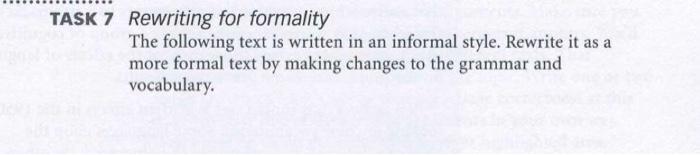
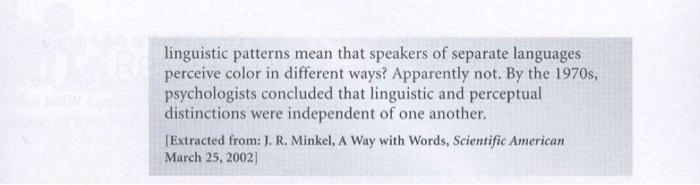
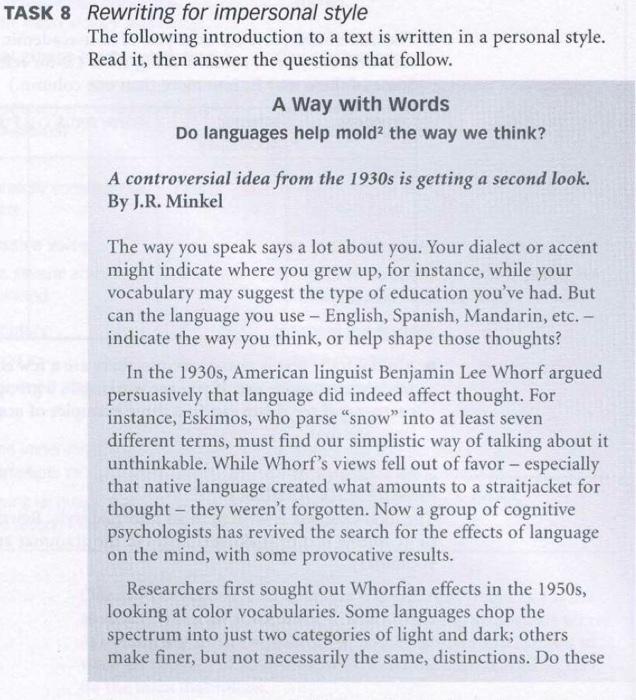
TASK 7 Rewriting for formality The following text is written in an informal style. Rewrite it as a more formal text by making changes to the grammar and vocabulary linguistic patterns mean that speakers of separate languages perceive color in different ways? Apparently not. By the 1970s, psychologists concluded that linguistic and perceptual distinctions were independent of one another. [Extracted from: J. R. Minkel, A Way with Words, Scientific American March 25, 2002) TASK 8 Rewriting for impersonal style The following introduction to a text is written in a personal style. Read it, then answer the questions that follow. A Way with Words Do languages help mold2 the way we think? A controversial idea from the 1930s is getting a second look. By J.R. Minkel The way you speak says a lot about you. Your dialect or accent might indicate where you grew up, for instance, while your vocabulary may suggest the type of education you've had. But can the language you use - English, Spanish, Mandarin, etc. - indicate the way you think, or help shape those thoughts? In the 1930s, American linguist Benjamin Lee Whorf argued persuasively that language did indeed affect thought. For instance, Eskimos, who parse "snow" into at least seven different terms, must find our simplistic way of talking about it unthinkable. While Whorf's views fell out of favor - especially that native language created what amounts to a straitjacket for thought - they weren't forgotten. Now a group of cognitive psychologists has revived the search for the effects of language on the mind, with some provocative results. Researchers first sought out Whorfian effects in the 1950s, looking at color vocabularies. Some languages chop the spectrum into just two categories of light and dark; others make finer, but not necessarily the same, distinctions. Do these TASK 7 Rewriting for formality The following text is written in an informal style. Rewrite it as a more formal text by making changes to the grammar and vocabulary linguistic patterns mean that speakers of separate languages perceive color in different ways? Apparently not. By the 1970s, psychologists concluded that linguistic and perceptual distinctions were independent of one another. [Extracted from: J. R. Minkel, A Way with Words, Scientific American March 25, 2002) TASK 8 Rewriting for impersonal style The following introduction to a text is written in a personal style. Read it, then answer the questions that follow. A Way with Words Do languages help mold2 the way we think? A controversial idea from the 1930s is getting a second look. By J.R. Minkel The way you speak says a lot about you. Your dialect or accent might indicate where you grew up, for instance, while your vocabulary may suggest the type of education you've had. But can the language you use - English, Spanish, Mandarin, etc. - indicate the way you think, or help shape those thoughts? In the 1930s, American linguist Benjamin Lee Whorf argued persuasively that language did indeed affect thought. For instance, Eskimos, who parse "snow" into at least seven different terms, must find our simplistic way of talking about it unthinkable. While Whorf's views fell out of favor - especially that native language created what amounts to a straitjacket for thought - they weren't forgotten. Now a group of cognitive psychologists has revived the search for the effects of language on the mind, with some provocative results. Researchers first sought out Whorfian effects in the 1950s, looking at color vocabularies. Some languages chop the spectrum into just two categories of light and dark; others make finer, but not necessarily the same, distinctions. Do these