







Question: Save X Table The following data represent the speed at which a ball was hit (in miles per hour) and the distance it traveled (in
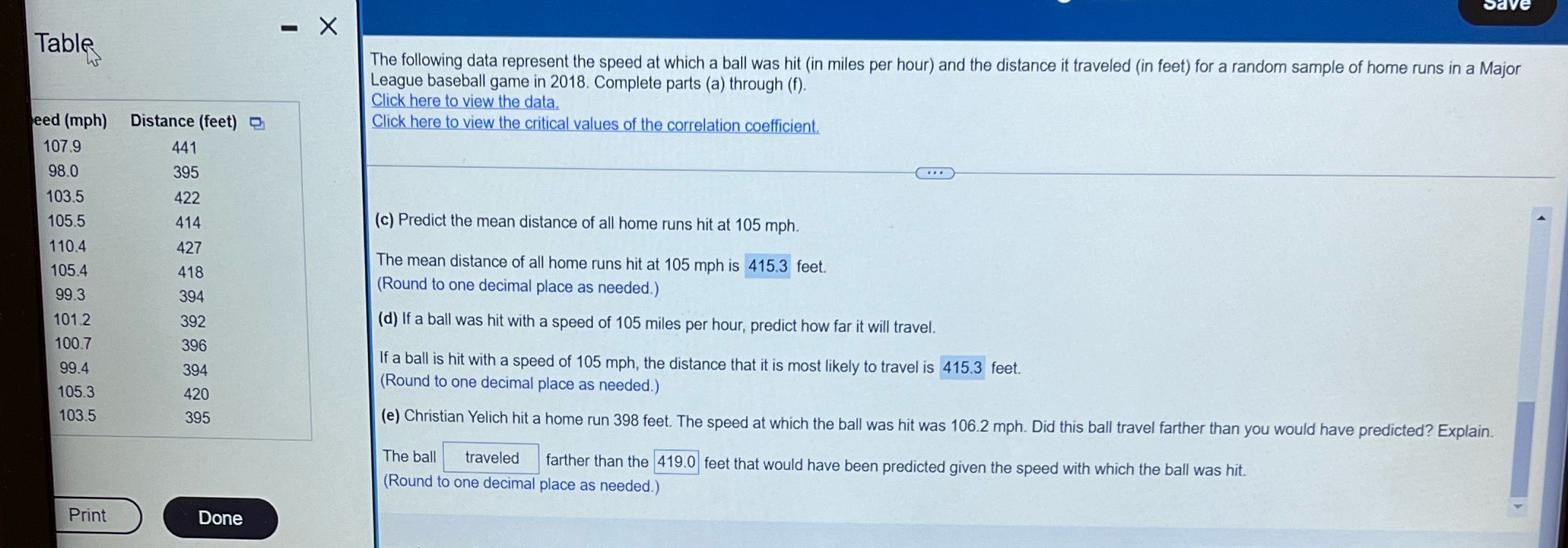
Save X Table The following data represent the speed at which a ball was hit (in miles per hour) and the distance it traveled (in feet) for a random sample of home runs in a Major League baseball game in 2018. Complete parts (a) through (f). Click here to view the data. eed (mph) Distance (feet) Click here to view the critical values of the correlation coefficient. 107.9 441 98.0 395 103.5 422 105.5 414 (c) Predict the mean distance of all home runs hit at 105 mph. 110.4 427 The mean distance of all home runs hit at 105 mph is 415.3 feet. 105.4 418 (Round to one decimal place as needed.) 99.3 394 101.2 392 (d) If a ball was hit with a speed of 105 miles per hour, predict how far it will travel. 100.7 396 99.4 If a ball is hit with a speed of 105 mph, the distance that it is most likely to travel is 415.3 feet. 394 (Round to one decimal place as needed.) 105.3 420 103.5 395 (e) Christian Yelich hit a home run 398 feet. The speed at which the ball was hit was 106.2 mph. Did this ball travel farther than you would have predicted? Explain. The ball traveled farther than the 419.0 feet that would have been predicted given the speed with which the ball was hit. (Round to one decimal place as needed.) Print Done
Step by Step Solution
There are 3 Steps involved in it

Get step-by-step solutions from verified subject matter experts
 Study Help