Question: Scenario 1: Read the following Request for Concept Note: Islamic Republic of Afghanistan Ministry of Agriculture, Irrigation and Livestock (SUPPORT TO NATIONAL PRIORITY PROGRAM2 SNAPP2)
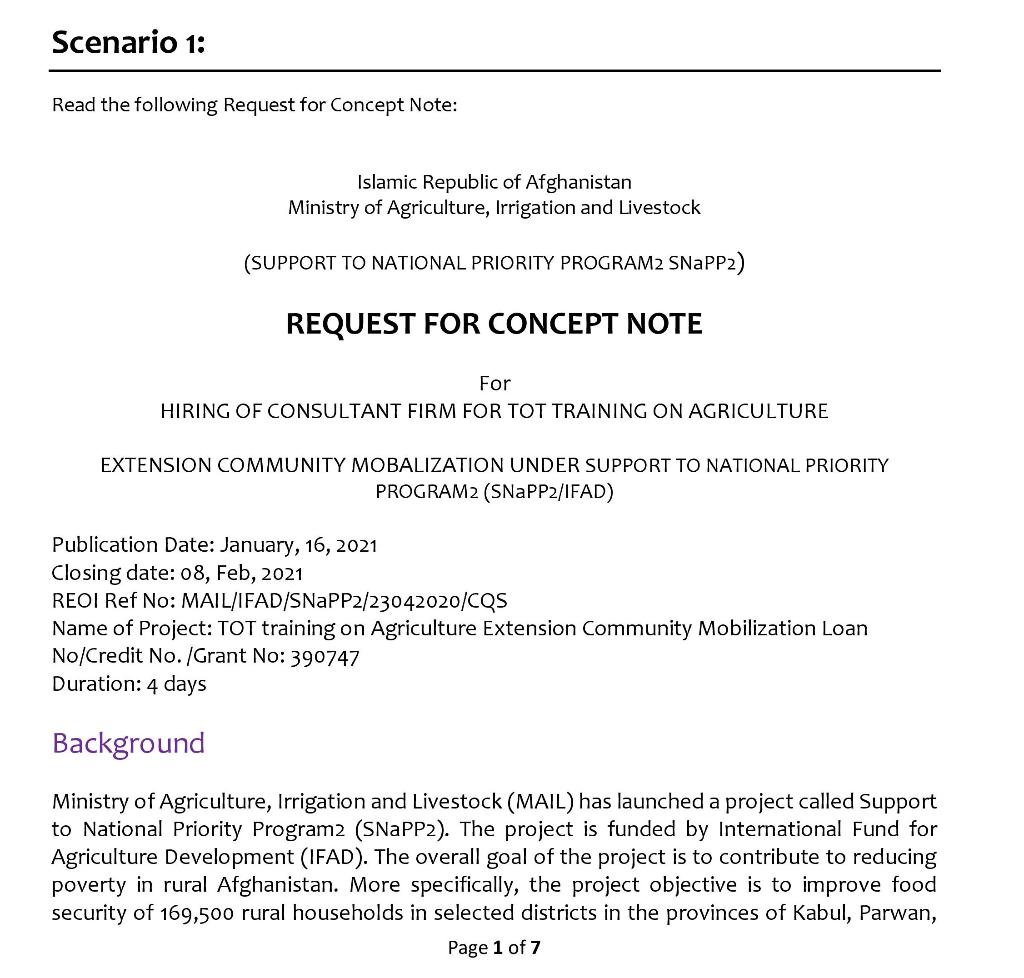
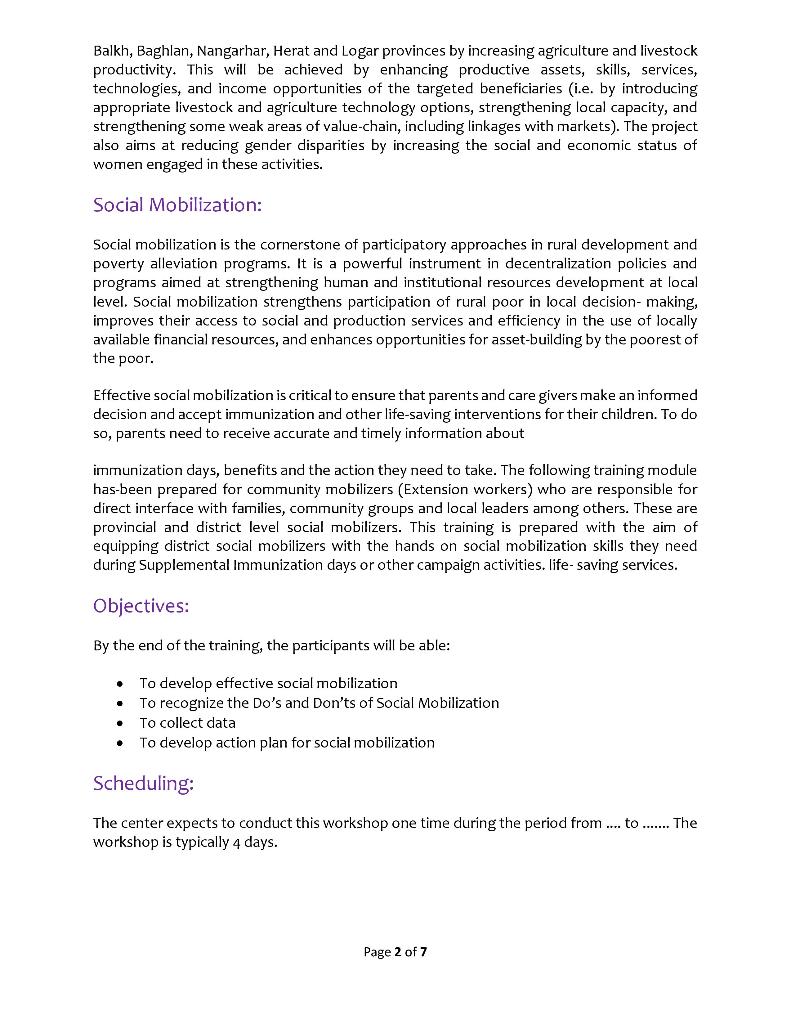
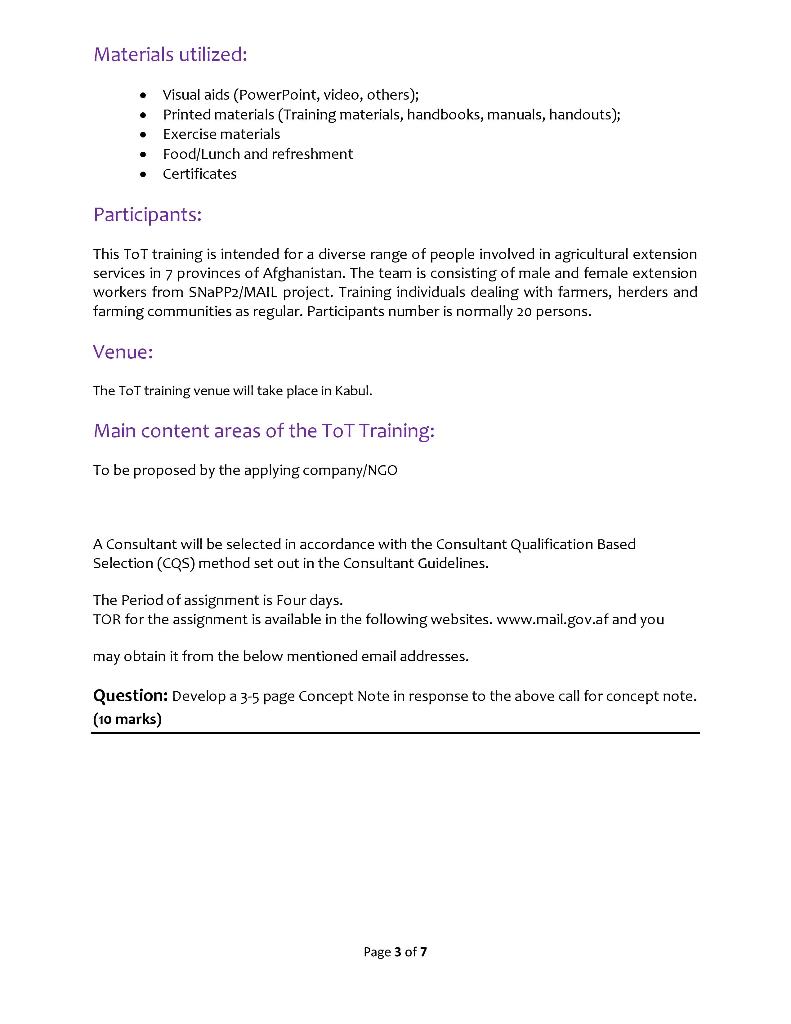
Scenario 1: Read the following Request for Concept Note: Islamic Republic of Afghanistan Ministry of Agriculture, Irrigation and Livestock (SUPPORT TO NATIONAL PRIORITY PROGRAM2 SNAPP2) REQUEST FOR CONCEPT NOTE For HIRING OF CONSULTANT FIRM FOR TOT TRAINING ON AGRICULTURE EXTENSION COMMUNITY MOBALIZATION UNDER SUPPORT TO NATIONAL PRIORITY PROGRAM2 (SNAPP2/IFAD) Publication Date: January, 16, 2021 Closing date: 08, Feb, 2021 REOI Ref No: MAIL/IFAD/SNAPP2/23042020/CQS Name of Project: TOT training on Agriculture Extension Community Mobilization Loan No/Credit No./Grant No: 390747 Duration: 4 days Background Ministry of Agriculture, Irrigation and Livestock (MAIL) has launched a project called Support to National Priority Program2 (SNAPP2). The project is funded by International Fund for Agriculture Development (IFAD). The overall goal of the project is to contribute to reducing poverty in rural Afghanistan. More specifically, the project objective is to improve food security of 169,500 rural households in selected districts in the provinces of Kabul, Parwan, Page 1 of 7 Balkh, Baghlan, Nangarhar, Herat and Logar provinces by increasing agriculture and livestock productivity. This will be achieved by enhancing productive assets, skills, services, technologies, and income opportunities of the targeted beneficiaries (i.e. by introducing appropriate livestock and agriculture technology options, strengthening local capacity, and strengthening some weak areas of value-chain, including linkages with markets). The project also aims at reducing gender disparities by increasing the social and economic status of women engaged in these activities. Social Mobilization: Social mobilization is the cornerstone of participatory approaches in rural development and poverty alleviation programs. It is a powerful instrument in decentralization policies and programs aimed at strengthening human and institutional resources development at local level. Social mobilization strengthens participation of rural poor in local decision-making, improves their access to social and production services and efficiency in the use of locally available financial resources, and enhances opportunities for asset-building by the poorest of the poor. Effective social mobilization is critical to ensure that parents and care givers make an informed decision and accept immunization and other life-saving interventions for their children. To do so, parents need to receive accurate and timely information about immunization days, benefits and the action they need to take. The following training module has been prepared for community mobilizers (Extension workers) who are responsible for direct interface with families, community groups and local leaders among others. These are provincial and district level social mobilizers. This training is prepared with the aim of equipping district social mobilizers with the hands on social mobilization skills they need during Supplemental Immunization days or other campaign activities. life-saving services. Objectives: By the end of the training, the participants will be able: To develop effective social mobilization To recognize the Do's and Don'ts of Social Mobilization To collect data To develop action plan for social mobilization Scheduling: The center expects to conduct this workshop one time during the period from .... to....... The workshop is typically 4 days. Page 2 of 7 Materials utilized: . Visual aids (PowerPoint, video, others); Printed materials (Training materials, handbooks, manuals, handouts); Exercise materials Food/Lunch and refreshment Certificates Participants: This ToT training is intended for a diverse range of people involved in agricultural extension services in 7 provinces of Afghanistan. The team is consisting of male and female extension workers from SNAPP2/MAIL project. Training individuals dealing with farmers, herders and farming communities as regular. Participants number is normally 20 persons. Venue: The ToT training venue will take place in Kabul. Main content areas of the ToT Training: To be proposed by the applying company/NGO A Consultant will be selected in accordance with the Consultant Qualification Based Selection (CQS) method set out in the Consultant Guidelines. The Period of assignment is Four days. TOR for the assignment is available in the following websites. www.mail.gov.af and you may obtain it from the below mentioned email addresses. Question: Develop a 3-5 page Concept Note in response to the above call for concept note. (10 marks) Page 3 of 7 Scenario 1: Read the following Request for Concept Note: Islamic Republic of Afghanistan Ministry of Agriculture, Irrigation and Livestock (SUPPORT TO NATIONAL PRIORITY PROGRAM2 SNAPP2) REQUEST FOR CONCEPT NOTE For HIRING OF CONSULTANT FIRM FOR TOT TRAINING ON AGRICULTURE EXTENSION COMMUNITY MOBALIZATION UNDER SUPPORT TO NATIONAL PRIORITY PROGRAM2 (SNAPP2/IFAD) Publication Date: January, 16, 2021 Closing date: 08, Feb, 2021 REOI Ref No: MAIL/IFAD/SNAPP2/23042020/CQS Name of Project: TOT training on Agriculture Extension Community Mobilization Loan No/Credit No./Grant No: 390747 Duration: 4 days Background Ministry of Agriculture, Irrigation and Livestock (MAIL) has launched a project called Support to National Priority Program2 (SNAPP2). The project is funded by International Fund for Agriculture Development (IFAD). The overall goal of the project is to contribute to reducing poverty in rural Afghanistan. More specifically, the project objective is to improve food security of 169,500 rural households in selected districts in the provinces of Kabul, Parwan, Page 1 of 7 Balkh, Baghlan, Nangarhar, Herat and Logar provinces by increasing agriculture and livestock productivity. This will be achieved by enhancing productive assets, skills, services, technologies, and income opportunities of the targeted beneficiaries (i.e. by introducing appropriate livestock and agriculture technology options, strengthening local capacity, and strengthening some weak areas of value-chain, including linkages with markets). The project also aims at reducing gender disparities by increasing the social and economic status of women engaged in these activities. Social Mobilization: Social mobilization is the cornerstone of participatory approaches in rural development and poverty alleviation programs. It is a powerful instrument in decentralization policies and programs aimed at strengthening human and institutional resources development at local level. Social mobilization strengthens participation of rural poor in local decision-making, improves their access to social and production services and efficiency in the use of locally available financial resources, and enhances opportunities for asset-building by the poorest of the poor. Effective social mobilization is critical to ensure that parents and care givers make an informed decision and accept immunization and other life-saving interventions for their children. To do so, parents need to receive accurate and timely information about immunization days, benefits and the action they need to take. The following training module has been prepared for community mobilizers (Extension workers) who are responsible for direct interface with families, community groups and local leaders among others. These are provincial and district level social mobilizers. This training is prepared with the aim of equipping district social mobilizers with the hands on social mobilization skills they need during Supplemental Immunization days or other campaign activities. life-saving services. Objectives: By the end of the training, the participants will be able: To develop effective social mobilization To recognize the Do's and Don'ts of Social Mobilization To collect data To develop action plan for social mobilization Scheduling: The center expects to conduct this workshop one time during the period from .... to....... The workshop is typically 4 days. Page 2 of 7 Materials utilized: . Visual aids (PowerPoint, video, others); Printed materials (Training materials, handbooks, manuals, handouts); Exercise materials Food/Lunch and refreshment Certificates Participants: This ToT training is intended for a diverse range of people involved in agricultural extension services in 7 provinces of Afghanistan. The team is consisting of male and female extension workers from SNAPP2/MAIL project. Training individuals dealing with farmers, herders and farming communities as regular. Participants number is normally 20 persons. Venue: The ToT training venue will take place in Kabul. Main content areas of the ToT Training: To be proposed by the applying company/NGO A Consultant will be selected in accordance with the Consultant Qualification Based Selection (CQS) method set out in the Consultant Guidelines. The Period of assignment is Four days. TOR for the assignment is available in the following websites. www.mail.gov.af and you may obtain it from the below mentioned email addresses. Question: Develop a 3-5 page Concept Note in response to the above call for concept note. (10 marks) Page 3 of 7









 Study Help