Question: - Searc Elements Tables Charts SmartArt Review ELE D : 1 000 ENDA Aabende Normal arbede AaBb CDI No Spacing Heading AL A E As
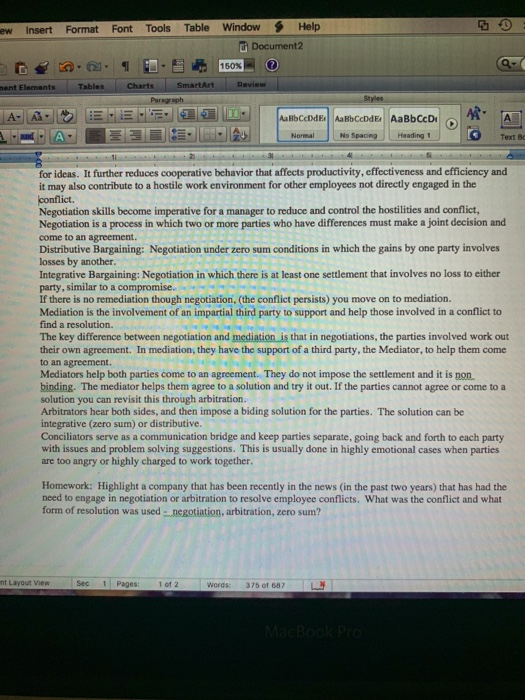
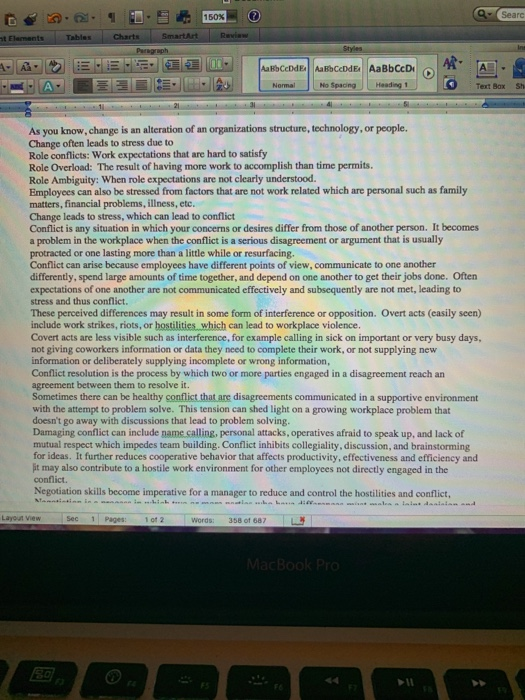
- Searc Elements Tables Charts SmartArt Review ELE D : 1 000 ENDA Aabende Normal arbede AaBb CDI No Spacing Heading AL A E As you know, change is an alteration of an organizations structure, technology, or people. Change often leads to stress due to Role conflicts: Work expectations that are hard to satisfy Role Overload: The result of having more work to accomplish than time permits. Role Ambiguity: When role expectations are not clearly understood. Employees can also be stressed from factors that are not work related which are personal such as family matters, financial problems, illness, etc. Change leads to stress, which can lead to conflict Conflict is any situation in which your concerns or desires differ from those of another person. It becomes a problem in the workplace when the conflict is a serious disagreement or argument that is usually protracted or one lasting more than a little while or resurfacing. Conflict can arise because employees have different points of view, communicate to one another differently, spend large amounts of time together, and depend on one another to get their jobs done. Often expectations of one another are not communicated effectively and subsequently are not met, leading to stress and thus conflict. These perceived differences may result in some form of interference or opposition. Overt acts (easily seen) include work strikes, riots, or hostilities which can lead to workplace violence, Covert acts are less visible such as interference, for example calling in sick on important or very busy days, not giving coworkers information or data they need to complete their work, or not supplying new information or deliberately supplying incomplete or wrong information, Conflict resolution is the process by which two or more parties engaged in a disagreement reach an agreement between them to resolve it. Sometimes there can be healthy conflict that are disagreements communicated in a supportive environment with the attempt to problem solve. This tension can shed light on a growing workplace problem that doesn't go away with discussions that lead to problem solving. Damaging conflict can include name calling, personal attacks, operatives afraid to speak up, and lack of mutual respect which impedes team building. Conflict inhibits collegiality, discussion, and brainstorming for ideas. It further reduces cooperative behavior that affects productivity, effectiveness and efficiency and fit may also contribute to a hostile work environment for other employees not directly engaged in the conflict. Negotiation skills become imperative for a manager to reduce and control the hostilities and conflict, Layout View Sec 1 Page 1 of 2 Words: 358 of 687 MacBook Pro e insert Format Font Tools Table Window Help Document2 D . 4 D. 160% ment Elements Tables Charts SmartArt Review Paragraph A ASEET AalbCabd A BEBAS Normal Aalb CcDdEt AaBbCDO No Spacing Heading 1 for ideas. It further reduces cooperative behavior that affects productivity, effectiveness and efficiency and it may also contribute to a hostile work environment for other employees not directly engaged in the conflict. Negotiation skills become imperative for a manager to reduce and control the hostilities and conflict, Negotiation is a process in which two or more parties who have differences must make a joint decision and come to an agreement. Distributive Bargaining: Negotiation under zero sum conditions in which the gains by one party involves losses by another. Integrative Bargaining: Negotiation in which there is at least one settlement that involves no loss to either party, similar to a compromise. If there is no remediation though negotiation, the conflict persists) you move on to mediation Mediation is the involvement of an impartial third party to support and help those involved in a conflict to find a resolution. The key difference between negotiation and mediation is that in negotiations, the parties involved work out their own agreement. In mediation, they have the support of a third party, the Mediator, to help them come to an agreement. Mediators help both parties come to an agreement. They do not impose the settlement and it is non binding. The mediator helps them agree to a solution and try it out. If the parties cannot agree or come to a solution you can revisit this through arbitration. Arbitrators hear both sides, and then impose a biding solution for the parties. The solution can be integrative (zero sum) or distributive. Conciliators serve as a communication bridge and keep parties separate, going back and forth to each party with issues and problem solving suggestions. This is usually done in highly emotional cases when parties are too angry or highly charged to work together. Homework: Highlight a company that has been recently in the news (in the past two years) that has had the need to engage in negotiation or arbitration to resolve employee conflicts. What was the conflict and what form of resolution was used negotiation, arbitration, zero sum? int Layout v 1 Pages: 1 of 2 Words: 375 of 687 #









 Study Help