



Question: Section A: Perfect Competition: Short-Run Profit Maximization or Loss Minimization A.1: The left panel of the diagram depicts the market supply and demand curves as
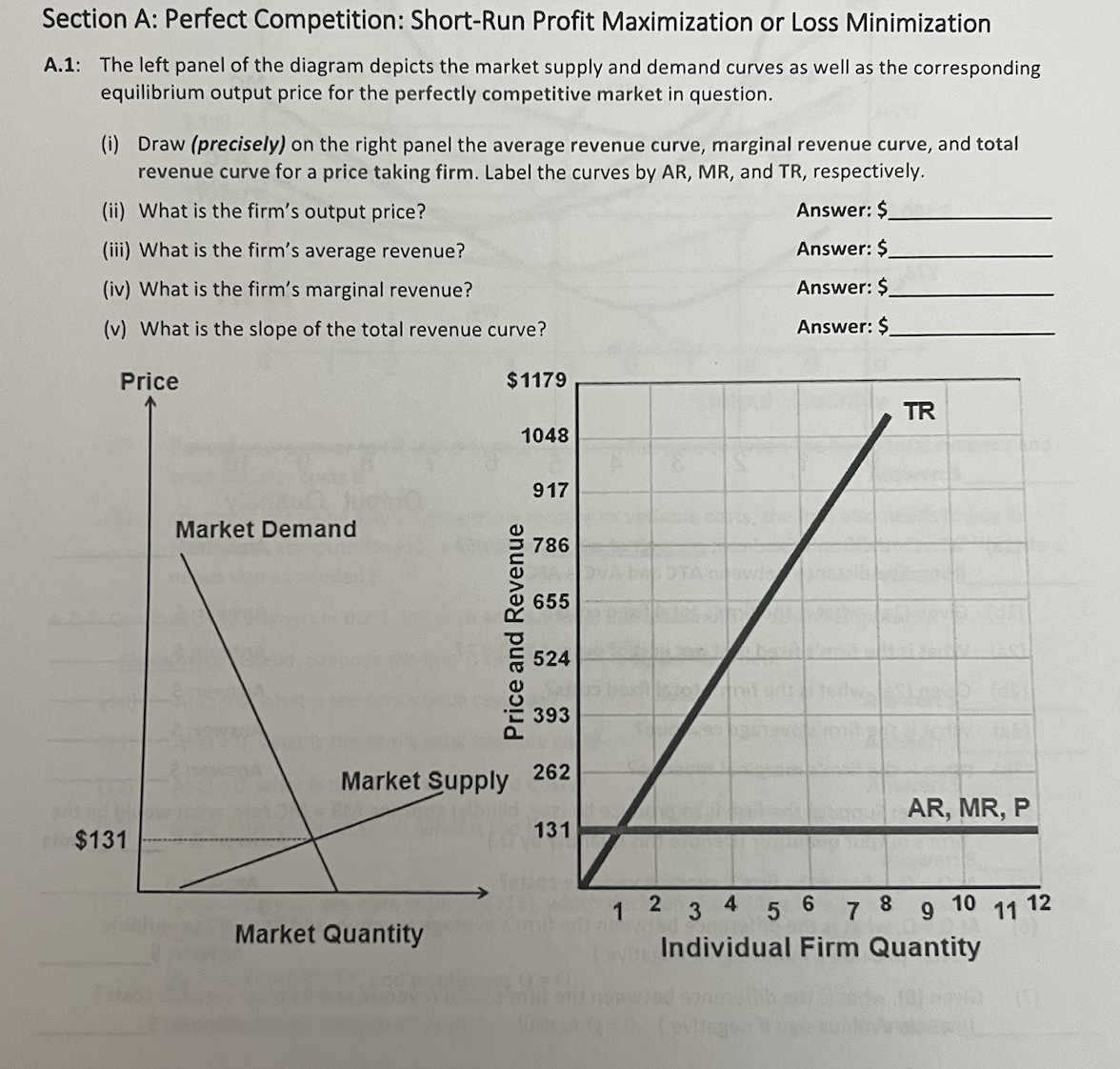
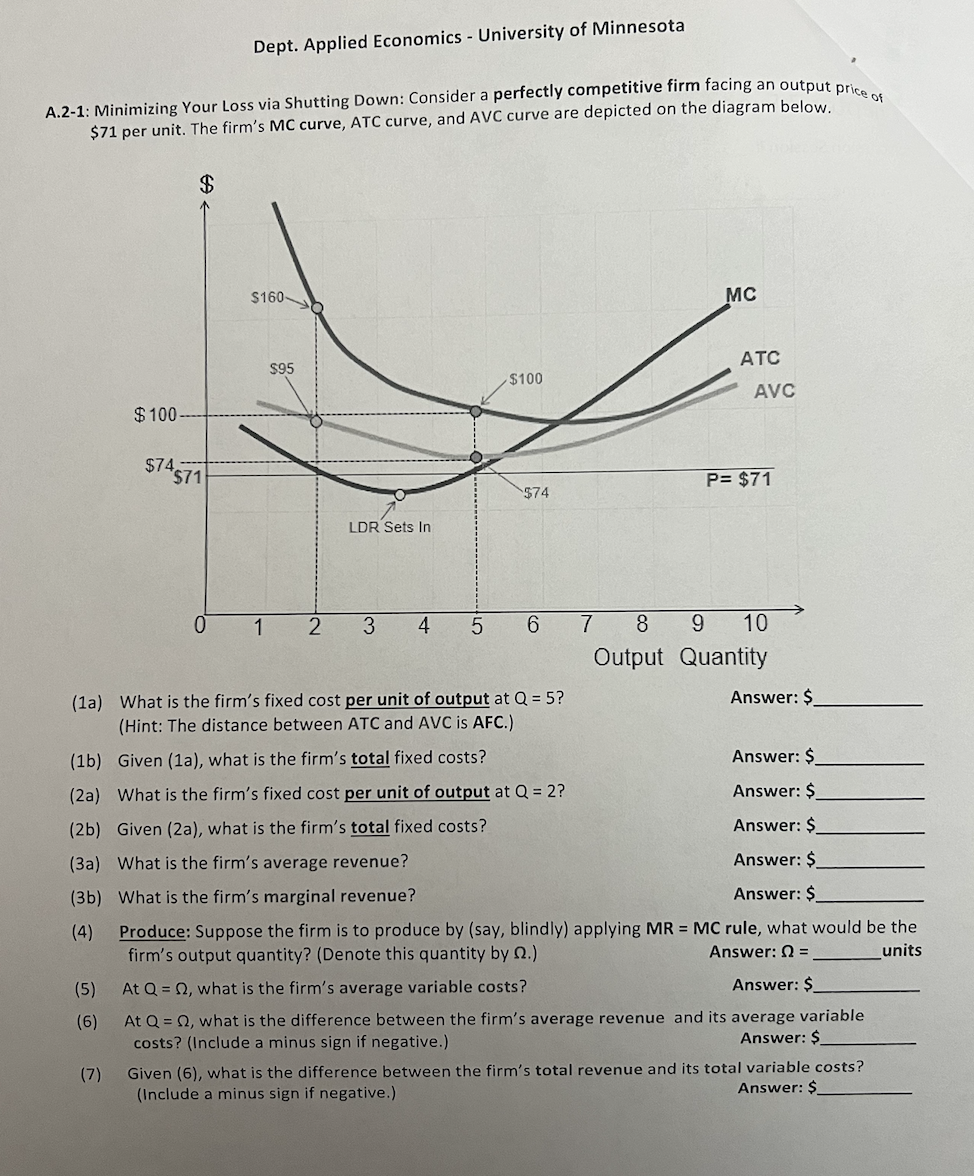
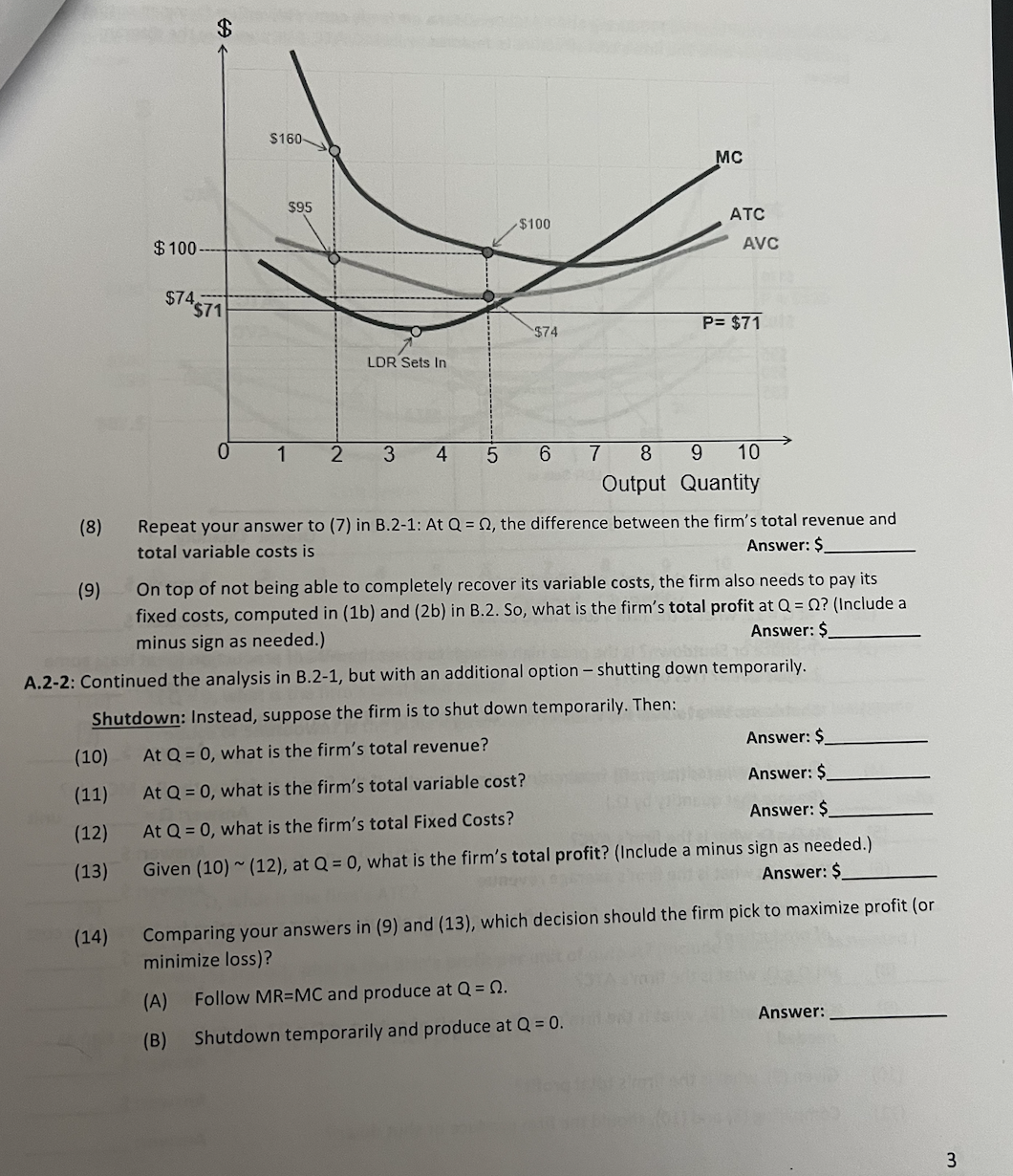
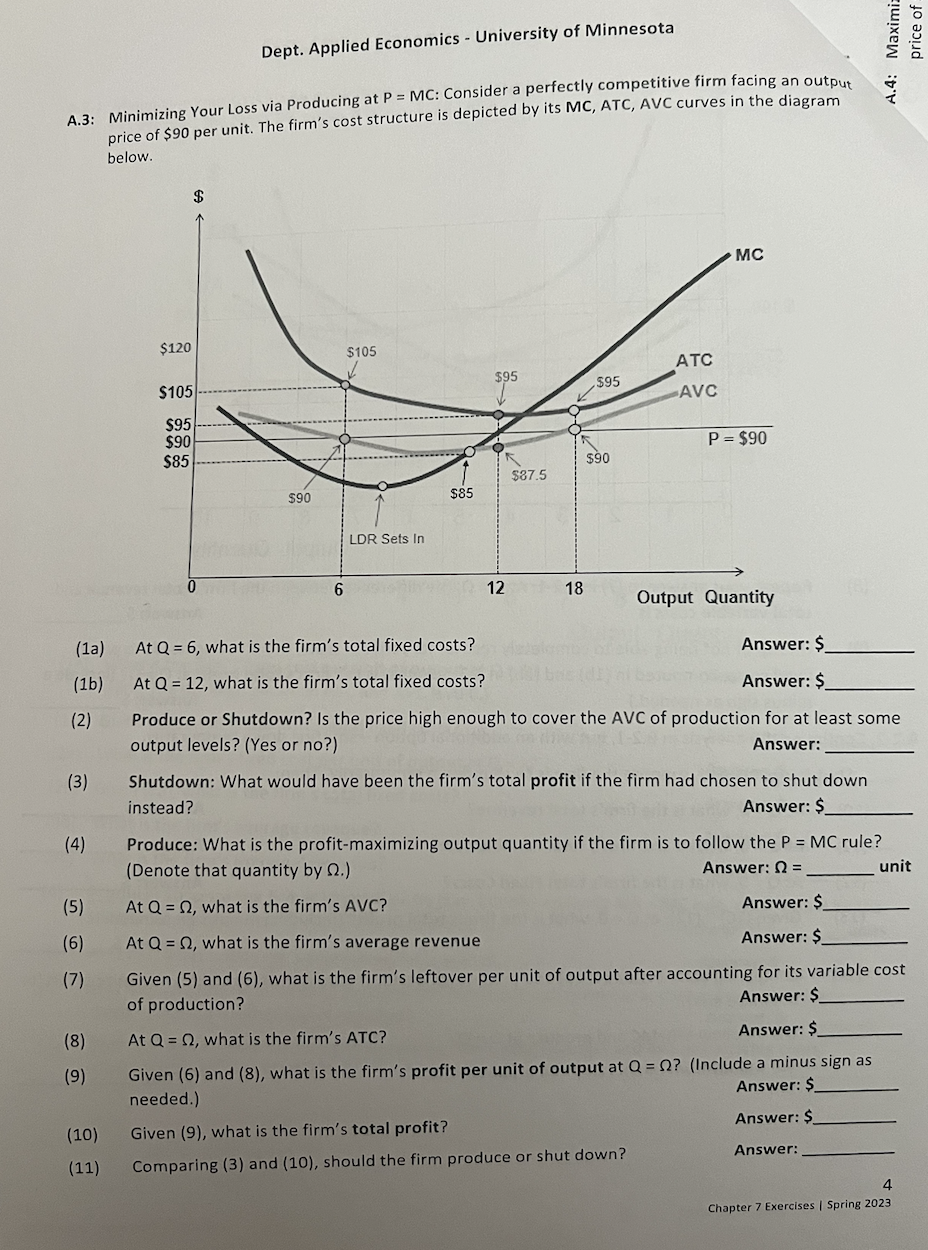
Section A: Perfect Competition: Short-Run Profit Maximization or Loss Minimization A.1: The left panel of the diagram depicts the market supply and demand curves as well as the corresponding equilibrium output price for the perfectly competitive market in question. (i) Draw (precisely) on the right panel the average revenue curve, marginal revenue curve, and total revenue curve for a price taking firm. Label the curves by AR, MR, and TR, respectively. (ii) What is the firm's output price? Answer: $_ (iii) What is the firm's average revenue? Answer: $ (iv) What is the firm's marginal revenue? Answer: $_ (v) What is the slope of the total revenue curve? Answer: $ Price $ 1179 TR 1048 917 Market Demand 786 655 Price and Revenue 524 393 Market Supply 262 AR, MR, P $131 131 1 2 3 4 5 6 7 8 9 10 11 12 Market Quantity Individual Firm QuantityDept. Applied Economics - University of Minnesota A.2-1: Minimizing Your Loss via Shutting Down: Consider a perfectly competitive firm facing an output price of $71 per unit. The firm's MC curve, ATC curve, and AVC curve are depicted on the diagram below. $160- MC $95 ATC $100 AVC $ 100- $74571 P= $71 $74 LDR Sets In 3 4 5 6 7 8 9 Output Quantity (1a) What is the firm's fixed cost per unit of output at Q = 5? Answer: $ (Hint: The distance between ATC and AVC is AFC.) (1b) Given (1a), what is the firm's total fixed costs? Answer: $ (2a) What is the firm's fixed cost per unit of output at Q = 2? Answer: $ (2b) Given (2a), what is the firm's total fixed costs? Answer: $ (3a) What is the firm's average revenue? Answer: $ (3b) What is the firm's marginal revenue? Answer: $_ (4) Produce: Suppose the firm is to produce by (say, blindly) applying MR = MC rule, what would be the firm's output quantity? (Denote this quantity by 2.) Answer: Q = units (5) At Q = 0, what is the firm's average variable costs? Answer: $_ (6) At Q = 0, what is the difference between the firm's average revenue and its average variable costs? (Include a minus sign if negative.) Answer: $_ (7) Given (6), what is the difference between the firm's total revenue and its total variable costs? (Include a minus sign if negative.) Answer: $$160- MC 595 $100 ATC $ 100- AVC $745 $74 P= $71 LDR Sets In 4 5 6 7 8 9 10 Output Quantity (8) Repeat your answer to (7) in B.2-1: At Q = Q, the difference between the firm's total revenue and total variable costs is Answer: $ (9) On top of not being able to completely recover its variable costs, the firm also needs to pay its fixed costs, computed in (1b) and (2b) in B.2. So, what is the firm's total profit at Q = 0? (Include a minus sign as needed.) Answer: $ A.2-2: Continued the analysis in B.2-1, but with an additional option - shutting down temporarily. Shutdown: Instead, suppose the firm is to shut down temporarily. Then: (10) At Q = 0, what is the firm's total revenue? Answer: $_ (11) At Q = 0, what is the firm's total variable cost? Answer: $ (12) At Q = 0, what is the firm's total Fixed Costs? Answer: $. (13) Given (10) ~ (12), at Q = 0, what is the firm's total profit? (Include a minus sign as needed.) Answer: $. (14) Comparing your answers in (9) and (13), which decision should the firm pick to maximize profit (or minimize loss)? Follow MR=MC and produce at Q = 0. (B) Shutdown temporarily and produce at Q = 0. Answer:Dept. Applied Economics - University of Minnesota price of A.4: Maximi A.3: Minimizing Your Loss via Producing at P = MC: Consider a perfectly competitive firm facing an output price of $90 per unit. The firm's cost structure is depicted by its MC, ATC, AVC curves in the diagram below. MC $120 $105 ATC $95 $105 -$95 AVC $95 $90 P = $90 $85 $90 $87.5 $90 $85 LDR Sets In 12 18 Output Quantity (1a) At Q = 6, what is the firm's total fixed costs? Answer: $ (1b) At Q = 12, what is the firm's total fixed costs? Answer: $_ (2) Produce or Shutdown? Is the price high enough to cover the AVC of production for at least some output levels? (Yes or no?) Answer: (3) Shutdown: What would have been the firm's total profit if the firm had chosen to shut down instead? Answer: $_ (4) Produce: What is the profit-maximizing output quantity if the firm is to follow the P = MC rule? (Denote that quantity by Q.) Answer: Q = unit (5) At Q = 0, what is the firm's AVC? Answer: $ (6) At Q = 0, what is the firm's average revenue Answer: $_ (7) Given (5) and (6), what is the firm's leftover per unit of output after accounting for its variable cost of production? Answer: $ (8) At Q = 0, what is the firm's ATC? Answer: $. (9) Given (6) and (8), what is the firm's profit per unit of output at Q = 0? (Include a minus sign as needed.) Answer: $_ (10) Given (9), what is the firm's total profit? Answer: $ (11) Comparing (3) and (10), should the firm produce or shut down? Answer: Chapter 7 Exercises | Spring 2023
Step by Step Solution
There are 3 Steps involved in it

Get step-by-step solutions from verified subject matter experts