



Question: Select a Big Idea INSTRUCTIONS Complete the following steps for evaluating the provided big ideas and selecting one of them for the Soft-Ts marketing campaign.
Select a Big Idea
INSTRUCTIONS
Complete the following steps for evaluating the provided big ideas and selecting one of them for the Soft-Ts marketing campaign.
1
Review Resources
Review the communication brief and the ABLE Framework available in your inbox, and use them to guide your big-idea evaluations and selection.
2
Evaluate the Big Ideas
Use the ABLE Framework to evaluate the provided big ideas. Indicate how well each big idea meets each requirement of the ABLE framework on the provided 1-5 scales, with one being a poor score and five being an excellent score.
3
Select a Big Idea
Select one of the big ideas to recommend to your supervisor as the basis for future creative assets.
Note: In selecting a big idea, be sure it is in line with the communication brief and meets the demands of the ABLE Framework.
Big Idea Evaluation and Selection
Thread Lightly is a play on tread lightly, suggesting viewers can minimize their environmental impacts by purchasing Soft-Ts shirts. Assets will highlight that Soft-Ts are made from a 50/50 blend of recycled and organic cotton and are 100% recyclable. Assets will also highlight that Soft-Ts helps plant trees. Each asset will display an image of a man wearing a shirt outdoors.
Big Idea 1
A - Attention
How attention grabbing is the asset?
low score is 0 high score is 5
B - Benefit
How well is the benefit communicated?
low score is 0 high score is 5
L - Linkage
How strong is the linkage to the brand?
low score is 0 high score is 5
E - Equity
How well will the asset hold up over time and across multiple platforms?
low score is 0 high score is 5
Total Score:
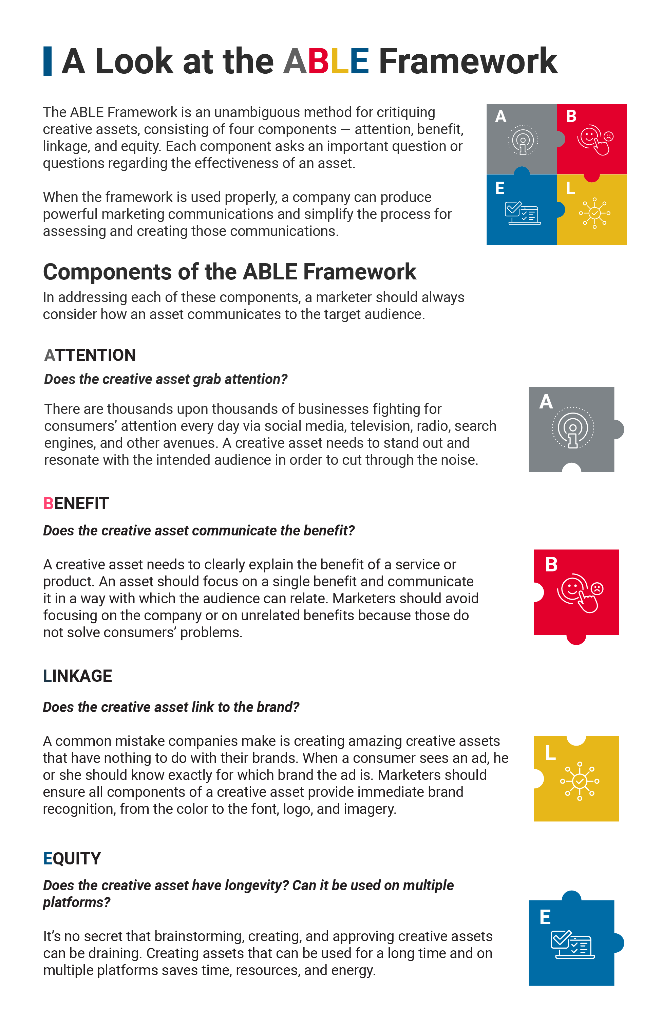
A Look at the ABLE Framework The ABLE Framework is an unambiguous method for critiquing creative assets, consisting of four components - attention, benefit, linkage, and equity. Each component asks an important question or questions regarding the effectiveness of an asset. When the framework is used properly, a company can produce powerful marketing communications and simplify the process for assessing and creating those communications. Components of the ABLE Framework In addressing each of these components, a marketer should always consider how an asset communicates to the target audience. ATTENTION Does the creative asset grab attention? There are thousands upon thousands of businesses fighting for consumers' attention every day via social media, television, radio, search engines, and other avenues. A creative asset needs to stand out and resonate with the intended audience in order to cut through the noise. BENEFIT Does the creative asset communicate the benefit? A creative asset needs to clearly explain the benefit of a service or product. An asset should focus on a single benefit and communicate it in a way with which the audience can relate. Marketers should avoid focusing on the company or on unrelated benefits because those do not solve consumers' problems. LINKAGE Does the creative asset link to the brand? A common mistake companies make is creating amazing creative assets that have nothing to do with their brands. When a consumer sees an ad, he or she should know exactly for which brand the ad is. Marketers should ensure all components of a creative asset provide immediate brand recognition, from the color to the font, logo, and imagery. EQUITY Does the creative asset have longevity? Can it be used on multiple platforms? It's no secret that brainstorming, creating, and approving creative assets can be draining. Creating assets that can be used for a long time and on multiple platforms saves time, resources, and energy
Step by Step Solution
There are 3 Steps involved in it

Get step-by-step solutions from verified subject matter experts