







Question: Q2. For simplicity assume only two states of the world S = {81,82). Suppose a consumer evaluates the AA acts as an average of
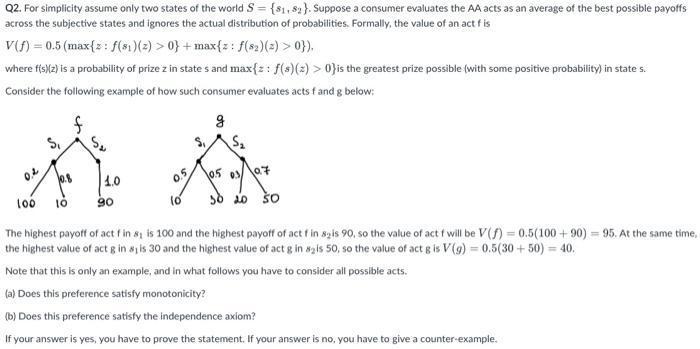
Q2. For simplicity assume only two states of the world S = {81,82). Suppose a consumer evaluates the AA acts as an average of the best possible payoffs across the subjective states and ignores the actual distribution of probabilities. Formally, the value of an act fis V(f) = 0.5 (max{z: f(8)(2) >0} + max{z: f(82)(2) >0}). where f(s)(2) is a probability of prize z in states and max{z: f(s) (2) >0}is the greatest prize possible (with some positive probability) in states. Consider the following example of how such consumer evaluates acts f and g below: 0.2 0.8 100 10 S 1.0 90 g S 0.5 10.5 03/07 10 30 20 50 The highest payoff of act f in 81 is 100 and the highest payoff of act f in 8gis 90, so the value of act f will be V(f) = 0.5(100+90) = 95. At the same time, the highest value of act g in sy is 30 and the highest value of act g in sis 50, so the value of act g is V(g) = 0.5(30+50) = 40. Note that this is only an example, and in what follows you have to consider all possible acts. (a) Does this preference satisfy monotonicity? (b) Does this preference satisfy the independence axiom? If your answer is yes, you have to prove the statement. If your answer is no, you have to give a counter-example.
Step by Step Solution
3.49 Rating (166 Votes )
There are 3 Steps involved in it
I have analyzed the image you uploaded The question involves a consumers evaluation of two possible acts f and g in two states of the world with proba... View full answer

Get step-by-step solutions from verified subject matter experts
 Study Help