







Question: solve it using MATLAB I T Consider the problem of predicting the population of two species that compete for the same food supply. The size
solve it using MATLAB
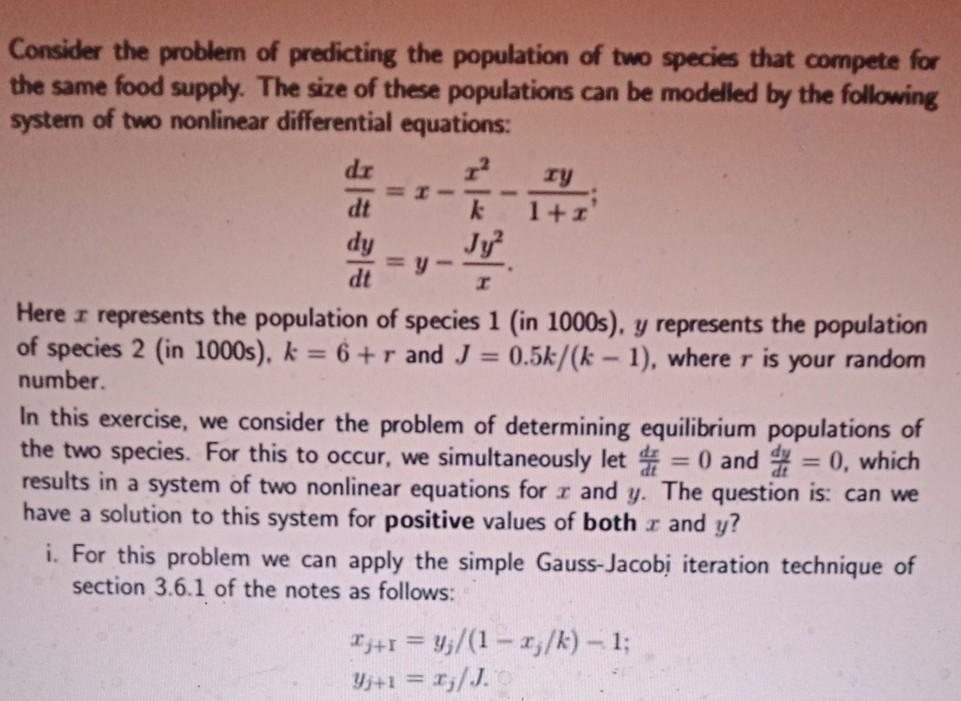
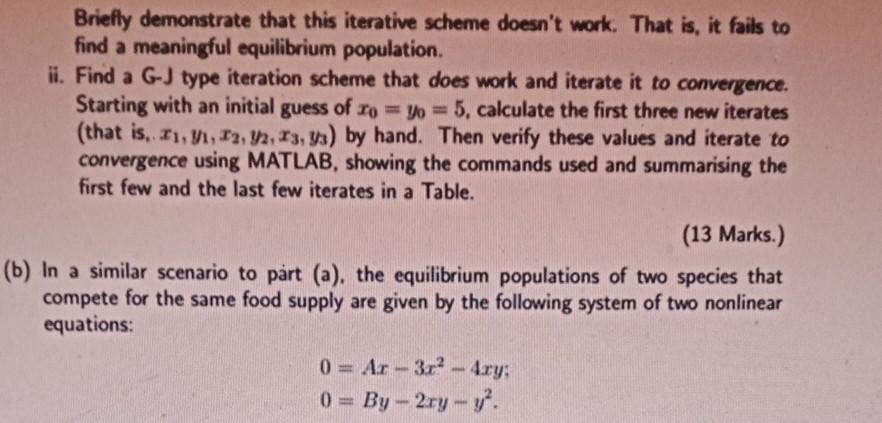
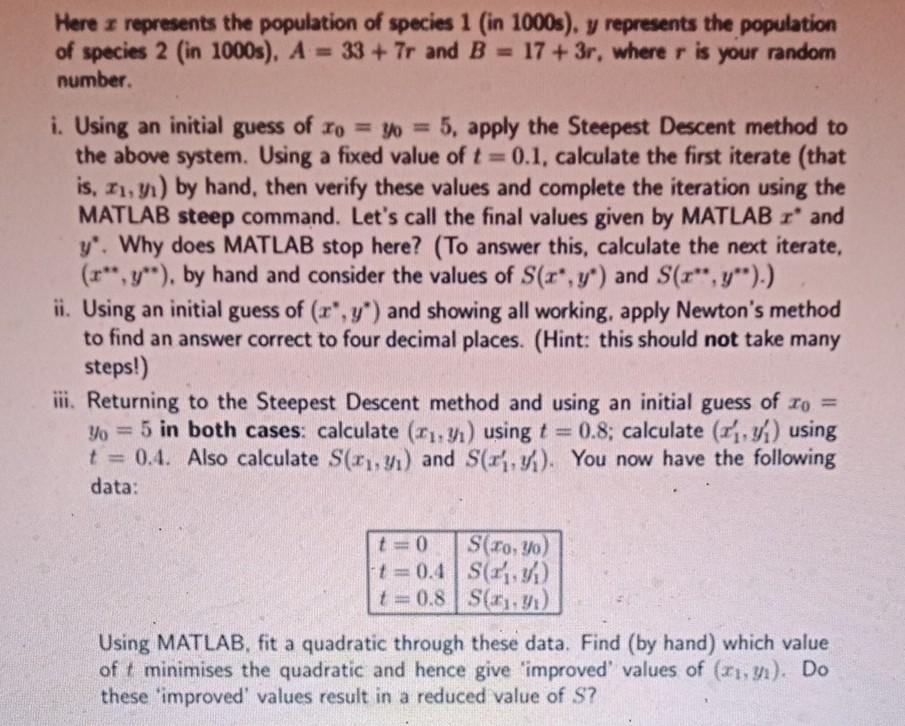
I T Consider the problem of predicting the population of two species that compete for the same food supply. The size of these populations can be modelled by the following system of two nonlinear differential equations: dt 1+1 dy = Y - dt Here I represents the population of species 1 in 1000s). y represents the population of species 2 (in 1000s), k = 6 + r and J 0.5k/(k - 1), where r is your random number. In this exercise, we consider the problem of determining equilibrium populations of the two species. For this to occur, we simultaneously let = 0 and = 0, which results in a system of two nonlinear equations for x and y. The question is: can we have a solution to this system for positive values of both r and y? i. For this problem we can apply the simple Gauss-Jacobi iteration technique of section 3.6.1 of the notes as follows: 33+1 = y/(1 - *;/k) - 1; 4;+1 = r;/J. Briefly demonstrate that this iterative scheme doesn't work. That is, it fails to find a meaningful equilibrium population. a ii. Find a G-J type iteration scheme that does work and iterate it to convergence. Starting with an initial guess of ro = yo = 5, calculate the first three new iterates 5 (that is, 11, 11, 13, 12, 13, ys) by hand. Then verify these values and iterate to convergence using MATLAB, showing the commands used and summarising the first few and the last few iterates in a Table. (13 Marks.) (b) In a similar scenario to prt (a). the equilibrium populations of two species that compete for the same food supply are given by the following system of two nonlinear equations: 0 = Ar - 3. - 4xy: 0 = By - 2ry - 12 Here I represents the population of species 1 (in 1000s), y represents the population of species 2 in 1000s). A = 33 + Tr and B = 17 + 3r, wherer is your random 2 number. i. Using an initial guess of Xo = yo = 5, apply the Steepest Descent method to the above system. Using a fixed value of t = 0.1, calculate the first iterate (that is, 11, yn) by hand, then verify these values and complete the iteration using the MATLAB steep command. Let's call the final values given by MATLAB r' and y'. Why does MATLAB stop here? (To answer this, calculate the next iterate, (r",Y**), by hand and consider the values of S(r*,y") and S(r", y").) ii. Using an initial guess of (r", y) and showing all working, apply Newton's method to find an answer correct to four decimal places. (Hint: this should not take many steps!) ii. Returning to the Steepest Descent method and using an initial guess of To = yo = 5 in both cases: calculate (11,91) using t = 0.8; calculate (114) using t = 0.4. Also calculate S(11:41) and S(r). You now have the following data: S(70,90) t=0 t = 0.4 S(1:4) t = 0.8 S(x,y) Using MATLAB, fit a quadratic through these data. Find (by hand) which value of t minimises the quadratic and hence give 'improved' values of (x1, y). Do these 'improved' values result in a reduced value of S
Step by Step Solution
There are 3 Steps involved in it

Get step-by-step solutions from verified subject matter experts
 Study Help