



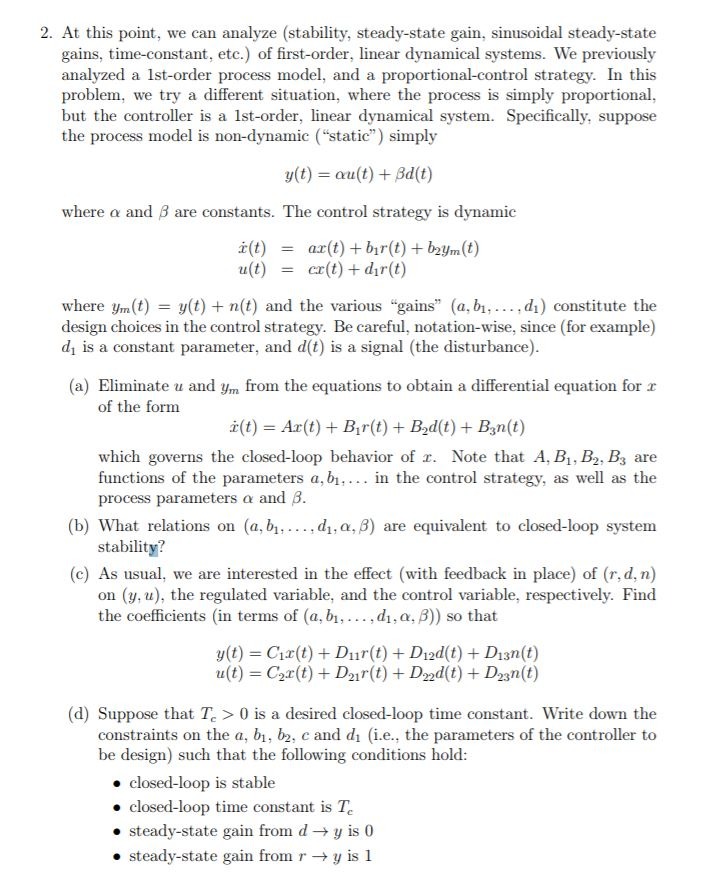
Question: solve the following 2. At this point, we can analyze (stability, steady-state gain, sinusoidal steady-state gains, time-constant, etc.) of first-order, linear dynamical systems. We previously
solve the following
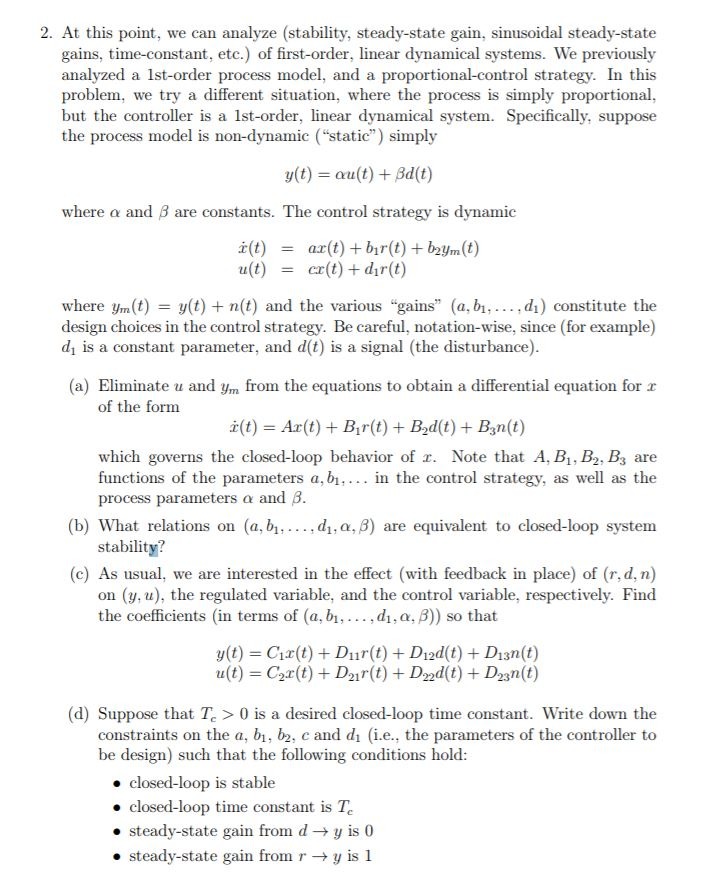
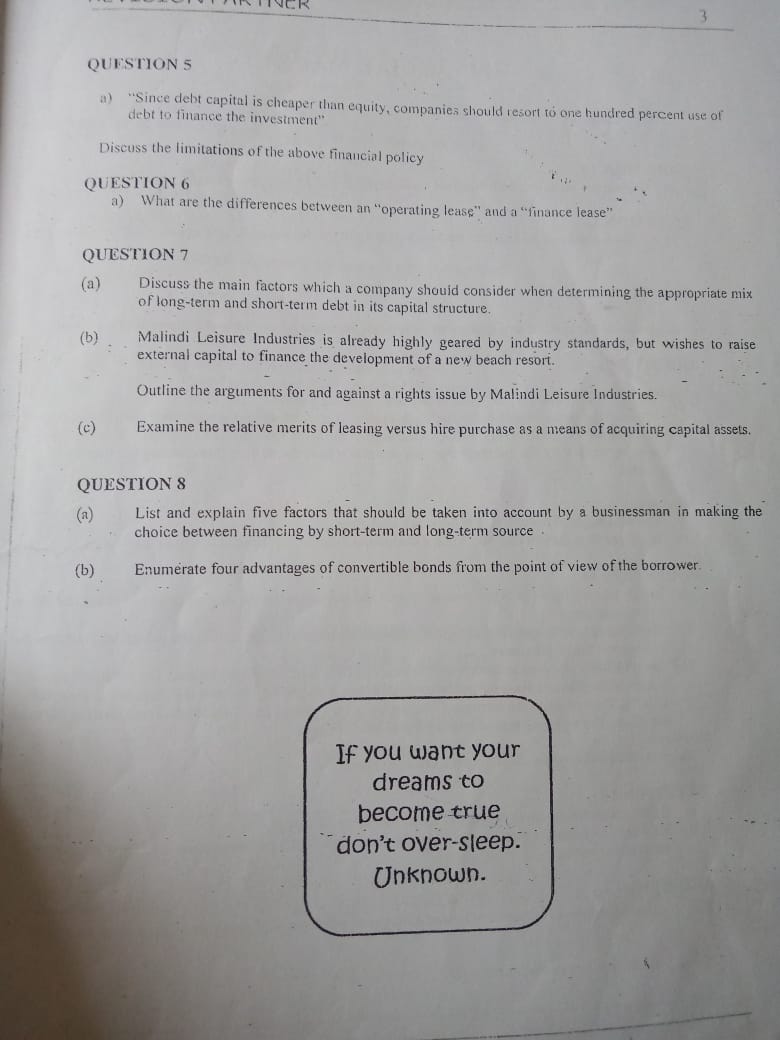
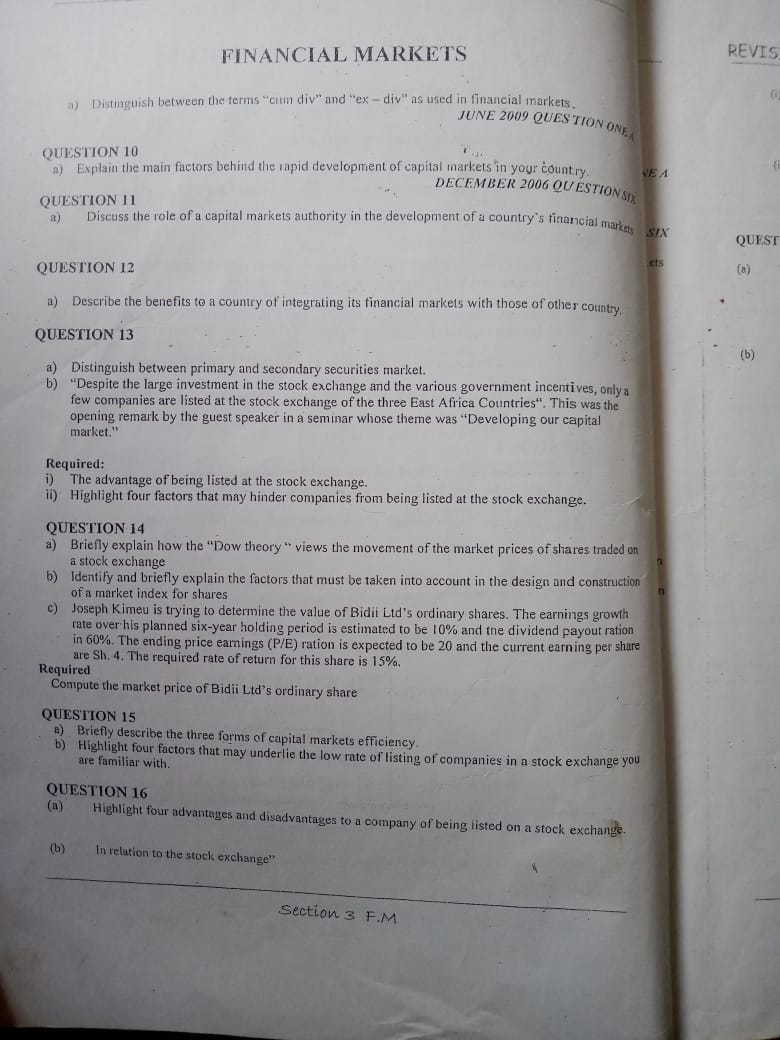
2. At this point, we can analyze (stability, steady-state gain, sinusoidal steady-state gains, time-constant, etc.) of first-order, linear dynamical systems. We previously analyzed a Ist-order process model, and a proportional-control strategy. In this problem, we try a different situation, where the process is simply proportional, but the controller is a Ist-order, linear dynamical system. Specifically, suppose the process model is non-dynamic ("static" ) simply y(t) = cu(t) + Bd(t) where o and B are constants. The control strategy is dynamic i (t) = ar(t) + bir(t) + bzym(t) u(t) = cr(t) + dir(t) where ym(t) = y(t) + n(t) and the various "gains" (a, bi, . .., di) constitute the design choices in the control strategy. Be careful, notation-wise, since (for example) d, is a constant parameter, and d(t) is a signal (the disturbance). (a) Eliminate u and ym from the equations to obtain a differential equation for r of the form r(t) = Ar(t) + Bir(t) + Bad(t) + Ban(t) which governs the closed-loop behavior of r. Note that A, B1, B2, By are functions of the parameters a, b1, ... in the control strategy, as well as the process parameters o and B. (b) What relations on (a, b1. .... dj, or, B) are equivalent to closed-loop system stability? (c) As usual, we are interested in the effect (with feedback in place) of (r, d, n) on (y, u), the regulated variable, and the control variable, respectively. Find the coefficients (in terms of (a, bi, . . ., d1, 0, B)) so that y(t) = Cix(t) + Dur(t) + Died(t) + Dian(t) u(t) = Car(t) + Dar(t) + Dad(t) + Dzan(t) (d) Suppose that T. > 0 is a desired closed-loop time constant. Write down the constraints on the a, b1, b2, c and di (i.e., the parameters of the controller to be design) such that the following conditions hold: . closed-loop is stable . closed-loop time constant is To . steady-state gain from d -> y is 0 . steady-state gain from r - y is 12. At this point, we can analyze (stability, steady-state gain, sinusoidal steady-state gains, time-constant, etc.) of first-order, linear dynamical systems. We previously analyzed a Ist-order process model, and a proportional-control strategy. In this problem, we try a different situation, where the process is simply proportional, but the controller is a Ist-order, linear dynamical system. Specifically, suppose the process model is non-dynamic ("static" ) simply y(t) = cu(t) + Bd(t) where o and B are constants. The control strategy is dynamic i (t) = ar(t) + bir(t) + bzym(t) u(t) = cr(t) + dir(t) where ym(t) = y(t) + n(t) and the various "gains" (a, bi, . .., di) constitute the design choices in the control strategy. Be careful, notation-wise, since (for example) d, is a constant parameter, and d(t) is a signal (the disturbance). (a) Eliminate u and ym from the equations to obtain a differential equation for r of the form r(t) = Ar(t) + Bir(t) + Bad(t) + Ban(t) which governs the closed-loop behavior of r. Note that A, B1, B2, By are functions of the parameters a, b1, ... in the control strategy, as well as the process parameters o and B. (b) What relations on (a, b1. .... dj, or, B) are equivalent to closed-loop system stability? (c) As usual, we are interested in the effect (with feedback in place) of (r, d, n) on (y, u), the regulated variable, and the control variable, respectively. Find the coefficients (in terms of (a, bi, . . ., d1, 0, B)) so that y(t) = Cix(t) + Dur(t) + Died(t) + Dian(t) u(t) = Car(t) + Dar(t) + Dad(t) + Dzan(t) (d) Suppose that T. > 0 is a desired closed-loop time constant. Write down the constraints on the a, b1, b2, c and di (i.e., the parameters of the controller to be design) such that the following conditions hold: . closed-loop is stable . closed-loop time constant is To . steady-state gain from d -> y is 0 . steady-state gain from r - y is 1QUESTION S ") "Since debt capital is cheaper than equity, companies should resort to one hundred percent use of debt to finance the investment" Discuss the limitations of the above financial policy QUESTION 6 a) What are the differences between an "operating lease" and a "finance lease" QUESTION 7 (a) Discuss the main factors which a company should consider when determining the appropriate mix of long-term and short-term debt in its capital structure. (b ). Malindi Leisure Industries is already highly geared by industry standards, but wishes to raise external capital to finance the development of a new beach resort. Outline the arguments for and against a rights issue by Malindi Leisure Industries. (c) Examine the relative merits of leasing versus hire purchase as a means of acquiring capital assets. QUESTION 8 (a) List and explain five factors that should be taken into account by a businessman in making the choice between financing by short-term and long-term source (b) Enumerate four advantages of convertible bonds from the point of view of the borrower. If you want your dreams to become true don't over-sleep. Unknown.FINANCIAL MARKETS REVIS 7) Distinguish between the terms "coin div" and "ex - div" as used in financial markets. JUNE 2009 QUESTION ONE, QUESTION 10 a) Explain the main factors behind the rapid development of capital markets in your country. VE A DECEMBER 2006 QUESTION SIX QUESTION 11 a ) Discuss the role of a capital markets authority in the development of a country's financial markets six QUEST ets QUESTION 12 a) Describe the benefits to a country of integrating its financial markets with those of other country. QUESTION 13 (b) a) Distinguish between primary and secondary securities market. b) "Despite the large investment in the stock exchange and the various government incentives, only a few companies are listed at the stock exchange of the three East Africa Countries", This was the opening remark by the guest speaker in a seminar whose theme was "Developing our capital market." Required: i) The advantage of being listed at the stock exchange. ii) Highlight four factors that may hinder companies from being listed at the stock exchange. QUESTION 14 a) Briefly explain how the "Dow theory " views the movement of the market prices of shares traded on a stock exchange b) Identify and briefly explain the factors that must be taken into account in the design and construction of a market index for shares c) Joseph Kimeu is trying to determine the value of Bidii Ltd's ordinary shares. The earnings growth rate over his planned six-year holding period is estimated to be 10% and the dividend payout ration in 60%. The ending price earnings (P/E) ration is expected to be 20 and the current earning per share are Sh. 4. The required rate of return for this share is 15%. Required Compute the market price of Bidii Lid's ordinary share QUESTION 15 b) Briefly describe the three forms of capital markets efficiency. are familiar with. Highlight four factors that may underlie the low rate of listing of companies in a stock exchange you QUESTION 16 (a) Highlight four advantages and disadvantages to a company of being listed on a stock exchange. (b) In relation to the stock exchange" Section 3 F.M
Step by Step Solution
There are 3 Steps involved in it

Get step-by-step solutions from verified subject matter experts