



Question: Solve the whole question with details and using MATLAB (must be matlab ) plz 3B The production of ethylene glycol from ethylene chlorohydrin and sodium
Solve the whole question with details and using MATLAB (must be matlab ) plz
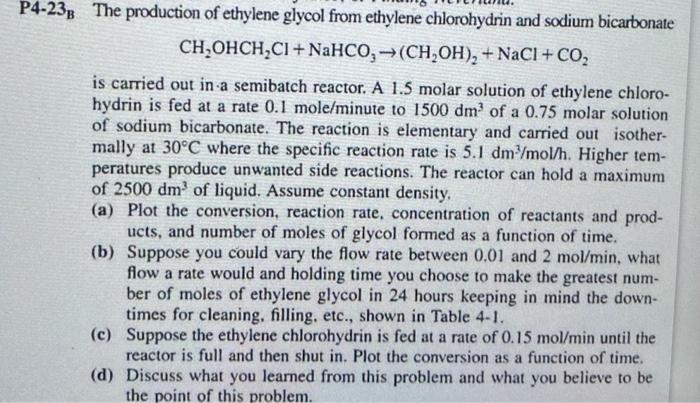
3B The production of ethylene glycol from ethylene chlorohydrin and sodium bicarbonate CH2OHCH2Cl+NaHCO3(CH2OH)2+NaCl+CO2 is carried out in a semibatch reactor. A 1.5 molar solution of ethylene chlorohydrin is fed at a rate 0.1mole/minute to 1500dm3 of a 0.75 molar solution of sodium bicarbonate. The reaction is elementary and carried out isothermally at 30C where the specific reaction rate is 5.1dm3/mol/h. Higher temperatures produce unwanted side reactions. The reactor can hold a maximum of 2500dm3 of liquid. Assume constant density. (a) Plot the conversion, reaction rate, concentration of reactants and products, and number of moles of glycol formed as a function of time. (b) Suppose you could vary the flow rate between 0.01 and 2mol/min, what flow a rate would and holding time you choose to make the greatest number of moles of ethylene glycol in 24 hours keeping in mind the downtimes for cleaning, filling, etc., shown in Table 4-1. (c) Suppose the ethylene chlorohydrin is fed at a rate of 0.15mol/min until the reactor is full and then shut in. Plot the conversion as a function of time. (d) Discuss what you learned from this problem and what you believe to be 3B The production of ethylene glycol from ethylene chlorohydrin and sodium bicarbonate CH2OHCH2Cl+NaHCO3(CH2OH)2+NaCl+CO2 is carried out in a semibatch reactor. A 1.5 molar solution of ethylene chlorohydrin is fed at a rate 0.1mole/minute to 1500dm3 of a 0.75 molar solution of sodium bicarbonate. The reaction is elementary and carried out isothermally at 30C where the specific reaction rate is 5.1dm3/mol/h. Higher temperatures produce unwanted side reactions. The reactor can hold a maximum of 2500dm3 of liquid. Assume constant density. (a) Plot the conversion, reaction rate, concentration of reactants and products, and number of moles of glycol formed as a function of time. (b) Suppose you could vary the flow rate between 0.01 and 2mol/min, what flow a rate would and holding time you choose to make the greatest number of moles of ethylene glycol in 24 hours keeping in mind the downtimes for cleaning, filling, etc., shown in Table 4-1. (c) Suppose the ethylene chlorohydrin is fed at a rate of 0.15mol/min until the reactor is full and then shut in. Plot the conversion as a function of time. (d) Discuss what you learned from this problem and what you believe to be
Step by Step Solution
There are 3 Steps involved in it

Get step-by-step solutions from verified subject matter experts