







Question: some are valid and some are invalid (1) Forall xP(x) Forallx[P(x)->Q(x)] :.ForallxQ(x) (2) AAxP(x) :.AAx[P(x)->Q(x)] :.EExQ(x) (4) AAxP(x) :.EE[P(x)->Q(x)] :.EE(x) (6)
some are valid and some are invalid \ (1) Forall
xP(x)\ Forallx[P(x)->Q(x)]\ :.ForallxQ(x)\ (2)
AAxP(x)\ :.AAx[P(x)->Q(x)]\ :.EExQ(x)\ (4)
AAxP(x)\ :.EE[P(x)->Q(x)]\ :.EE(x)\ (6)
EExP(x)\ :.AAx[P(x)->Q(x)]\ :.xQ(x)\ (7)
EExP(x)\ EEx[P(x)->Q(x)]\ :.AAxQ(x)\ (8)
EExP(x)\ EEx[P(x)->Q(x)]\ :.EE(x)\ (9)
AAxnotQ(x)\ AAx[P(x)->Q(x)]\ :.AAxnotP(x)\ (10)
AAxnotQ(x)\ :.AAx[P(x)->Q(x)]\ :.EExnotP(x)\ (12)
(EEx[P(x)->Q(x)])/(:.xnotP(x))\ (13)
EExnotQ(x)\ :.AAx[P(x)->Q(x)]\ :.xP(x)\ (14)
EExnotQ(x)\ AAx[P(x)->Q(x)]\ :.EExnotP(x)\
EExnotQ(x)\ EE{[
P(x)->Q(x)]}
\ :.AAxnotP(x)\ (16)
EExQ(x)\ {[
:EE(EEx)/(EEx)PP(x)->Q(x)]}\ pick some valid syllogism(s) above, and prove their validity. Recall that for a syllogism with two premises
P_(1)and
P_(2)and one conclusion
C, its validity is shown by proving
(P_(1)^P_(2))=>C. Use the four inference rules introdued and mind the restrictions. specify the number of each valid syllogism.\ Valid syllogism 1 (Number: )\ Valid syllogism 2 (Number: )
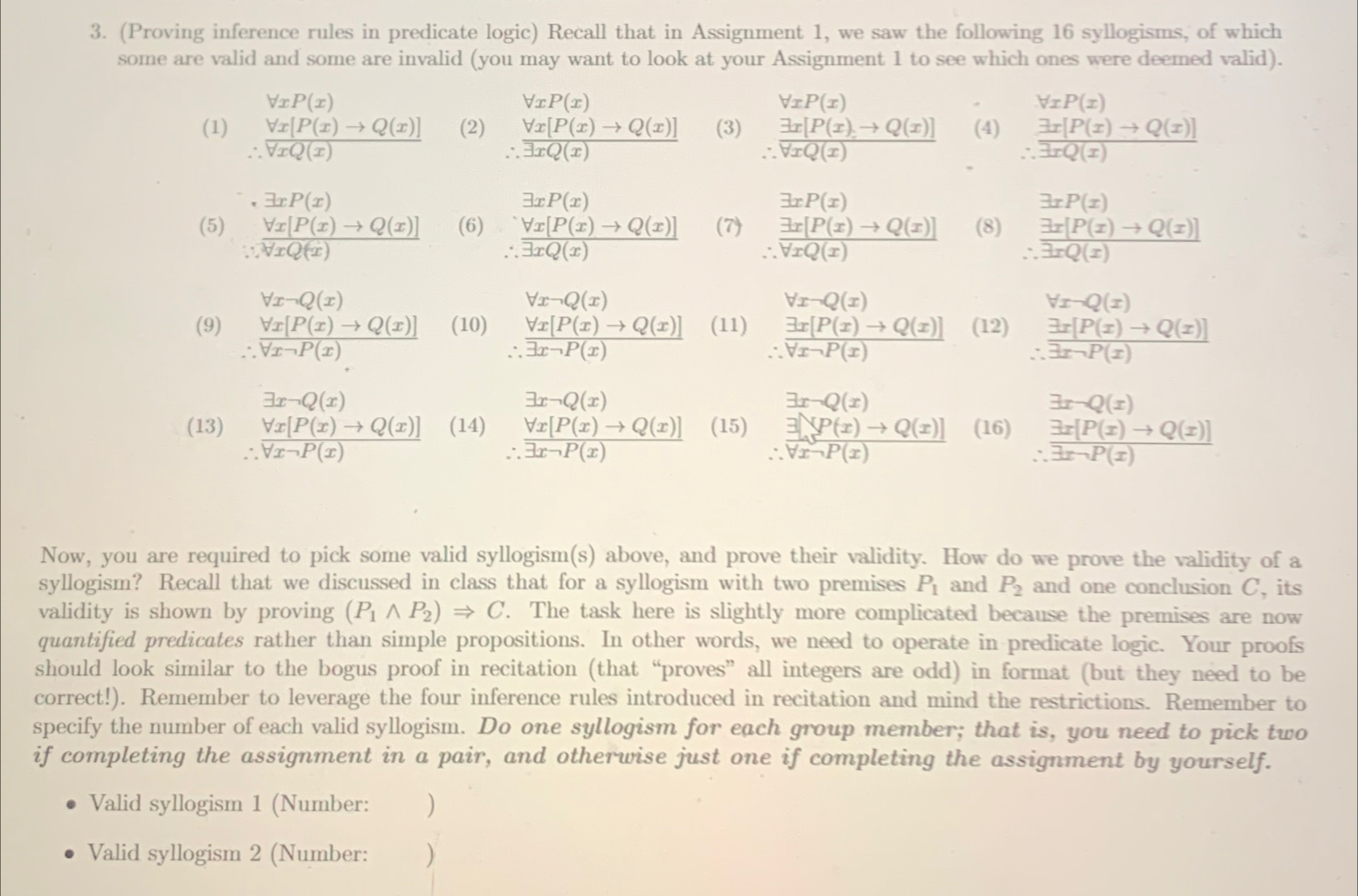
3. (Proving inference rules in predicate logic) Recall that in Assignment 1, we saw the following 16 syllogisms, of which some are valid and some are invalid (you may want to look at your Assignment 1 to see which ones were deemed valid). (1) xP(x)x[P(x)Q(x)]x(x) (2) xP(x)x[P(x)Q(x)]xQ(x) xP(x)x[P(x)Q(x)]xQ(x) xP(x)x[P(x)Q(x)]Q(x) (5) xP(x)x[P(x)Q(x)] xP(x) (6) x[P(x)Q(x)]Q(x) (7) xP(x)[P(x)Q(x)]xQ(x) (8) xP(x)x[P(x)Q(x)] (9) x[P(x)Q(x)]xP(x) (10) xQ(x) xQ(x) xP(x)x[P(x)Q(x)] xQ(x)x[P(x)Q(x)]xP(x) xQ(x)[P(x)Q(x)]P(x) Now, you are required to pick some valid syllogism(s) above, and prove their validity. How do we prove the validity of a syllogism? Recall that we discussed in class that for a syllogism with two premises P1 and P2 and one conclusion C, its validity is shown by proving (P1P2)C. The task here is slightly more complicated because the premises are now quantified predicates rather than simple propositions. In other words, we need to operate in predicate logic. Your proofs should look similar to the bogus proof in recitation (that "proves" all integers are odd) in format (but they need to be correct!). Remember to leverage the four inference rules introduced in recitation and mind the restrictions. Remember to specify the number of each valid syllogism. Do one syllogism for each group member; that is, you need to pick two if completing the assignment in a pair, and otherwise just one if completing the assignment by yourself. - Valid syllogism 1 (Number: ) - Valid syllogism 2 (Number: )
Step by Step Solution
There are 3 Steps involved in it

Get step-by-step solutions from verified subject matter experts
 Study Help