Question: The Interface case study is located on page 361 in your textbook (or find the Interface case study if your version of the text has
The Interface case study is located on page 361 in your textbook (or find the Interface case study if your version of the text has it on a different page). MEET the PAGE COUNT of 2 PAGES and ANSWER the 4 QUESTION FOR THOUGHT.
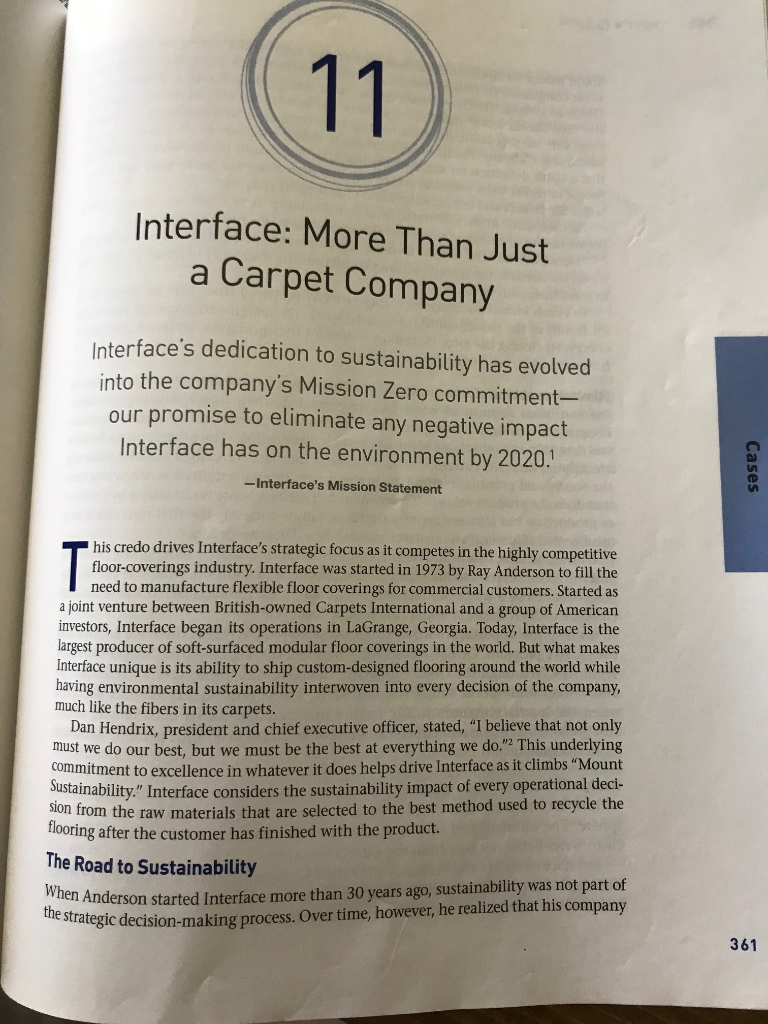
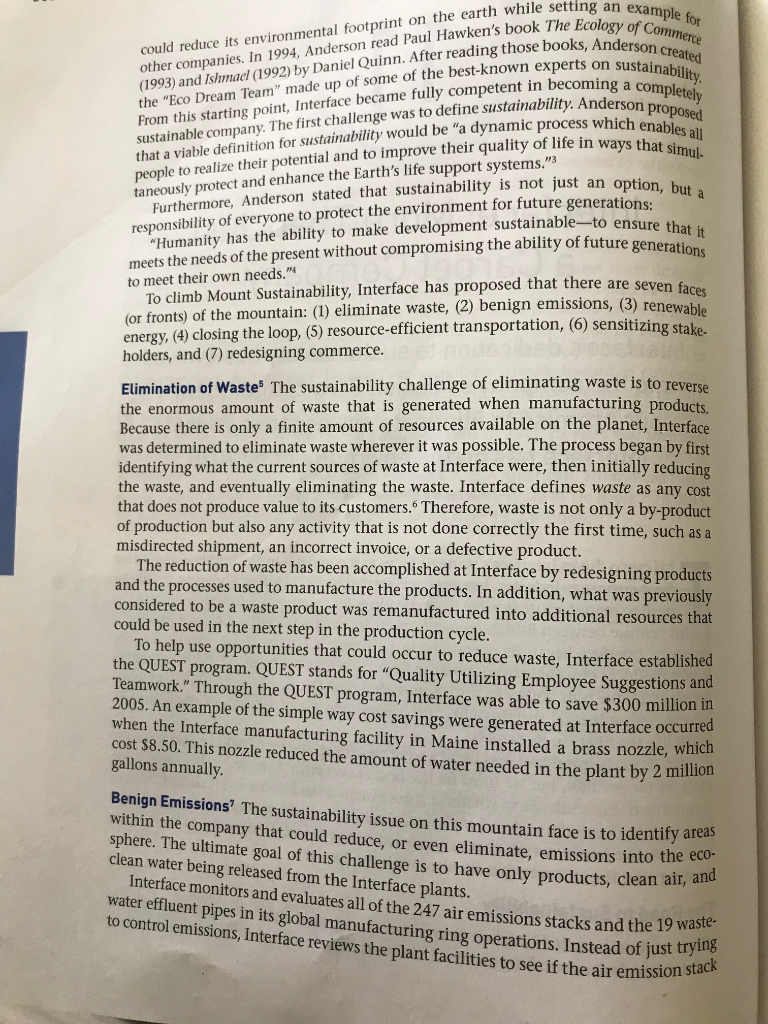
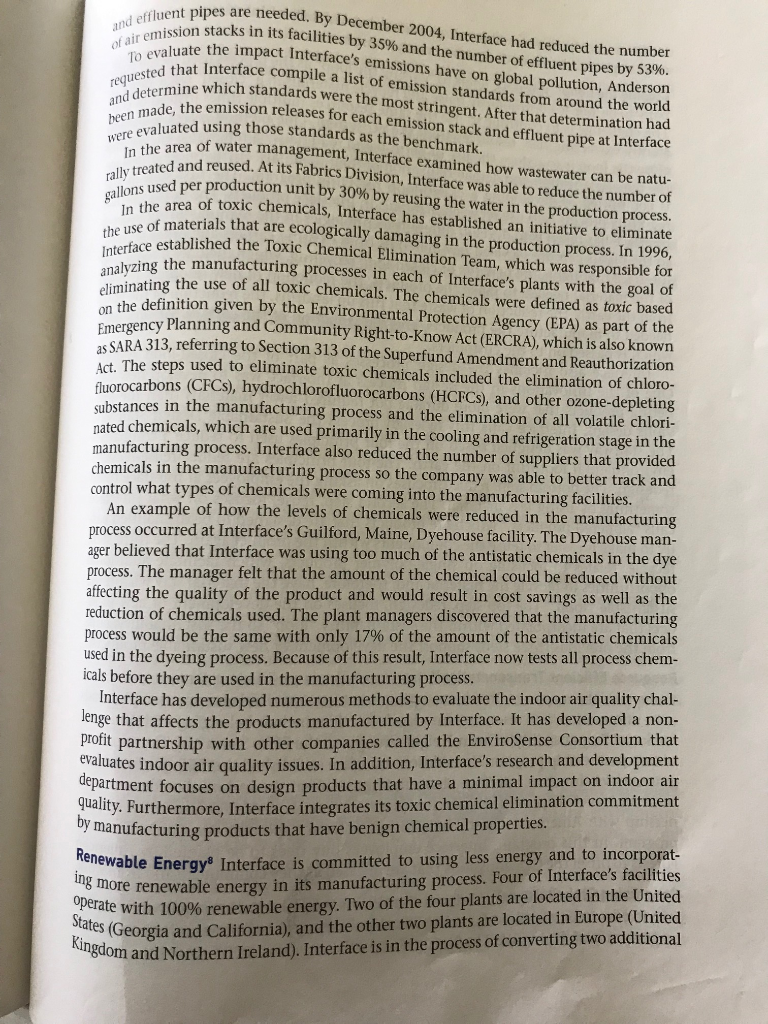
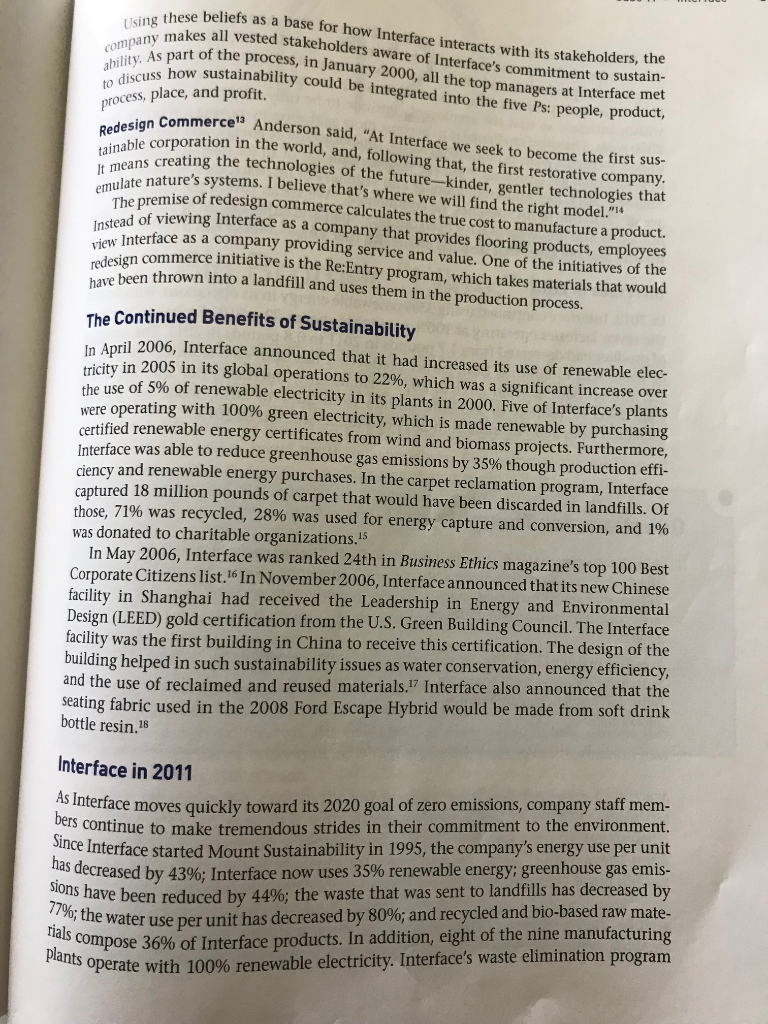
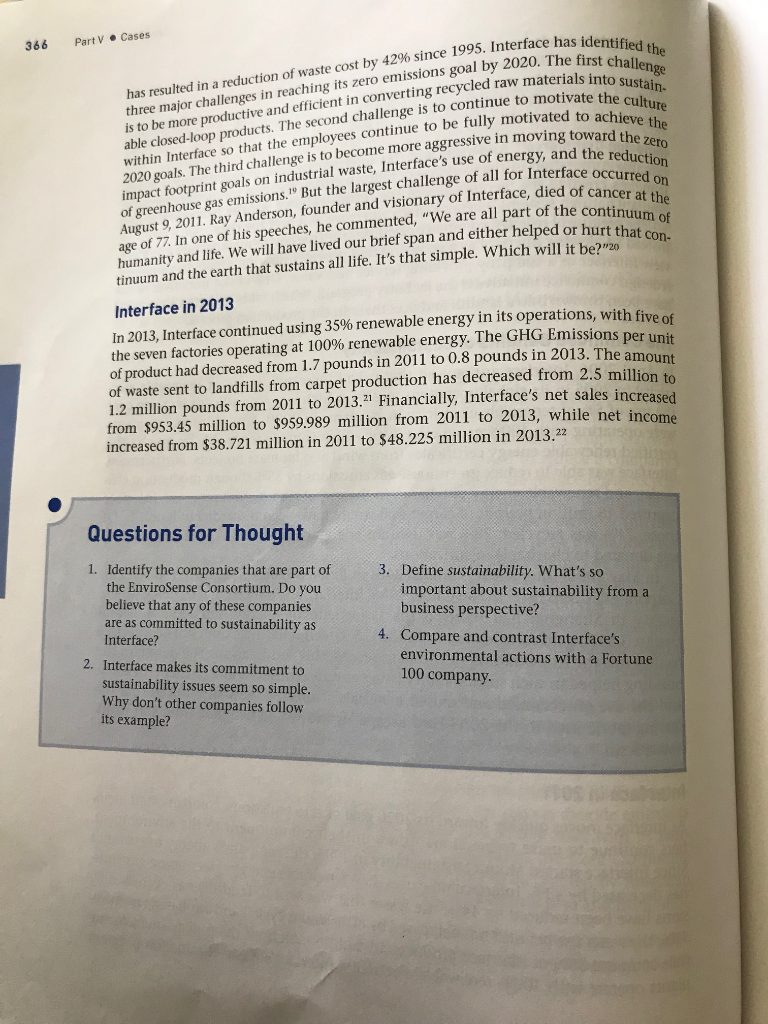
11 Interface: More Than Just a Carpet Company Interface's dedication to sustainability has evolved into the company's Mission Zero commitment- our promise to eliminate any negative impact Interface has on the environment by 2020. Cases -Interface's Mission Statement his credo drives Interface's strategic focus as it competes in the highly competitive floor-coverings industry. Interface was started in 1973 by Ray Anderson to fill the need to manufacture flexible floor coverings for commercial customers. Started as a joint venture between British-owned Carpets International and a group of American investors, Interface began its operations in LaGrange, Georgia. Today, Interface is the largest producer of soft-surfaced modular floor coverings in the world. But what makes Interface unique is its ability to ship custom-designed flooring around the world while having environmental sustainability interwoven into every decision of the company, much like the fibers in its carpets. Dan Hendrix, president and chief executive officer, stated, "I believe that not only must we do our best, but we must be the best at everything we do." This underlying commitment to excellence in whatever it does helps drive Interface as it climbs "Mount Sustainability." Interface considers the sustainability impact of every operational deci- Sion from the raw materials that are selected to the best method used to recycle the flooring after the customer has finished with the product. The Road to Sustainability When Anderson started Interface more than 30 years ago, sustainability was not part of the strategic decision-making process. Over time, however, he realized that his company 361 could reduce its environmental footprint on the earth while setting an example for other companies. In 1994, Anderson read Paul Hawken's book The Ecology of Commerce (1993) and Ishmael (1992) by Daniel Quinn. After reading those books, Anderson created From this starting point, Interface became fully competent in becoming a completely sustainable company. The first challenge was to define sustainability. Anderson proposed that a viable definition for sustainability would be "a dynamic process which enables all Furthermore, Anderson stated that sustainability is not just an option, but a "Humanity has the ability to make development sustainable to ensure that it people to realize their potential and to improve their quality of life in ways that simul- sustainability "Eco Dream Team" up of some of the best-known taneously protect and enhance the Earth's life support systems,"3 responsibility of everyone to protect the environment for future generations: meets the needs of the present without compromising the ability of future generations to meet their own needs." To climb Mount Sustainability, Interface has proposed that there are seven faces (or fronts) of the mountain: (1) eliminate waste, (2) benign emissions, (3) renewable energy, (4) closing the loop, (5) resource-efficient transportation, (6) sensitizing stake holders, and (7) redesigning commerce. Elimination of Waste The sustainability challenge of eliminating waste is to reverse the enormous amount of waste that is generated when manufacturing products, Because there is only a finite amount of resources available on the planet, Interface was determined to eliminate waste wherever it was possible. The process began by first identifying what the current sources of waste at Interface were, then initially reducing the waste, and eventually eliminating the waste. Interface defines waste as any cost that does not produce value to its customers. Therefore, waste is not only a by-product of production but also any activity that is not done correctly the first time, such as a misdirected shipment, an incorrect invoice, or a defective product. The reduction of waste has been accomplished at Interface by redesigning products and the processes used to manufacture the products. In addition, what was previously considered to be a waste product was remanufactured into additional resources that could be used in the next step in the production cycle. To help use opportunities that could occur to reduce waste, Interface established the QUEST program. QUEST stands for "Quality Utilizing Employee Suggestions and Teamwork." Through the QUEST program, Interface was able to save $300 million in 2005. An example of the simple way cost savings were generated at Interface occurred when the Interface manufacturing facility in Maine installed a brass nozzle, which cost $8.50. This nozzle reduced the amount of water needed in the plant by 2 million gallons annually. Benign Emissions? The sustainability issue on this mountain face is to identify areas within the company that could reduce, or even eliminate, emissions into the eco sphere . The ultimate goal of this challenge is to have only products, clean air, and clean water being released from the Interface plants. Interface monitors and evaluates all of the 247 air emissions stacks and the 19 waste water effluent pipes in its global manufacturing ring operations. Instead of just trying to control emissions, Interface reviews the plant facilities to see if the air emission stack In the area of toxic chemicals, Interface has established an initiative to eliminate and effluent pipes are needed. By December 2004, Interface had reduced the number of air emission stacks in its facilities by 35% and the number of effluent pipes by 53%. To evaluate the impact Interface's emissions have on global pollution, Anderson requested that Interface compile a list of emission standards from around the world and determine which standards were the most stringent. After that determination had been made, the emission releases for each emission stack and effluent pipe at Interface were evaluated using those standards as the benchmark. rally treated and reused. At its Fabrics Division, Interface was able to reduce the number of gallons used per production unit by 30% by reusing the water in the production process. Interface established the Toxic Chemical Elimination Team, which was responsible for the use of materials that are ecologically damaging in the production process. In 1996, eliminating the use of all toxic chemicals. The chemicals were defined as toxic based operate with 100% renewable energy. Two of the four plants are located in the United States (Georgia and California), and the other two plants are located in Europe (United on the definition given by the Environmental Protection Agency (EPA) as part of the Emergency Planning and Community Right-to-Know Act (ERCRA), which is also known as SARA 313, referring to Section 313 of the Superfund Amendment and Reauthorization Act. The steps used to eliminate toxic chemicals included the elimination of chloro- fluorocarbons (CFCs), hydrochlorofluorocarbons (HCFCs), and other ozone-depleting substances in the manufacturing process and the elimination of all volatile chlori- nated chemicals, which are used primarily in the cooling and refrigeration stage in the manufacturing process. Interface also reduced the number of suppliers that provided chemicals in the manufacturing process so the company was able to better track and control what types of chemicals were coming into the manufacturing facilities. An example of how the levels of chemicals were reduced in the manufacturing process occurred at Interface's Guilford, Maine, Dyehouse facility. The Dyehouse man- ager believed that Interface was using too much of the antistatic chemicals in the dye process. The manager felt that the amount of the chemical could be reduced without affecting the quality of the product and would result in cost savings as well as the reduction of chemicals used. The plant managers discovered that the manufacturing process would be the same with only 17% of the amount of the antistatic chemicals used in the dyeing process. Because of this result, Interface now tests all process chem- icals before they are used in the manufacturing process. Interface has developed numerous methods to evaluate the indoor air quality chal- lenge that affects the products manufactured by Interface. It has developed a non- profit partnership with other companies called the EnviroSense Consortium that evaluates indoor air quality issues. In addition, Interface's research and development department focuses on design products that have a minimal impact on indoor air quality. Furthermore, Interface integrates its toxic chemical elimination commitment by manufacturing products that have benign chemical properties. Renewable Energy Interface is committed to using less energy and to incorporat- ing more renewable energy in its manufacturing process. Four of Interface's facilities Kingdom and Northern Ireland). Interface is in the process of converting two additional Using these beliefs as a base for how Interface interacts with its stakeholders, the company makes all vested stakeholders aware of Interface's commitment to sustain- ability. As part of the process, in January 2000, all the top managers at Interface met to discuss how sustainability could be integrated into the five Ps: people, product, Redesign Commerces Anderson said, "At Interface we seek to become the first sus- tainable corporation in the world, and, following that, the first restorative company. emulate nature's systems. I believe that's where we will find the right model."14 It means creating the technologies of the future-kinder, gentler technologies that Instead of viewing Interface as a company that provides flooring products, employees have been thrown into a landfill and uses them in the production process. , place, and The premise of redesign commerce calculates the true cost to manufacture a product. view Interface as a company providing service and value. One of the initiatives of the redesign commerce initiative is the Re:Entry program, which takes materials that would The Continued Benefits of Sustainability In April 2006, Interface announced that it had increased its use of renewable elec- tricity in 2005 in its global operations to 22%, which was a significant increase over the use of 5% of renewable electricity in its plants in 2000. Five of Interface's plants were operating with 100% green electricity, which is made renewable by purchasing certified renewable energy certificates from wind and biomass projects. Furthermore, Interface was able to reduce greenhouse gas emissions by 35% though production effi- ciency and renewable energy purchases. In the carpet reclamation program, Interface captured 18 million pounds of carpet that would have been discarded in landfills. Of those, 71% was recycled, 28% was used for energy capture and conversion, and 1% was donated to charitable organizations.15 In May 2006, Interface was ranked 24th in Business Ethics magazine's top 100 Best Corporate Citizens list.16 In November 2006, Interface announced that its new Chinese facility in Shanghai had received the Leadership in Energy and Environmental Design (LEED) gold certification from the U.S. Green Building Council. The Interface facility was the first building in China to receive this certification. The design of the building helped in such sustainability issues as water conservation, energy efficiency, and the use of reclaimed and reused materials.17 Interface also announced that the seating fabric used in the 2008 Ford Escape Hybrid would be made from soft drink bottle resin.18 Interface in 2011 has decreased As Interface moves quickly toward its 2020 goal of zero emissions, company staff mem- bers continue to make tremendous strides in their commitment to the environment. Since Interface started Mount Sustainability in 1995, the company's energy use per unit 43%; Interface ow uses 35% renewable energy; greenhouse gas emis- sions have been reduced by 44%; the waste that was sent to landfills has decreased by 77%; the water use per unit has decreased by 80%; and recycled and bio-based raw mate? mals compose 36% of Interface products. In addition, eight of the nine manufacturing operate with 100% renewable electricity. Interface's waste elimination program plants has resulted in a reduction of waste cost by 42% since 1995. Interface has identified the is to be more productive and efficient in converting recycled raw materials into sustain- three major challenges in reaching its zero emissions goal by 2020. The first challenge within Interface so that the employees continue to be fully motivated to achieve the able closed-loop products. The second challenge is to continue to motivate the culture 2020 goals. The third challenge is to become more aggressive in moving toward the zero impact footprint goals on industrial waste, Interface's use of energy, and the reduction of greenhouse gas emissions. But the largest challenge of all for Interface occurred on August 9, 2011. Ray Anderson, founder and visionary of Interface, died of cancer at the humanity and life. We will have lived our brief span and either helped or hurt that con- age of 77. In one of his speeches, he commented, "We are all part of the continuum of 366 Part V Cases tinuum and the earth that sustains all life. It's that simple. Which will it be?"20 Interface in 2013 In 2013, Interface continued using 35% renewable energy in its operations, with five of the seven factories operating at 100% renewable energy. The GHG Emissions per unit of product had decreased from 1.7 pounds in 2011 to 0.8 pounds in 2013. The amount of waste sent to landfills from carpet production has decreased from 2.5 million to 1.2 million pounds from 2011 to 2013.41 Financially, Interface's net sales increased from $953.45 million to $959.989 million from 2011 to 2013, while net income increased from $38.721 million in 2011 to $48.225 million in 2013.22 Questions for Thought 1. Identify the companies that are part of the EnviroSense Consortium. Do you believe that any of these companies are as committed to sustainability as Interface? 3. Define sustainability. What's so important about sustainability from a business perspective? 4. Compare and contrast Interface's environmental actions with a Fortune 100 company. 2. Interface makes its commitment to sustainability issues seem so simple. Why don't other companies follow its example? 11 Interface: More Than Just a Carpet Company Interface's dedication to sustainability has evolved into the company's Mission Zero commitment- our promise to eliminate any negative impact Interface has on the environment by 2020. Cases -Interface's Mission Statement his credo drives Interface's strategic focus as it competes in the highly competitive floor-coverings industry. Interface was started in 1973 by Ray Anderson to fill the need to manufacture flexible floor coverings for commercial customers. Started as a joint venture between British-owned Carpets International and a group of American investors, Interface began its operations in LaGrange, Georgia. Today, Interface is the largest producer of soft-surfaced modular floor coverings in the world. But what makes Interface unique is its ability to ship custom-designed flooring around the world while having environmental sustainability interwoven into every decision of the company, much like the fibers in its carpets. Dan Hendrix, president and chief executive officer, stated, "I believe that not only must we do our best, but we must be the best at everything we do." This underlying commitment to excellence in whatever it does helps drive Interface as it climbs "Mount Sustainability." Interface considers the sustainability impact of every operational deci- Sion from the raw materials that are selected to the best method used to recycle the flooring after the customer has finished with the product. The Road to Sustainability When Anderson started Interface more than 30 years ago, sustainability was not part of the strategic decision-making process. Over time, however, he realized that his company 361 could reduce its environmental footprint on the earth while setting an example for other companies. In 1994, Anderson read Paul Hawken's book The Ecology of Commerce (1993) and Ishmael (1992) by Daniel Quinn. After reading those books, Anderson created From this starting point, Interface became fully competent in becoming a completely sustainable company. The first challenge was to define sustainability. Anderson proposed that a viable definition for sustainability would be "a dynamic process which enables all Furthermore, Anderson stated that sustainability is not just an option, but a "Humanity has the ability to make development sustainable to ensure that it people to realize their potential and to improve their quality of life in ways that simul- sustainability "Eco Dream Team" up of some of the best-known taneously protect and enhance the Earth's life support systems,"3 responsibility of everyone to protect the environment for future generations: meets the needs of the present without compromising the ability of future generations to meet their own needs." To climb Mount Sustainability, Interface has proposed that there are seven faces (or fronts) of the mountain: (1) eliminate waste, (2) benign emissions, (3) renewable energy, (4) closing the loop, (5) resource-efficient transportation, (6) sensitizing stake holders, and (7) redesigning commerce. Elimination of Waste The sustainability challenge of eliminating waste is to reverse the enormous amount of waste that is generated when manufacturing products, Because there is only a finite amount of resources available on the planet, Interface was determined to eliminate waste wherever it was possible. The process began by first identifying what the current sources of waste at Interface were, then initially reducing the waste, and eventually eliminating the waste. Interface defines waste as any cost that does not produce value to its customers. Therefore, waste is not only a by-product of production but also any activity that is not done correctly the first time, such as a misdirected shipment, an incorrect invoice, or a defective product. The reduction of waste has been accomplished at Interface by redesigning products and the processes used to manufacture the products. In addition, what was previously considered to be a waste product was remanufactured into additional resources that could be used in the next step in the production cycle. To help use opportunities that could occur to reduce waste, Interface established the QUEST program. QUEST stands for "Quality Utilizing Employee Suggestions and Teamwork." Through the QUEST program, Interface was able to save $300 million in 2005. An example of the simple way cost savings were generated at Interface occurred when the Interface manufacturing facility in Maine installed a brass nozzle, which cost $8.50. This nozzle reduced the amount of water needed in the plant by 2 million gallons annually. Benign Emissions? The sustainability issue on this mountain face is to identify areas within the company that could reduce, or even eliminate, emissions into the eco sphere . The ultimate goal of this challenge is to have only products, clean air, and clean water being released from the Interface plants. Interface monitors and evaluates all of the 247 air emissions stacks and the 19 waste water effluent pipes in its global manufacturing ring operations. Instead of just trying to control emissions, Interface reviews the plant facilities to see if the air emission stack In the area of toxic chemicals, Interface has established an initiative to eliminate and effluent pipes are needed. By December 2004, Interface had reduced the number of air emission stacks in its facilities by 35% and the number of effluent pipes by 53%. To evaluate the impact Interface's emissions have on global pollution, Anderson requested that Interface compile a list of emission standards from around the world and determine which standards were the most stringent. After that determination had been made, the emission releases for each emission stack and effluent pipe at Interface were evaluated using those standards as the benchmark. rally treated and reused. At its Fabrics Division, Interface was able to reduce the number of gallons used per production unit by 30% by reusing the water in the production process. Interface established the Toxic Chemical Elimination Team, which was responsible for the use of materials that are ecologically damaging in the production process. In 1996, eliminating the use of all toxic chemicals. The chemicals were defined as toxic based operate with 100% renewable energy. Two of the four plants are located in the United States (Georgia and California), and the other two plants are located in Europe (United on the definition given by the Environmental Protection Agency (EPA) as part of the Emergency Planning and Community Right-to-Know Act (ERCRA), which is also known as SARA 313, referring to Section 313 of the Superfund Amendment and Reauthorization Act. The steps used to eliminate toxic chemicals included the elimination of chloro- fluorocarbons (CFCs), hydrochlorofluorocarbons (HCFCs), and other ozone-depleting substances in the manufacturing process and the elimination of all volatile chlori- nated chemicals, which are used primarily in the cooling and refrigeration stage in the manufacturing process. Interface also reduced the number of suppliers that provided chemicals in the manufacturing process so the company was able to better track and control what types of chemicals were coming into the manufacturing facilities. An example of how the levels of chemicals were reduced in the manufacturing process occurred at Interface's Guilford, Maine, Dyehouse facility. The Dyehouse man- ager believed that Interface was using too much of the antistatic chemicals in the dye process. The manager felt that the amount of the chemical could be reduced without affecting the quality of the product and would result in cost savings as well as the reduction of chemicals used. The plant managers discovered that the manufacturing process would be the same with only 17% of the amount of the antistatic chemicals used in the dyeing process. Because of this result, Interface now tests all process chem- icals before they are used in the manufacturing process. Interface has developed numerous methods to evaluate the indoor air quality chal- lenge that affects the products manufactured by Interface. It has developed a non- profit partnership with other companies called the EnviroSense Consortium that evaluates indoor air quality issues. In addition, Interface's research and development department focuses on design products that have a minimal impact on indoor air quality. Furthermore, Interface integrates its toxic chemical elimination commitment by manufacturing products that have benign chemical properties. Renewable Energy Interface is committed to using less energy and to incorporat- ing more renewable energy in its manufacturing process. Four of Interface's facilities Kingdom and Northern Ireland). Interface is in the process of converting two additional Using these beliefs as a base for how Interface interacts with its stakeholders, the company makes all vested stakeholders aware of Interface's commitment to sustain- ability. As part of the process, in January 2000, all the top managers at Interface met to discuss how sustainability could be integrated into the five Ps: people, product, Redesign Commerces Anderson said, "At Interface we seek to become the first sus- tainable corporation in the world, and, following that, the first restorative company. emulate nature's systems. I believe that's where we will find the right model."14 It means creating the technologies of the future-kinder, gentler technologies that Instead of viewing Interface as a company that provides flooring products, employees have been thrown into a landfill and uses them in the production process. , place, and The premise of redesign commerce calculates the true cost to manufacture a product. view Interface as a company providing service and value. One of the initiatives of the redesign commerce initiative is the Re:Entry program, which takes materials that would The Continued Benefits of Sustainability In April 2006, Interface announced that it had increased its use of renewable elec- tricity in 2005 in its global operations to 22%, which was a significant increase over the use of 5% of renewable electricity in its plants in 2000. Five of Interface's plants were operating with 100% green electricity, which is made renewable by purchasing certified renewable energy certificates from wind and biomass projects. Furthermore, Interface was able to reduce greenhouse gas emissions by 35% though production effi- ciency and renewable energy purchases. In the carpet reclamation program, Interface captured 18 million pounds of carpet that would have been discarded in landfills. Of those, 71% was recycled, 28% was used for energy capture and conversion, and 1% was donated to charitable organizations.15 In May 2006, Interface was ranked 24th in Business Ethics magazine's top 100 Best Corporate Citizens list.16 In November 2006, Interface announced that its new Chinese facility in Shanghai had received the Leadership in Energy and Environmental Design (LEED) gold certification from the U.S. Green Building Council. The Interface facility was the first building in China to receive this certification. The design of the building helped in such sustainability issues as water conservation, energy efficiency, and the use of reclaimed and reused materials.17 Interface also announced that the seating fabric used in the 2008 Ford Escape Hybrid would be made from soft drink bottle resin.18 Interface in 2011 has decreased As Interface moves quickly toward its 2020 goal of zero emissions, company staff mem- bers continue to make tremendous strides in their commitment to the environment. Since Interface started Mount Sustainability in 1995, the company's energy use per unit 43%; Interface ow uses 35% renewable energy; greenhouse gas emis- sions have been reduced by 44%; the waste that was sent to landfills has decreased by 77%; the water use per unit has decreased by 80%; and recycled and bio-based raw mate? mals compose 36% of Interface products. In addition, eight of the nine manufacturing operate with 100% renewable electricity. Interface's waste elimination program plants has resulted in a reduction of waste cost by 42% since 1995. Interface has identified the is to be more productive and efficient in converting recycled raw materials into sustain- three major challenges in reaching its zero emissions goal by 2020. The first challenge within Interface so that the employees continue to be fully motivated to achieve the able closed-loop products. The second challenge is to continue to motivate the culture 2020 goals. The third challenge is to become more aggressive in moving toward the zero impact footprint goals on industrial waste, Interface's use of energy, and the reduction of greenhouse gas emissions. But the largest challenge of all for Interface occurred on August 9, 2011. Ray Anderson, founder and visionary of Interface, died of cancer at the humanity and life. We will have lived our brief span and either helped or hurt that con- age of 77. In one of his speeches, he commented, "We are all part of the continuum of 366 Part V Cases tinuum and the earth that sustains all life. It's that simple. Which will it be?"20 Interface in 2013 In 2013, Interface continued using 35% renewable energy in its operations, with five of the seven factories operating at 100% renewable energy. The GHG Emissions per unit of product had decreased from 1.7 pounds in 2011 to 0.8 pounds in 2013. The amount of waste sent to landfills from carpet production has decreased from 2.5 million to 1.2 million pounds from 2011 to 2013.41 Financially, Interface's net sales increased from $953.45 million to $959.989 million from 2011 to 2013, while net income increased from $38.721 million in 2011 to $48.225 million in 2013.22 Questions for Thought 1. Identify the companies that are part of the EnviroSense Consortium. Do you believe that any of these companies are as committed to sustainability as Interface? 3. Define sustainability. What's so important about sustainability from a business perspective? 4. Compare and contrast Interface's environmental actions with a Fortune 100 company. 2. Interface makes its commitment to sustainability issues seem so simple. Why don't other companies follow its example









 Study Help