







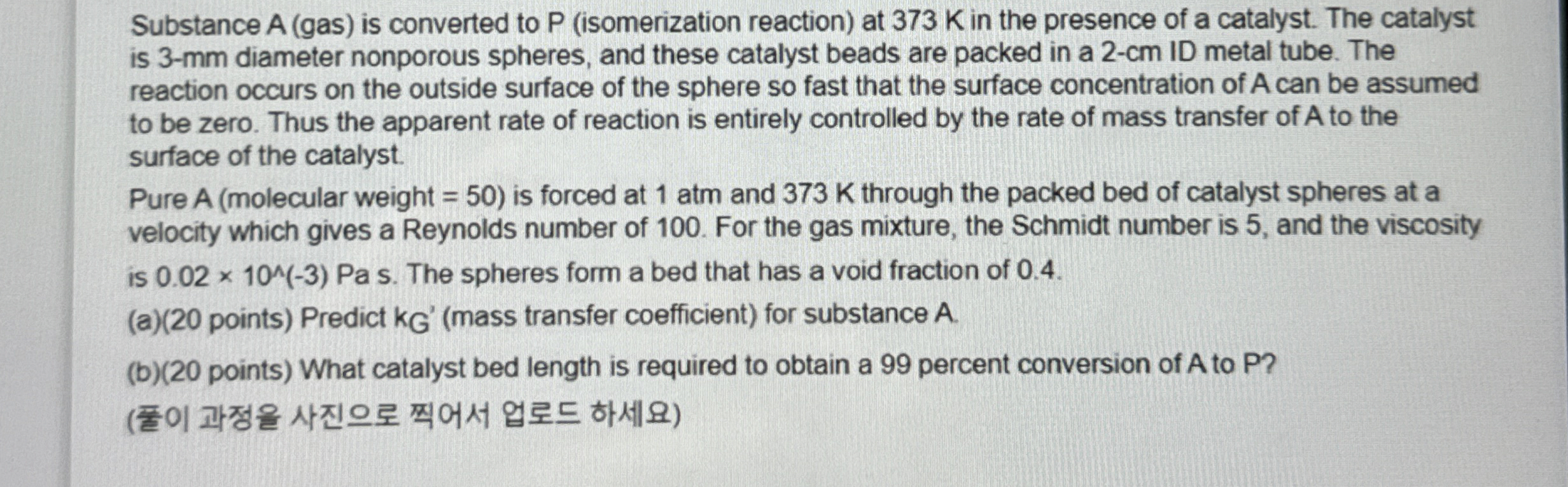
Question: Substance A ( gas ) is converted to P ( isomerization reaction ) at 3 7 3 K in the presence of a catalyst. The
Substance gas is converted to isomerization reaction at in the presence of a catalyst. The catalyst is mm diameter nonporous spheres, and these catalyst beads are packed in a cm ID metal tube. The reaction occurs on the outside surface of the sphere so fast that the surface concentration of A can be assumed to be zero. Thus the apparent rate of reaction is entirely controlled by the rate of mass transfer of A to the surface of the catalyst.
Pure A molecular weight is forced at atm and through the packed bed of catalyst spheres at a velocity which gives a Reynolds number of For the gas mixture, the Schmidt number is and the viscosity is Pas. The spheres form a bed that has a void fraction of
a points Predict mass transfer coefficient for substance A
b points What catalyst bed length is required to obtain a percent conversion of to
Step by Step Solution
There are 3 Steps involved in it
1 Expert Approved Answer
Step: 1 Unlock

Question Has Been Solved by an Expert!
Get step-by-step solutions from verified subject matter experts
Step: 2 Unlock
Step: 3 Unlock
 Study Help