



Question: Suppose the polynomial ax + bx + c corresponds to the vector (a, b, c). To what polynomial will (3, 4, 2) correspond? |3x +
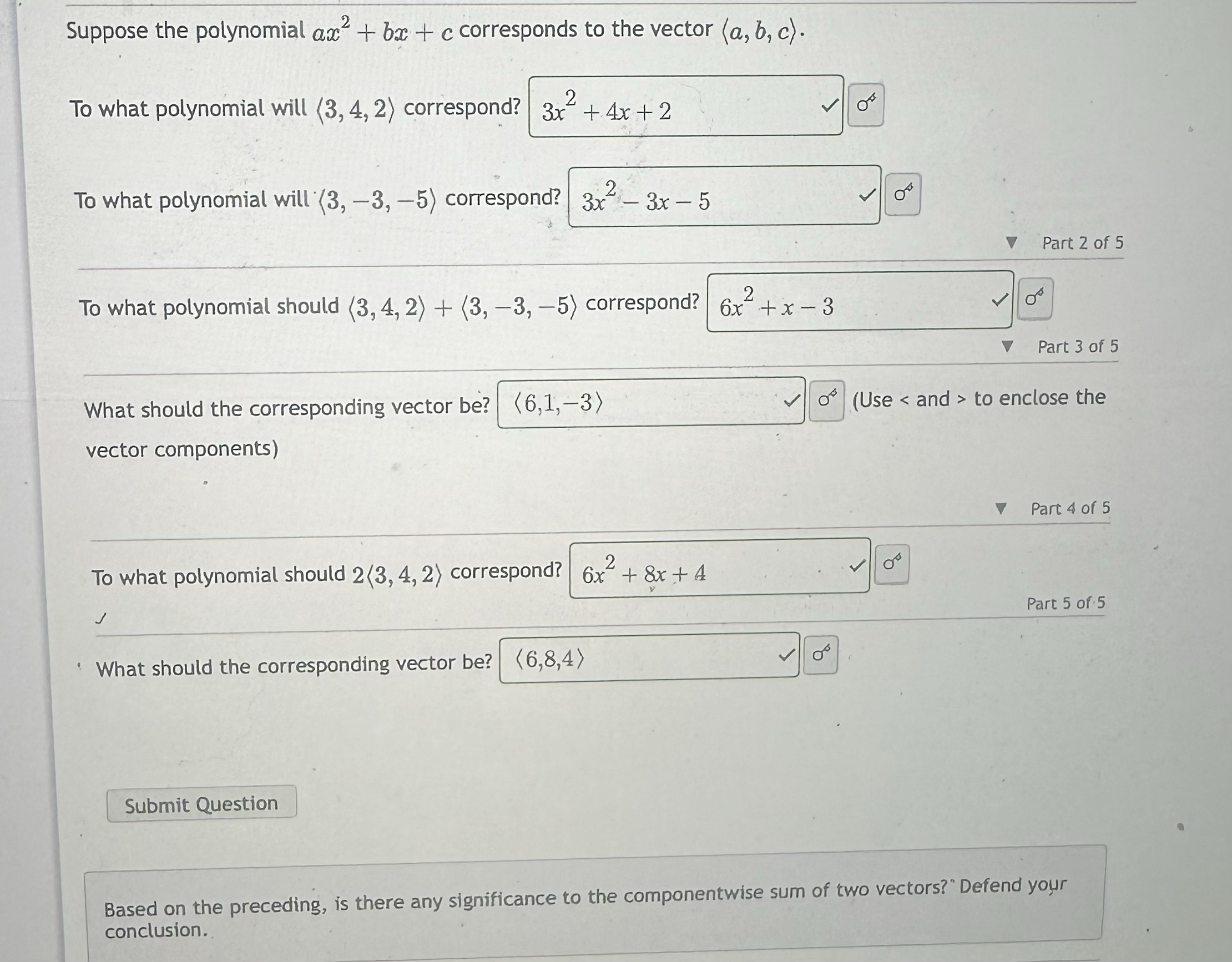
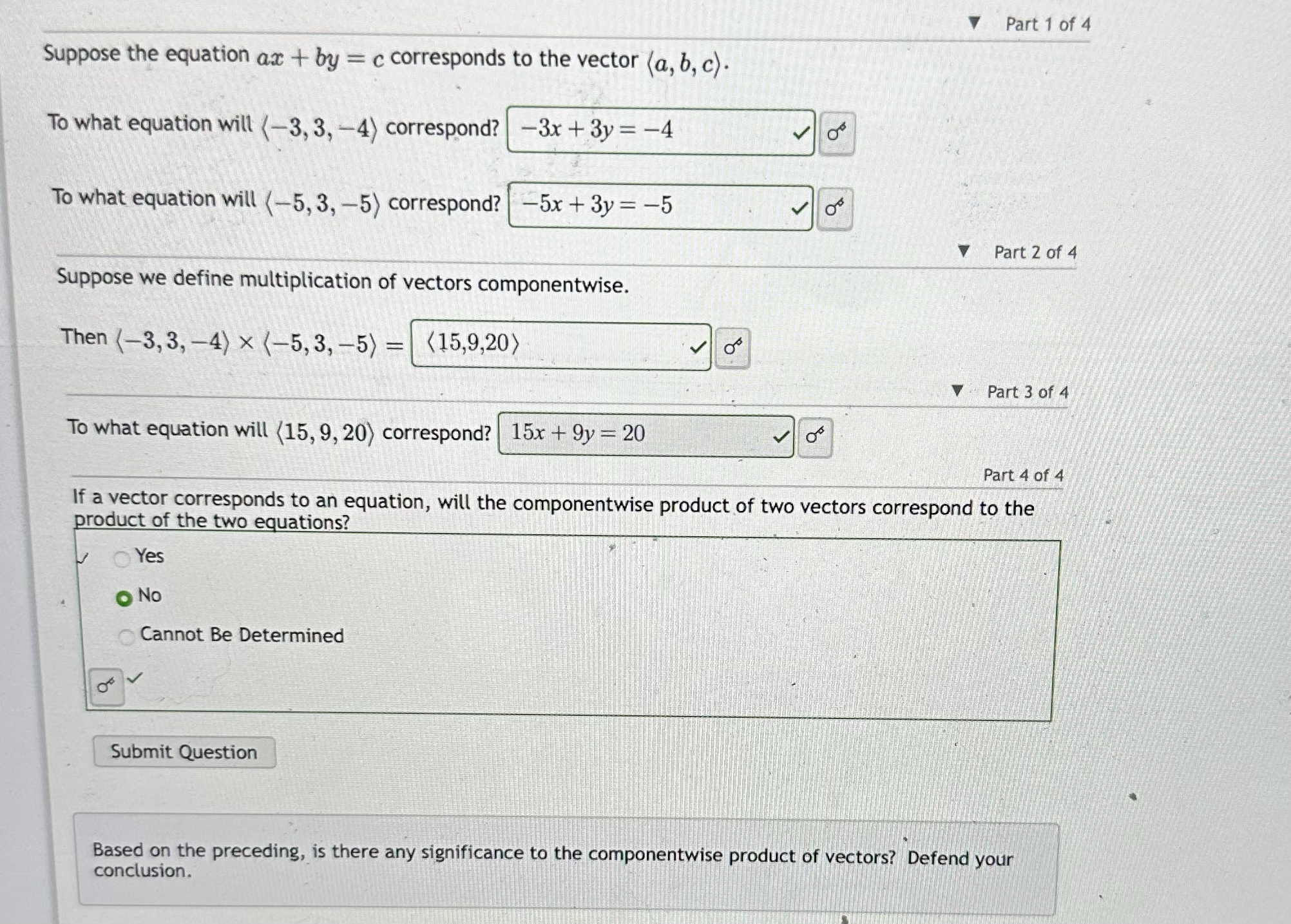
Suppose the polynomial ax + bx + c corresponds to the vector (a, b, c). To what polynomial will (3, 4, 2) correspond? |3x + 4x + 2 To what polynomial will (3, -3, -5) correspond? | 3x - 3x - 5 V Part 2 of 5 To what polynomial should (3, 4, 2) + (3, -3, -5) correspond? |6x + x - 3 Part 3 of 5 What should the corresponding vector be? (6, 1, -3) (Use to enclose the vector components) V Part 4 of 5 To what polynomial should 2(3, 4, 2) correspond? | 6x + &x + 4 Part 5 of .5 What should the corresponding vector be? (6,8,4) Submit Question Based on the preceding, is there any significance to the componentwise sum of two vectors? " Defend your conclusion..Part 1 of 4 Suppose the equation ax + by = c corresponds to the vector (a, b, c). To what equation will (-3, 3, -4) correspond? -3x + 3y = -4 To what equation will (-5, 3, -5) correspond? -5x + 3y = -5 Part 2 of 4 Suppose we define multiplication of vectors componentwise. Then (-3, 3, -4) x (-5, 3, -5) = (15,9,20) Part 3 of 4 To what equation will (15, 9, 20) correspond? | 15x + 9y = 20 Part 4 of 4 If a vector corresponds to an equation, will the componentwise product of two vectors correspond to the product of the two equations? Yes No Cannot Be Determined Submit Question Based on the preceding, is there any significance to the componentwise product of vectors? Defend your conclusion
Step by Step Solution
There are 3 Steps involved in it

Get step-by-step solutions from verified subject matter experts