







Question: Table 1 begin{tabular}{|c|c|c|} hline Item # & AverageWeeklyUsage(units) & UnitCost($) hline Bacon & 50 & 56 hline Chickens & 180 & 78
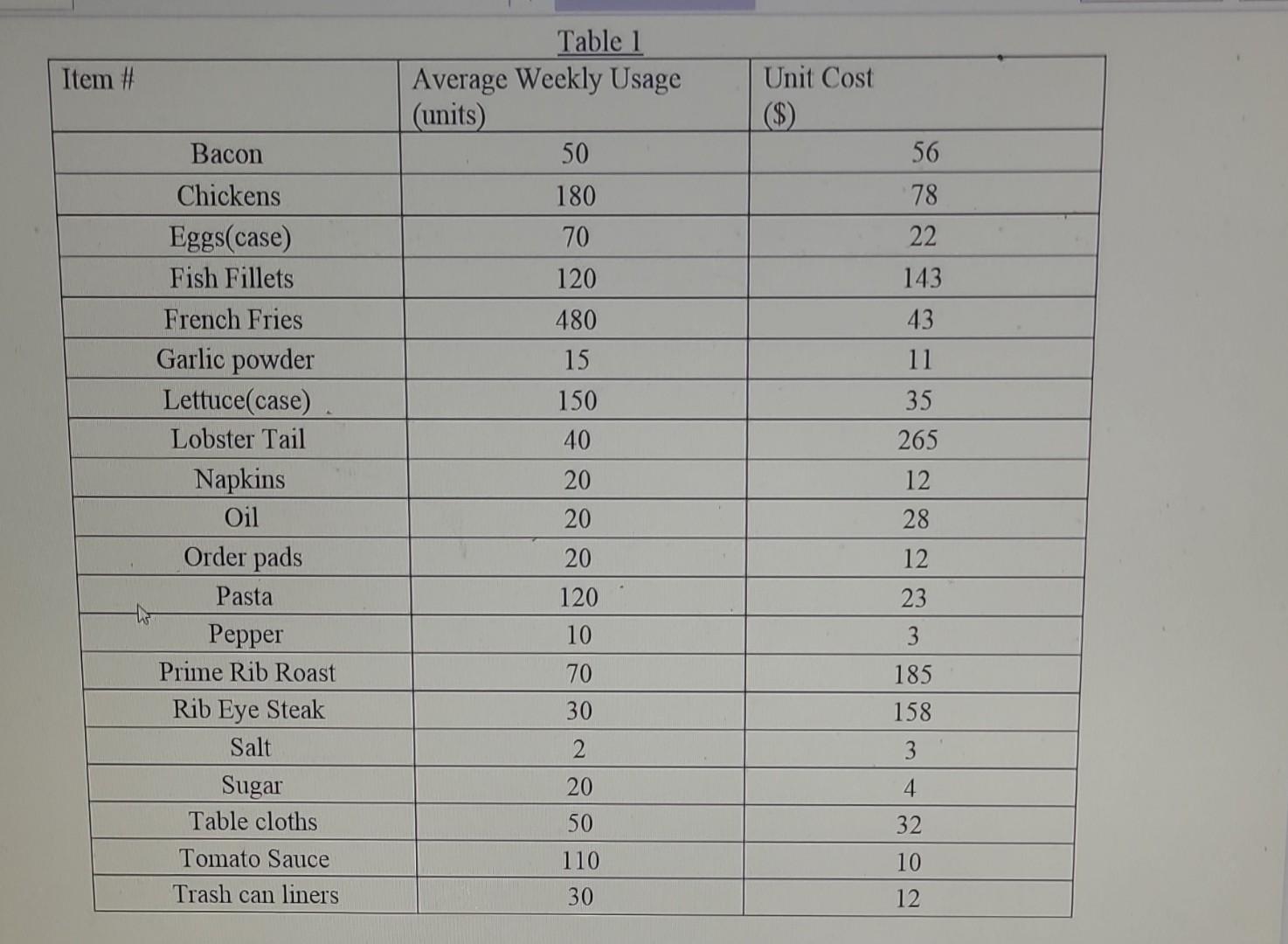
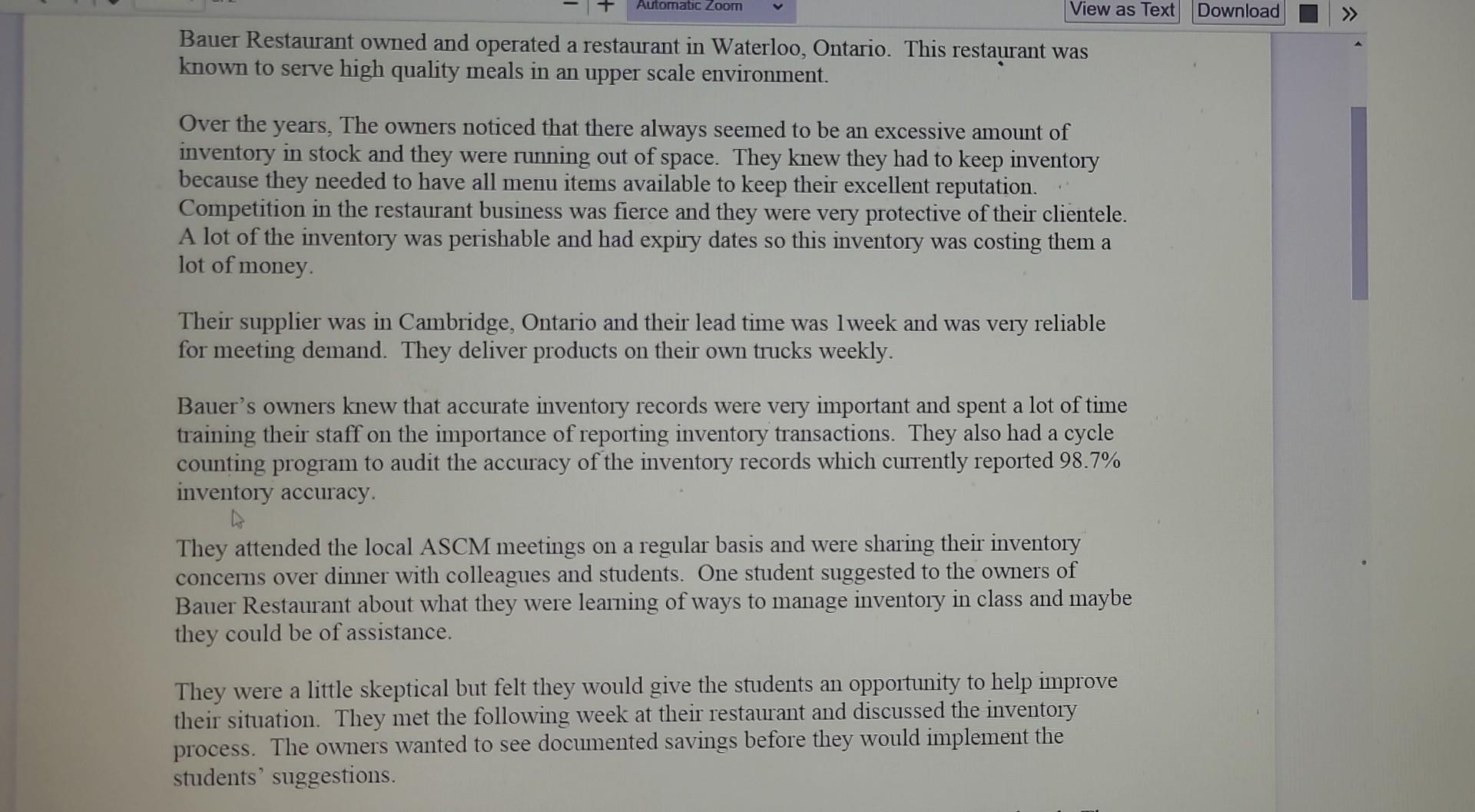
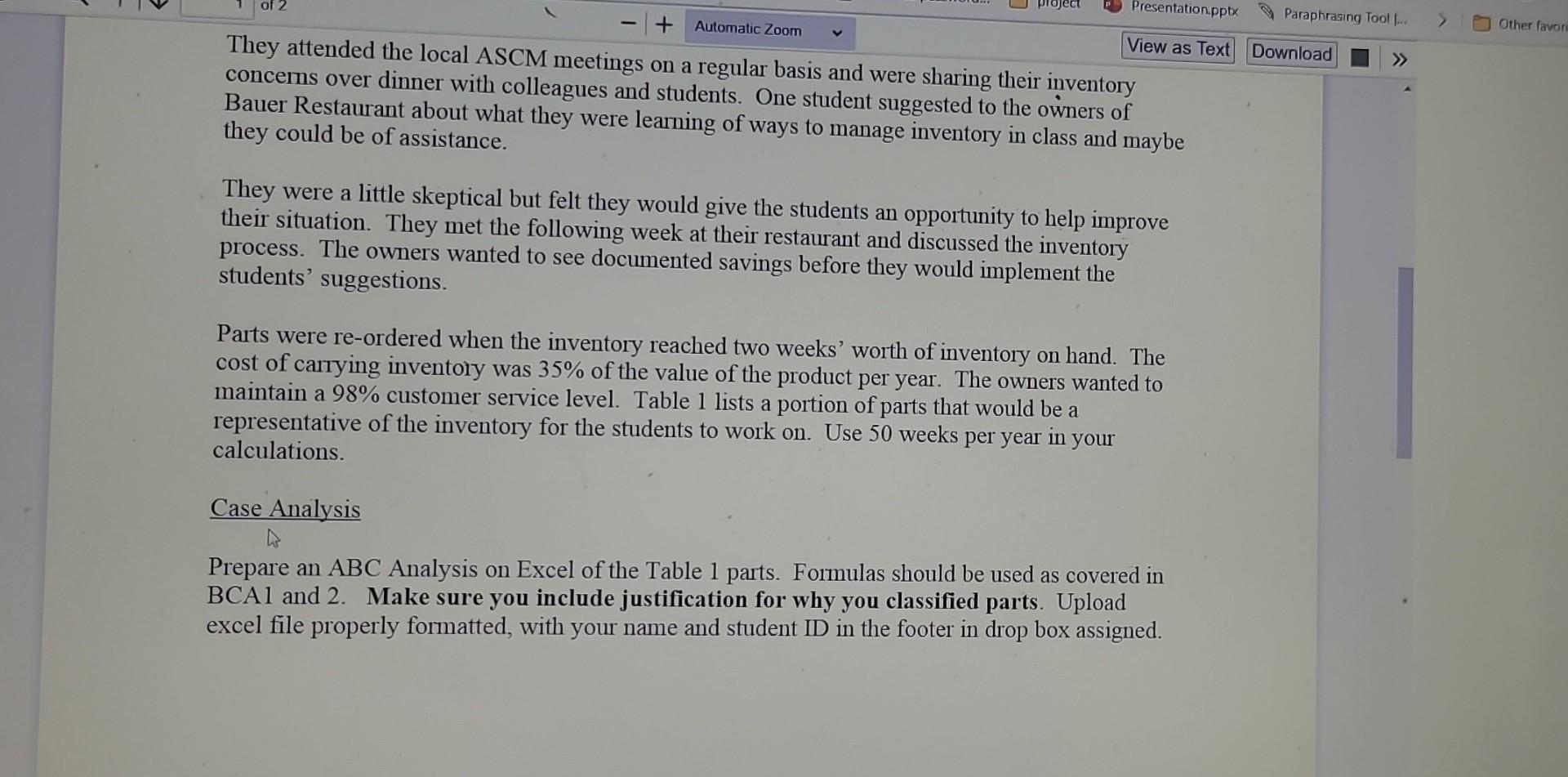
Table 1 \begin{tabular}{|c|c|c|} \hline Item \# & AverageWeeklyUsage(units) & UnitCost($) \\ \hline Bacon & 50 & 56 \\ \hline Chickens & 180 & 78 \\ \hline Eggs(case) & 70 & 22 \\ \hline Fish Fillets & 120 & 143 \\ \hline French Fries & 480 & 43 \\ \hline Garlic powder & 15 & 11 \\ \hline Lettuce(case) & 150 & 35 \\ \hline Lobster Tail & 40 & 265 \\ \hline Napkins & 20 & 12 \\ \hline Oil & 20 & 28 \\ \hline Order pads & 20 & 12 \\ \hline Pasta & 120 & 23 \\ \hline Pepper & 10 & 3 \\ \hline Prime Rib Roast & 70 & 185 \\ \hline Rib Eye Steak & 30 & 158 \\ \hline Salt & 2 & 3 \\ \hline Sugar & 20 & 4 \\ \hline Table cloths & 50 & 32 \\ \hline Tomato Sauce & 110 & 10 \\ \hline Trash can liners & 30 & 12 \\ \hline \end{tabular} Bauer Restaurant owned and operated a restaurant in Waterloo, Ontario. This restaurant was known to serve high quality meals in an upper scale environment. Over the years, The owners noticed that there always seemed to be an excessive amount of inventory in stock and they were running out of space. They knew they had to keep inventory because they needed to have all menu items available to keep their excellent reputation. Competition in the restaurant business was fierce and they were very protective of their clientele. A lot of the inventory was perishable and had expiry dates so this inventory was costing them a lot of money. Their supplier was in Cambridge, Ontario and their lead time was lweek and was very reliable for meeting demand. They deliver products on their own trucks weekly. Bauer's owners knew that accurate inventory records were very important and spent a lot of time training their staff on the importance of reporting inventory transactions. They also had a cycle counting program to audit the accuracy of the inventory records which currently reported 98.7% inventory accuracy. They attended the local ASCM meetings on a regular basis and were sharing their inventory concerns over dinner with colleagues and students. One student suggested to the owners of Bauer Restaurant about what they were learning of ways to manage inventory in class and maybe they could be of assistance. They were a little skeptical but felt they would give the students an opportunity to help improve their situation. They met the following week at their restaurant and discussed the inventory process. The owners wanted to see documented savings before they would implement the students' suggestions. They attended the local ASCM meetings on a regular basis and were sharing their inventory concerns over dinner with colleagues and students. One student suggested to the owners of Bauer Restaurant about what they were learning of ways to manage inventory in class and maybe they could be of assistance. They were a little skeptical but felt they would give the students an opportunity to help improve their situation. They met the following week at their restaurant and discussed the inventory process. The owners wanted to see documented savings before they would implement the students' suggestions. Parts were re-ordered when the inventory reached two weeks' worth of inventory on hand. The cost of carrying inventory was 35% of the value of the product per year. The owners wanted to maintain a 98% customer service level. Table 1 lists a portion of parts that would be a representative of the inventory for the students to work on. Use 50 weeks per year in your calculations. Case Analysis Prepare an ABC Analysis on Excel of the Table 1 parts. Formulas should be used as covered in BCA1 and 2. Make sure you include justification for why you classified parts. Upload excel file properly formatted, with your name and student ID in the footer in drop box assigned. Table 1 \begin{tabular}{|c|c|c|} \hline Item \# & AverageWeeklyUsage(units) & UnitCost($) \\ \hline Bacon & 50 & 56 \\ \hline Chickens & 180 & 78 \\ \hline Eggs(case) & 70 & 22 \\ \hline Fish Fillets & 120 & 143 \\ \hline French Fries & 480 & 43 \\ \hline Garlic powder & 15 & 11 \\ \hline Lettuce(case) & 150 & 35 \\ \hline Lobster Tail & 40 & 265 \\ \hline Napkins & 20 & 12 \\ \hline Oil & 20 & 28 \\ \hline Order pads & 20 & 12 \\ \hline Pasta & 120 & 23 \\ \hline Pepper & 10 & 3 \\ \hline Prime Rib Roast & 70 & 185 \\ \hline Rib Eye Steak & 30 & 158 \\ \hline Salt & 2 & 3 \\ \hline Sugar & 20 & 4 \\ \hline Table cloths & 50 & 32 \\ \hline Tomato Sauce & 110 & 10 \\ \hline Trash can liners & 30 & 12 \\ \hline \end{tabular} Bauer Restaurant owned and operated a restaurant in Waterloo, Ontario. This restaurant was known to serve high quality meals in an upper scale environment. Over the years, The owners noticed that there always seemed to be an excessive amount of inventory in stock and they were running out of space. They knew they had to keep inventory because they needed to have all menu items available to keep their excellent reputation. Competition in the restaurant business was fierce and they were very protective of their clientele. A lot of the inventory was perishable and had expiry dates so this inventory was costing them a lot of money. Their supplier was in Cambridge, Ontario and their lead time was lweek and was very reliable for meeting demand. They deliver products on their own trucks weekly. Bauer's owners knew that accurate inventory records were very important and spent a lot of time training their staff on the importance of reporting inventory transactions. They also had a cycle counting program to audit the accuracy of the inventory records which currently reported 98.7% inventory accuracy. They attended the local ASCM meetings on a regular basis and were sharing their inventory concerns over dinner with colleagues and students. One student suggested to the owners of Bauer Restaurant about what they were learning of ways to manage inventory in class and maybe they could be of assistance. They were a little skeptical but felt they would give the students an opportunity to help improve their situation. They met the following week at their restaurant and discussed the inventory process. The owners wanted to see documented savings before they would implement the students' suggestions. They attended the local ASCM meetings on a regular basis and were sharing their inventory concerns over dinner with colleagues and students. One student suggested to the owners of Bauer Restaurant about what they were learning of ways to manage inventory in class and maybe they could be of assistance. They were a little skeptical but felt they would give the students an opportunity to help improve their situation. They met the following week at their restaurant and discussed the inventory process. The owners wanted to see documented savings before they would implement the students' suggestions. Parts were re-ordered when the inventory reached two weeks' worth of inventory on hand. The cost of carrying inventory was 35% of the value of the product per year. The owners wanted to maintain a 98% customer service level. Table 1 lists a portion of parts that would be a representative of the inventory for the students to work on. Use 50 weeks per year in your calculations. Case Analysis Prepare an ABC Analysis on Excel of the Table 1 parts. Formulas should be used as covered in BCA1 and 2. Make sure you include justification for why you classified parts. Upload excel file properly formatted, with your name and student ID in the footer in drop box assigned
Step by Step Solution
There are 3 Steps involved in it

Get step-by-step solutions from verified subject matter experts
 Study Help