







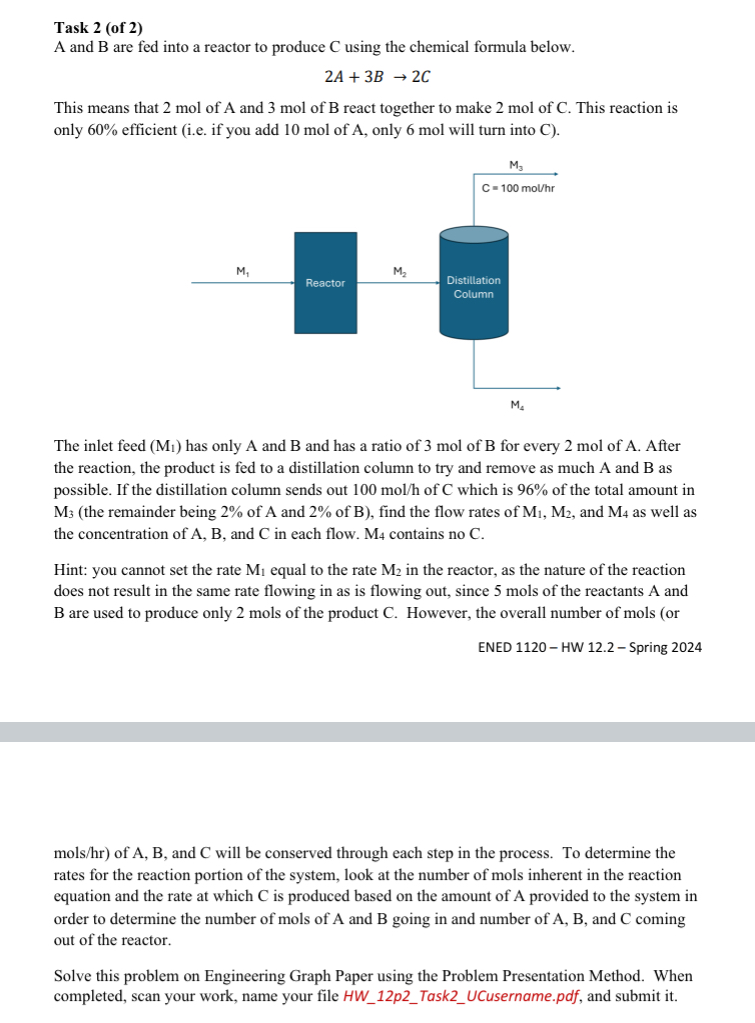
Question: Task 2 ( of 2 ) A and B are fed into a reactor to produce C using the chemical formula below. 2 A +
Task of
A and are fed into a reactor to produce using the chemical formula below.
This means that mol of A and mol of react together to make mol of This reaction is only efficient ie if you add mol of only mol will turn into C
The inlet feed has only A and B and has a ratio of mol of B for every mol of A After the reaction, the product is fed to a distillation column to try and remove as much A and B as possible. If the distillation column sends out of which is of the total amount in the remainder being of A and of find the flow rates of and as well as the concentration of and in each flow. contains no
Hint: you cannot set the rate equal to the rate in the reactor, as the nature of the reaction does not result in the same rate flowing in as is flowing out, since mols of the reactants A and are used to produce only mols of the product However, the overall number of mols or
ENED HW Spring
mol of A B and C will be conserved through each step in the process. To determine the rates for the reaction portion of the system, look at the number of mols inherent in the reaction equation and the rate at which is produced based on the amount of A provided to the system in order to determine the number of mols of A and B going in and number of A B and C coming out of the reactor.
Solve this problem on Engineering Graph Paper using the Problem Presentation Method. When completed, scan your work, name your file HWpTaskUCusername.pdf and submit it
Step by Step Solution
There are 3 Steps involved in it
1 Expert Approved Answer
Step: 1 Unlock

Question Has Been Solved by an Expert!
Get step-by-step solutions from verified subject matter experts
Step: 2 Unlock
Step: 3 Unlock
 Study Help