







Question: TASK 2 (oF 2): STATICS AND COMPUTING The figure below shows a crane (for simplicity we will negleet the crane's mass) whose arms have lengths
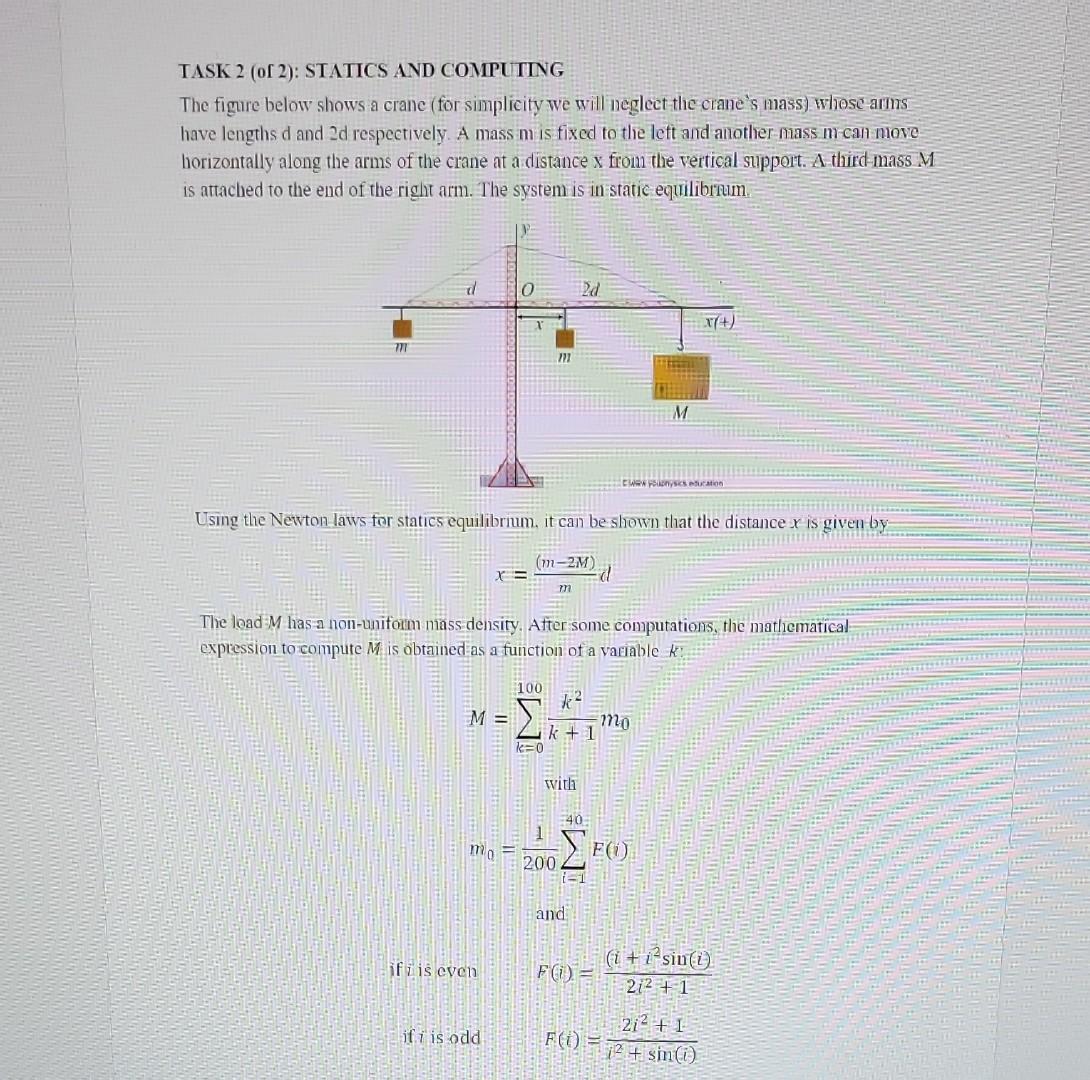
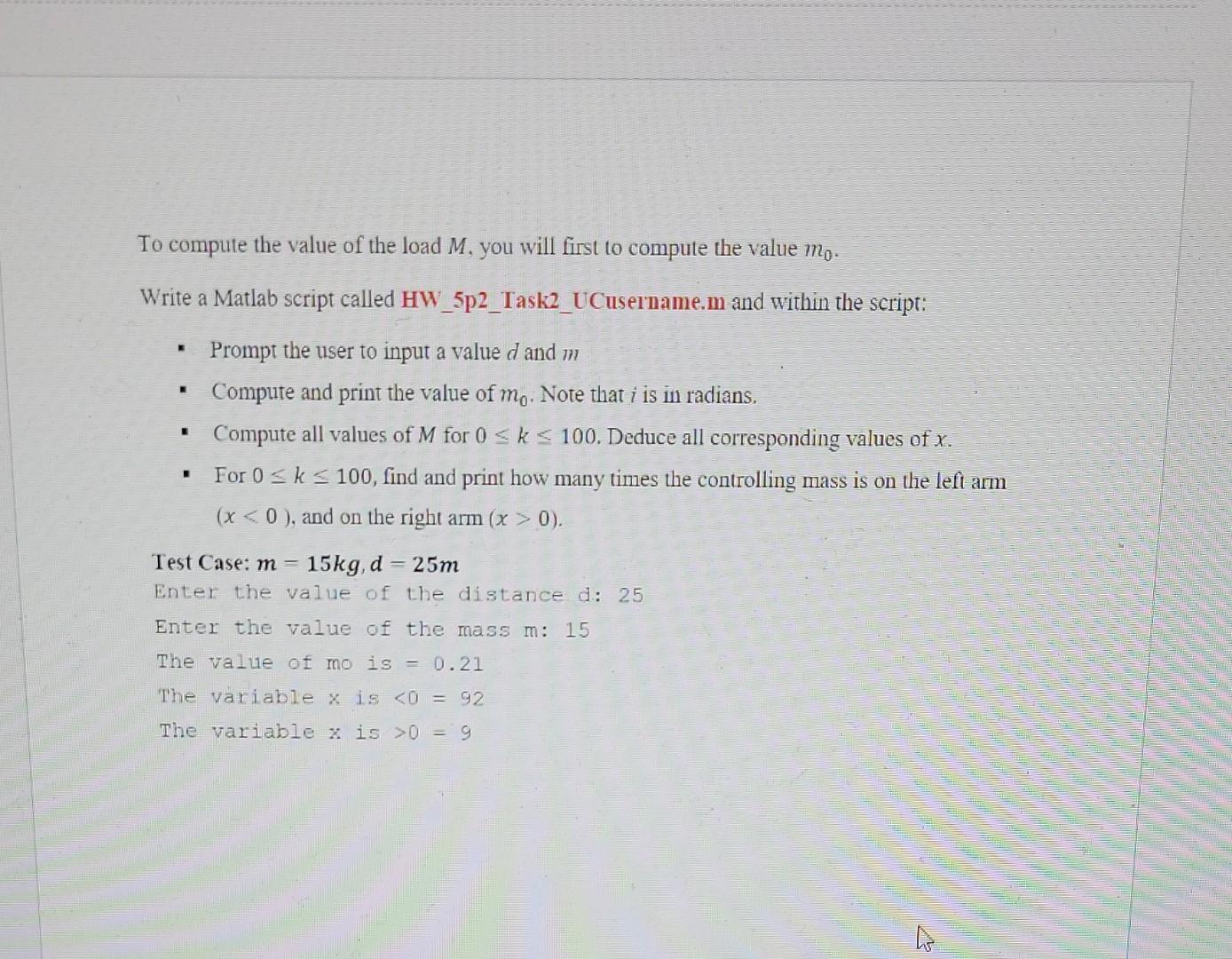
TASK 2 (oF 2): STATICS AND COMPUTING The figure below shows a crane (for simplicity we will negleet the crane's mass) whose arms have lengths d and 2d respectively. A mass m is fixed to the left and allother mass m-can move. horizontally along the arms of the crane at a distance x from the vertical suppert. A thired-mass. M is attached to the end of the right arm. The system is in static equilibrizum. Using the Newton laws fer statics equilibrium, it can be shown that the distance x is given by x=m(m2M)d The load M hasa non-uniform mass density. After some computatiens, the mathematical expression to compute M is obtained as a function of a vafiable k : M=k=0100k+1k2m0 with m0=2001i=140E(i) and ifisisevenF(i)=2i2+1(i+i2sin(i)ifiisoddF(i)=i2+sin(i)2i2+1 To compute the value of the load M, you will first to compute the value m0. Write a Matlab script called HW_5p2_Task2_UCuselname.m and within the script: - Prompt the user to input a value d and m - Compute and print the value of m0. Note that i is in radians. - Compute all values of M for 0k100. Deduce all corresponding values of x. - For 0k100, find and print how many times the controlling mass is on the left arm (x0). Test Case: m=15kg,d=25m Enter the value of the distance d: 25 Enter the value of the mass m:15 The value of mo is =0.21 The variable x is 0=9
Step by Step Solution
There are 3 Steps involved in it

Get step-by-step solutions from verified subject matter experts
 Study Help