Question: TASK B. Read the following in-text citations. a. Identify if the in-text citation is a 1) Long, 2) Short Quotation, or 3) Paraphrase/Summary. b. Explain
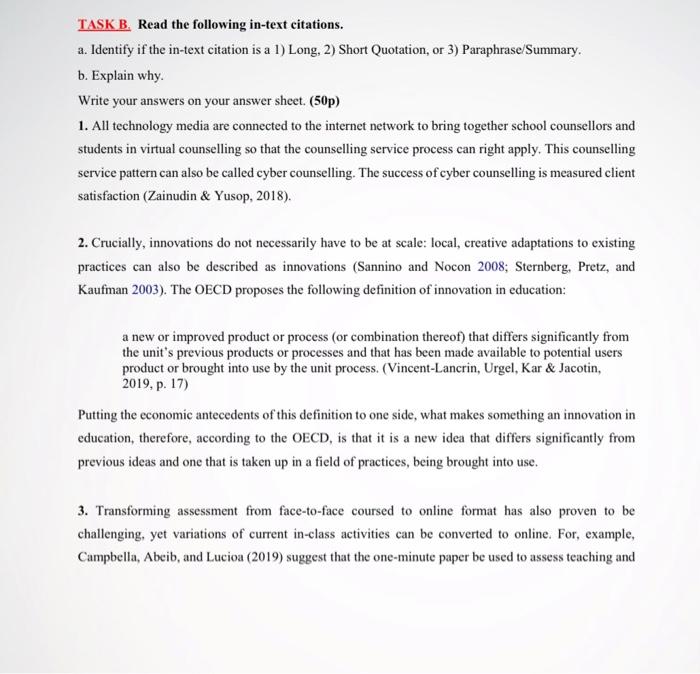
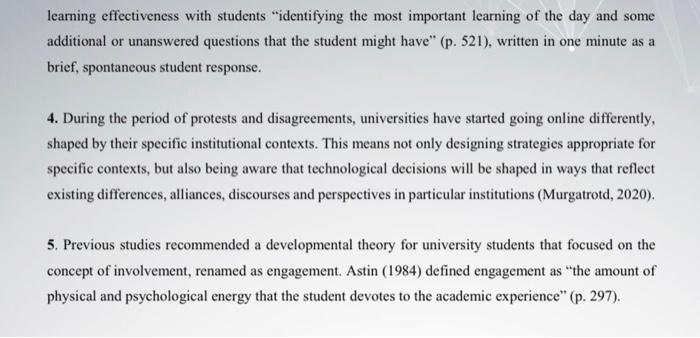
TASK B. Read the following in-text citations. a. Identify if the in-text citation is a 1) Long, 2) Short Quotation, or 3) Paraphrase/Summary. b. Explain why. Write your answers on your answer sheet. (50p) 1. All technology media are connected to the internet network to bring together school counsellors and students in virtual counselling so that the counselling service process can right apply. This counselling service pattern can also be called cyber counselling. The success of cyber counselling is measured client satisfaction (Zainudin & Yusop, 2018). 2. Crucially, innovations do not necessarily have to be at scale: local, creative adaptations to existing practices can also be described as innovations (Sannino and Nocon 2008; Sternberg, Pretz, and Kaufman 2003). The OECD proposes the following definition of innovation in education: a new or improved product or process (or combination thereof) that differs significantly from the unit's previous products or processes and that has been made available to potential users product or brought into use by the unit process. (Vincent-Lancrin, Urgel, Kar & Jacotin, 2019, p. 17) Putting the economic antecedents of this definition to one side, what makes something an innovation in education, therefore, according to the OECD, is that it is a new idea that differs significantly from previous ideas and one that is taken up in a field of practices, being brought into use. 3. Transforming assessment from face-to-face coursed to online format has also proven to be challenging, yet variations of current in-class activities can be converted to online. For example, Campbella, Abeib, and Lucioa (2019) suggest that the one-minute paper be used to assess teaching and learning effectiveness with students "identifying the most important learning of the day and some additional or unanswered questions that the student might have" (p. 521), written in one minute as a brief, spontaneous student response. 4. During the period of protests and disagreements, universities have started going online differently, shaped by their specific institutional contexts. This means not only designing strategies appropriate for specific contexts, but also being aware that technological decisions will be shaped in ways that reflect existing differences, alliances, discourses and perspectives in particular institutions (Murgatrotd, 2020). 5. Previous studies recommended a developmental theory for university students that focused on the concept of involvement, renamed as engagement. Astin (1984) defined engagement as the amount of physical and psychological energy that the student devotes to the academic experience" (p. 297)









 Study Help