Question: TASK C. Read the following in-text citations. a. Identify if the in-text citation is a Long, or Short Quotation, or a Paraphrase/Summary. b. Explain why.
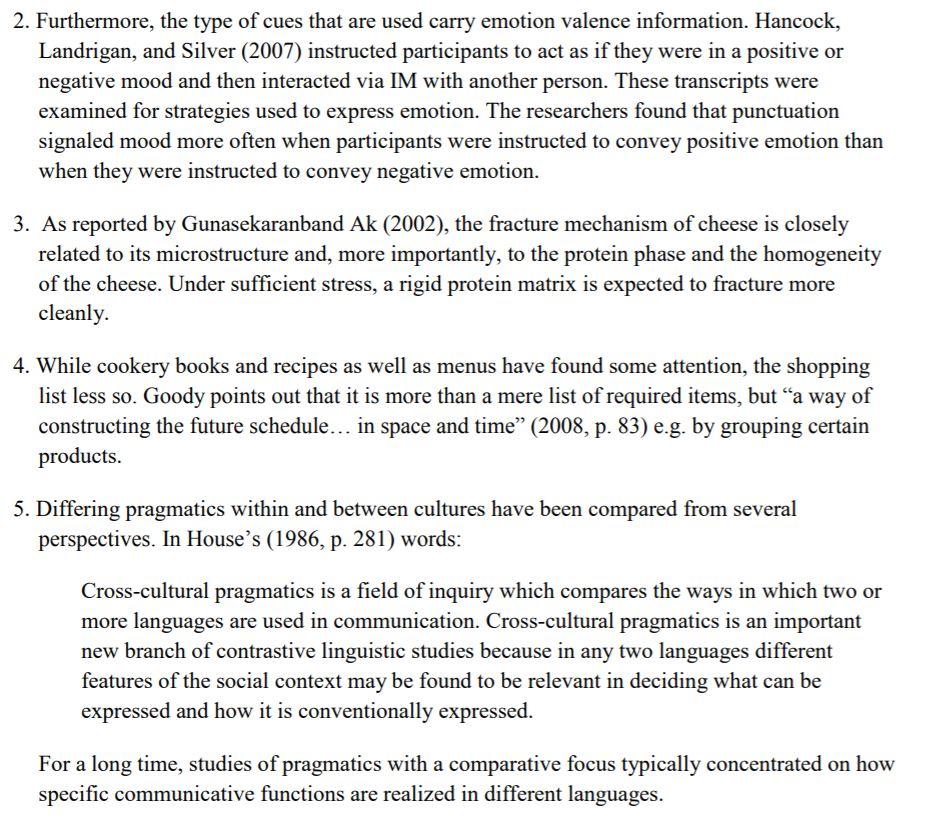
TASK C. Read the following in-text citations. a. Identify if the in-text citation is a Long, or Short Quotation, or a Paraphrase/Summary. b. Explain why. Write your answers on your answer sheet. (50p) AUM American University of the Middle East 1. Moreover, in regard to the concept of mindfulness, researchers have identified clearly that the mindfulness of breathing assessed via this programme pertains to the awareness of the present moment yet excludes the facet of nonjudgement or nonattachment (Levinson et al., 2014, p. 1), and notably, mentioning that mindfulness practice may importantly include facets (e.g. nonjudgment, nonattachment) that may not be as emphasized in mindfulness of breathing as in other mindfulness styles. Thus, it could be assumed that the accuracy of breath counting indicates the level of awareness held in regard to the self-reported measuring as to the mindfulness scale. 2. Furthermore, the type of cues that are used carry emotion valence information. Hancock, Landrigan, and Silver (2007) instructed participants to act as if they were in a positive or negative mood and then interacted via IM with another person. These transcripts were examined for strategies used to express emotion. The researchers found that punctuation signaled mood more often when participants were instructed to convey positive emotion than when they were instructed to convey negative emotion. 3. As reported by Gunasekaranband Ak (2002), the fracture mechanism of cheese is closely related to its microstructure and, more importantly, to the protein phase and the homogeneity of the cheese. Under sufficient stress, a rigid protein matrix is expected to fracture more cleanly. 4. While cookery books and recipes as well as menus have found some attention, the shopping list less so. Goody points out that it is more than a mere list of required items, but a way of constructing the future schedule... in space and time (2008, p. 83) e.g. by grouping certain products. 5. Differing pragmatics within and between cultures have been compared from several perspectives. In House's (1986, p. 281) words: Cross-cultural pragmatics is a field of inquiry which compares the ways in which two or more languages are used in communication. Cross-cultural pragmatics is an important new branch of contrastive linguistic studies because in any two languages different features of the social context may be found to be relevant in deciding what can be expressed and how it is conventionally expressed. For a long time, studies of pragmatics with a comparative focus typically concentrated on how specific communicative functions are realized in different languages









 Study Help