Question: Textbook:- Colquitt, J. A., LePine, J. A., & Wesson, M. J. (2021). Organizational behavior: Improving performance and commitment in the workplace (7th ed) . Burr
Textbook:-
Colquitt, J. A., LePine, J. A., & Wesson, M. J. (2021). Organizational behavior: Improving performance and commitment in the workplace (7th ed). Burr Ridge, IL: McGraw-Hill Irwin.
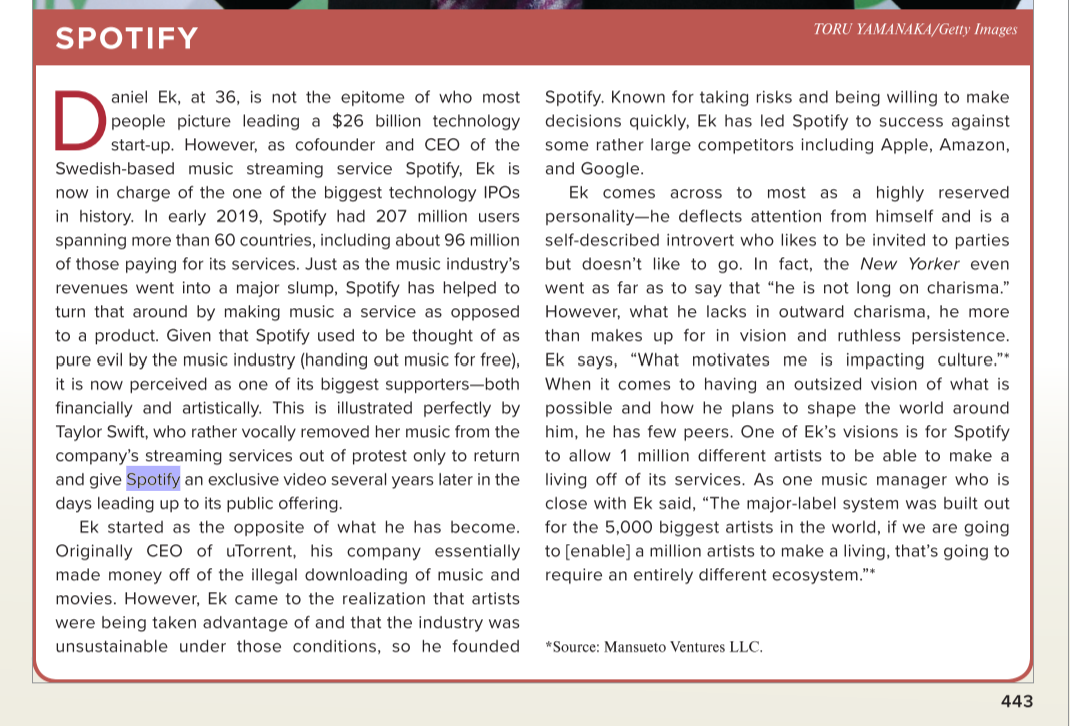
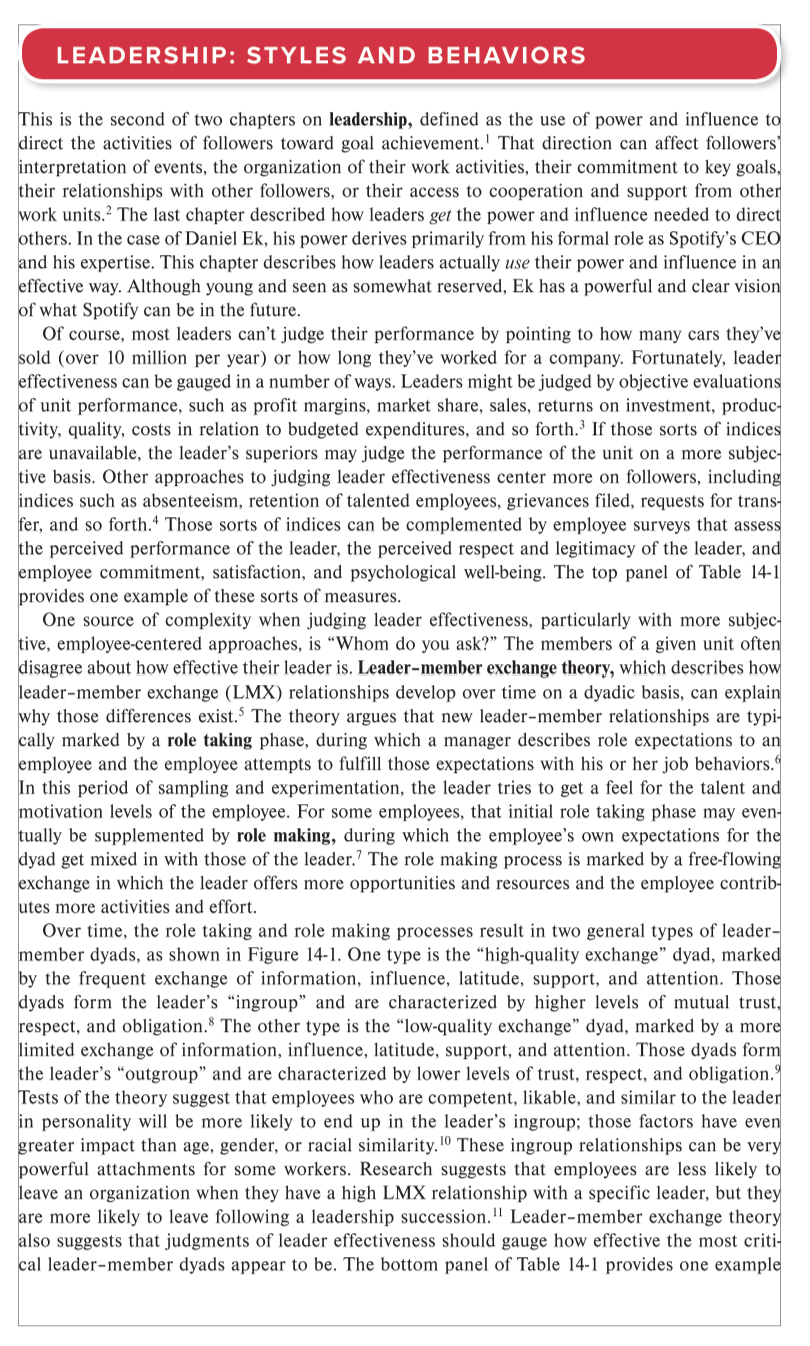
Please read the case SPOTIFY from Chapter 14 Leadership: Styles and Behaviors Page: - 469 given in your textbook Organizational behaviour: Improving performance and commitment in the workplace (7th ed). by Colquitt, J. A., LePine, J. A., & Wesson, M. J. (2021) and Answer the following Questions:
Assignment Question(s):
Part:-1
1. Is it reasonable for a CEO like Ek to expect his employees to have the same passion and commitment to their work as he does? (Min words 150-200)
2. Does Ek fit your perception of what a "transformational leader" is supposed to be? (Min words 150-200)
3. What are the advantages and disadvantages of having a leader with such a strong vision for the company? (Min words 150-200)
Discussion questions: Please read Chapter 14 Leadership: Styles and Behaviors carefully and then give your answers on the basis of your understanding.
4. Before reading this chapter, which statement did you feel was more accurate: Leaders are born or Leaders are made? How do you feel now, and why do you feel that way? (Min words 200-300)
5. Consider the four dimensions of transformational leadership: idealized influence, inspirational motivation, intellectual stimulation, and individualized consideration. Which of those dimensions would you respond to most favorably? Why? (Min words 200-300)
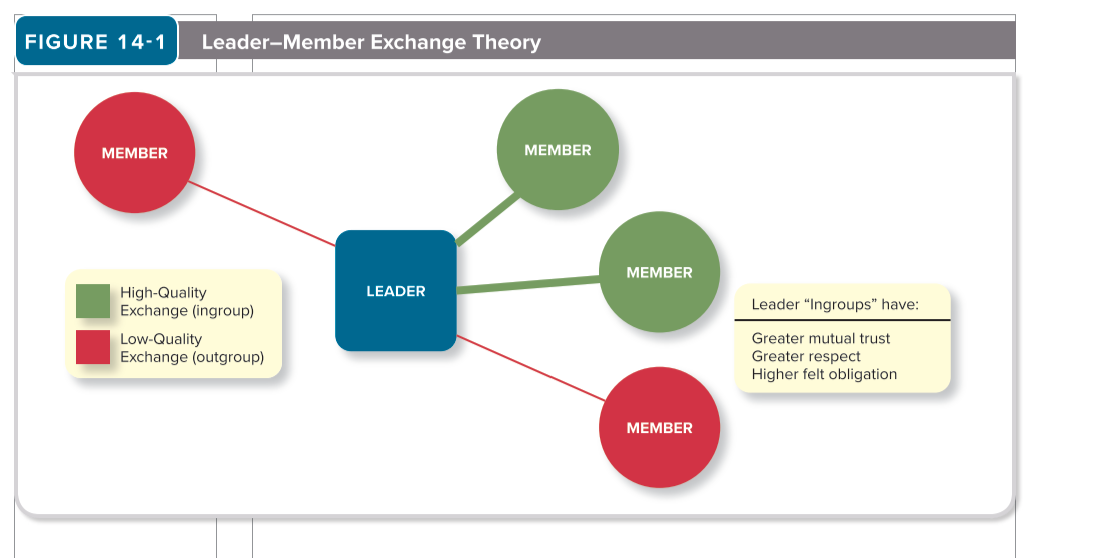
SPOTIFY D aniel Ek, at 36, is not the epitome of who most people picture leading a $26 billion technology start-up. However, as cofounder and CEO of the Swedish-based music streaming service Spotify, Ek is now in charge of the one of the biggest technology IPOS in history. In early 2019, Spotify had 207 million users spanning more than 60 countries, including about 96 million of those paying for its services. Just as the music industry's revenues went into a major slump, Spotify has helped to turn that around by making music a service as opposed to a product. Given that Spotify used to be thought of as pure evil by the music industry (handing out music for free), it is now perceived as one of its biggest supporters-both financially and artistically. This is illustrated perfectly by Taylor Swift, who rather vocally removed her music from the company's streaming services out of protest only to return and give Spotify an exclusive video several years later in the days leading up to its public offering. Ek started as the opposite of what he has become. Originally CEO of uTorrent, his company essentially made money off of the illegal downloading of music and movies. However, Ek came to the realization that artists were being taken advantage of and that the industry was unsustainable under those conditions, so he founded TORU YAMANAKA/Getty Images Spotify. Known for taking risks and being willing to make decisions quickly, Ek has led Spotify to success against some rather large competitors including Apple, Amazon, and Google. Ek comes across to most as a highly reserved personality-he deflects attention from himself and is a self-described introvert who likes to be invited to parties but doesn't like to go. In fact, the New Yorker even went as far as to say that "he is not long on charisma." However, what he lacks in outward charisma, he more than makes up for in vision and ruthless persistence. Ek says, "What motivates me is impacting culture."* When it comes to having an outsized vision of what is possible and how he plans to shape the world around him, he has few peers. One of Ek's visions is for Spotify to allow 1 million different artists to be able to make a living off of its services. As one music manager who is close with Ek said, "The major-label system was built out for the 5,000 biggest artists in the world, if we are going to [enable] a million artists to make a living, that's going to require an entirely different ecosystem."* *Source: Mansueto Ventures LLC. 443 LEADERSHIP: STYLES AND BEHAVIORS This is the second of two chapters on leadership, defined as the use of power and influence to direct the activities of followers toward goal achievement. That direction can affect followers interpretation of events, the organization of their work activities, their commitment to key goals, their relationships with other followers, or their access to cooperation and support from other work units. The last chapter described how leaders get the power and influence needed to direct others. In the case of Daniel Ek, his power derives primarily from his formal role as Spotify's CEO and his expertise. This chapter describes how leaders actually use their power and influence in an effective way. Although young and seen as somewhat reserved, Ek has a powerful and clear vision of what Spotify can be in the future. Of course, most leaders can't judge their performance by pointing to how many cars they've sold (over 10 million per year) or how long they've worked for a company. Fortunately, leader effectiveness can be gauged in a number of ways. Leaders might be judged by objective evaluations of unit performance, such as profit margins, market share, sales, returns on investment, produc tivity, quality, costs in relation to budgeted expenditures, and so forth. If those sorts of indices are unavailable, the leader's superiors may judge the performance of the unit on a more subjec- tive basis. Other approaches to judging leader effectiveness center more on followers, including indices such as absenteeism, retention of talented employees, grievances filed, requests for trans- fer, and so forth.4 Those sorts of indices can be complemented by employee surveys that assess the perceived performance of the leader, the perceived respect and legitimacy of the leader, and employee commitment, satisfaction, and psychological well-being. The top panel of Table 14-1 provides one example of these sorts of measures. One source of complexity when judging leader effectiveness, particularly with more subjec- tive, employee-centered approaches, is "Whom do you ask?" The members of a given unit often disagree about how effective their leader is. Leader-member exchange theory, which describes how leader-member exchange (LMX) relationships develop over time on a dyadic basis, can explain why those differences exist. The theory argues that new leader-member relationships are typi- cally marked by a role taking phase, during which a manager describes role expectations to an employee and the employee attempts to fulfill those expectations with his or her job behaviors. In this period of sampling and experimentation, the leader tries to get a feel for the talent and motivation levels of the employee. For some employees, that initial role taking phase may even- tually be supplemented by role making, during which the employee's own expectations for the dyad get mixed in with those of the leader. The role making process is marked by a free-flowing exchange in which the leader offers more opportunities and resources and the employee contrib- utes more activities and effort. Over time, the role taking and role making processes result in two general types of leader- member dyads, as shown in Figure 14-1. One type is the "high-quality exchange" dyad, marked by the frequent exchange of information, influence, latitude, support, and attention. Those dyads form the leader's "ingroup" and are characterized by higher levels of mutual trust, respect, and obligation. The other type is the "low-quality exchange" dyad, marked by a more limited exchange of information, influence, latitude, support, and attention. Those dyads form the leader's "outgroup" and are characterized by lower levels of trust, respect, and obligation. Tests of the theory suggest that employees who are competent, likable, and similar to the leader in personality will be more likely to end up in the leader's ingroup; those factors have even greater impact than age, gender, or racial similarity, 10 These ingroup relationships can be very powerful attachments for some workers. Research suggests that employees are less likely to leave an organization when they have a high LMX relationship with a specific leader, but they are more likely to leave following a leadership succession." Leader-member exchange theory also suggests that judgments of leader effectiveness should gauge how effective the most criti cal leader-member dyads appear to be. The bottom panel of Table 14-1 provides one example FIGURE 14-1 Leader-Member Exchange Theory MEMBER MEMBER LEADER High-Quality Exchange (ingroup) Low-Quality Exchange (outgroup) MEMBER MEMBER Leader "Ingroups" have: Greater mutual trust Greater respect Higher felt obligation









 Study Help