







Question: The dynamic relation between a process output variable Y(s) and a process input variable X(s) is described by a first order transfer function with a
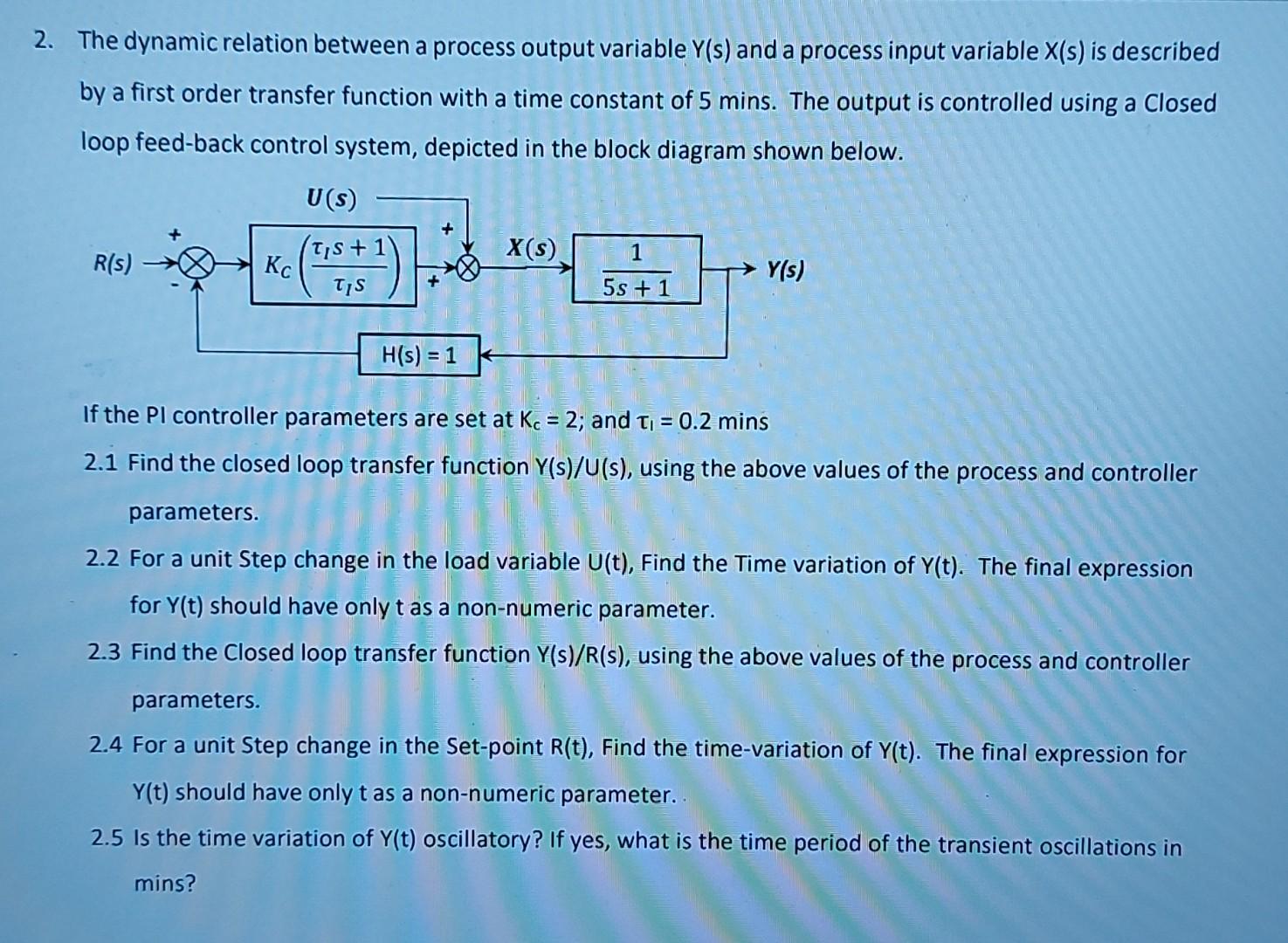
The dynamic relation between a process output variable Y(s) and a process input variable X(s) is described by a first order transfer function with a time constant of 5 mins. The output is controlled using a Closed loop feed-back control system, depicted in the block diagram shown below. If the PI controller parameters are set at Kc=2; and 1=0.2 mins 2.1 Find the closed loop transfer function Y(s)/U(s), using the above values of the process and controller parameters. 2.2 For a unit Step change in the load variable U(t), Find the Time variation of Y(t). The final expression for Y(t) should have only t as a non-numeric parameter. 2.3 Find the Closed loop transfer function Y(s)/R(s), using the above values of the process and controller parameters. 2.4 For a unit Step change in the Set-point R(t), Find the time-variation of Y(t). The final expression for Y(t) should have only t as a non-numeric parameter. . 2.5 Is the time variation of Y(t) oscillatory? If yes, what is the time period of the transient oscillations in mins? The dynamic relation between a process output variable Y(s) and a process input variable X(s) is described by a first order transfer function with a time constant of 5 mins. The output is controlled using a Closed loop feed-back control system, depicted in the block diagram shown below. If the PI controller parameters are set at Kc=2; and 1=0.2 mins 2.1 Find the closed loop transfer function Y(s)/U(s), using the above values of the process and controller parameters. 2.2 For a unit Step change in the load variable U(t), Find the Time variation of Y(t). The final expression for Y(t) should have only t as a non-numeric parameter. 2.3 Find the Closed loop transfer function Y(s)/R(s), using the above values of the process and controller parameters. 2.4 For a unit Step change in the Set-point R(t), Find the time-variation of Y(t). The final expression for Y(t) should have only t as a non-numeric parameter. . 2.5 Is the time variation of Y(t) oscillatory? If yes, what is the time period of the transient oscillations in mins
Step by Step Solution
There are 3 Steps involved in it

Get step-by-step solutions from verified subject matter experts
 Study Help