


Question: The dynamic response of a reactant concentration in the reactor, CA to a step change in inlet concentration (C'A0) is to be evaluated for an
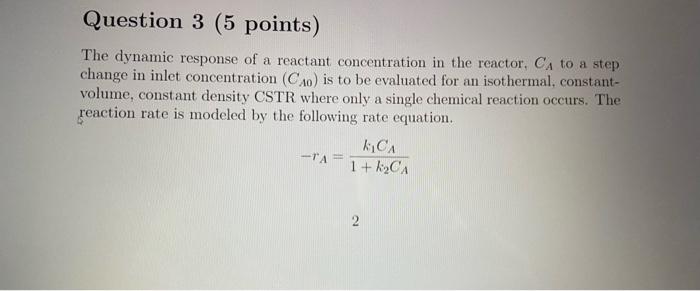
The dynamic response of a reactant concentration in the reactor, CA to a step
change in inlet concentration (C'A0) is to be evaluated for an isothermal, constant-
volume, constant density CSTR where only a single chemical reaction occurs. The
reaction rate is modeled by the following rate equation.
-TA
k CA
1 + koCA
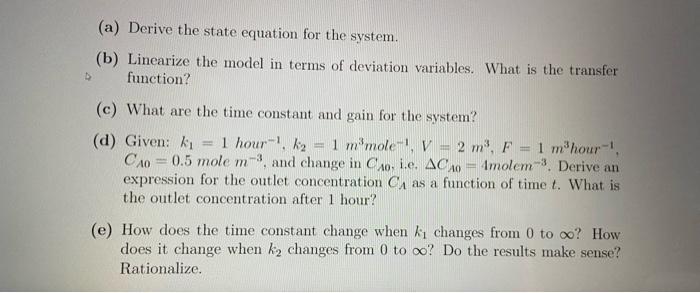
(a) Derive the state equation for the system.
(b) Linearize the model in terms of deviation variables. What is the transfer
function?
(c) What are the time constant and gain for the system?
(d) Given:
kip
= 1 hour
-1
ki2
11
mimole-t
V
2 m3 F
1 mhour-1
CAO
0.5 mole m
-3
and change in CA0, i.e. ACAO
Amolem
-3
. Derive an
expression for the outlet concentration CA as a function of time t. What is
the outlet concentration after 1 hour?
(e) How does the time constant change when k1 changes from O to o? How
does it change when k2 changes from 0 to co? Do the results make sense?
Rationalize.
 The dynamic response of a reactant concentration in the reactor, CA
to a step change in inlet concentration (C'A0) is to be evaluated

Question 3 (5 points) The dynamic response of a reactant concentration in the reactor, CA to a step change in inlet concentration (CA) is to be evaluated for an isothermal, constant- volume, constant density CSTR where only a single chemical reaction occurs. The reaction rate is modeled by the following rate equation. KICA -TA= 1 + KCA 2 (a) Derive the state equation for the system. (b) Linearize the model in terms of deviation variables. What is the transfer function? D (c) What are the time constant and gain for the system? (d) Given: k 1 hour 1 kg = 1 m mole-I, V = 2 m F = 1 m'hour- CA=0.5 mole m3. and change in Co. i.e. ACA = Imolem-3. Derive an expression for the outlet concentration C as a function of time t. What is the outlet concentration after 1 hour? m 9 (e) How does the time constant change when I changes from 0 to oc? How does it change when k2 changes from 0 to oo? Do the results make sense? Rationalize

Step by Step Solution

There are 3 Steps involved in it

1 Expert Approved Answer
Step: 1 Unlock blur-text-image
Question Has Been Solved by an Expert!

Get step-by-step solutions from verified subject matter experts

Step: 2 Unlock
Step: 3 Unlock

Students Have Also Explored These Related Chemical Engineering Questions!