







Question: The function y = (x) is transformed to y = f(x+2) +4. I If the point (2.-1) lies on the graph of y = f(x).
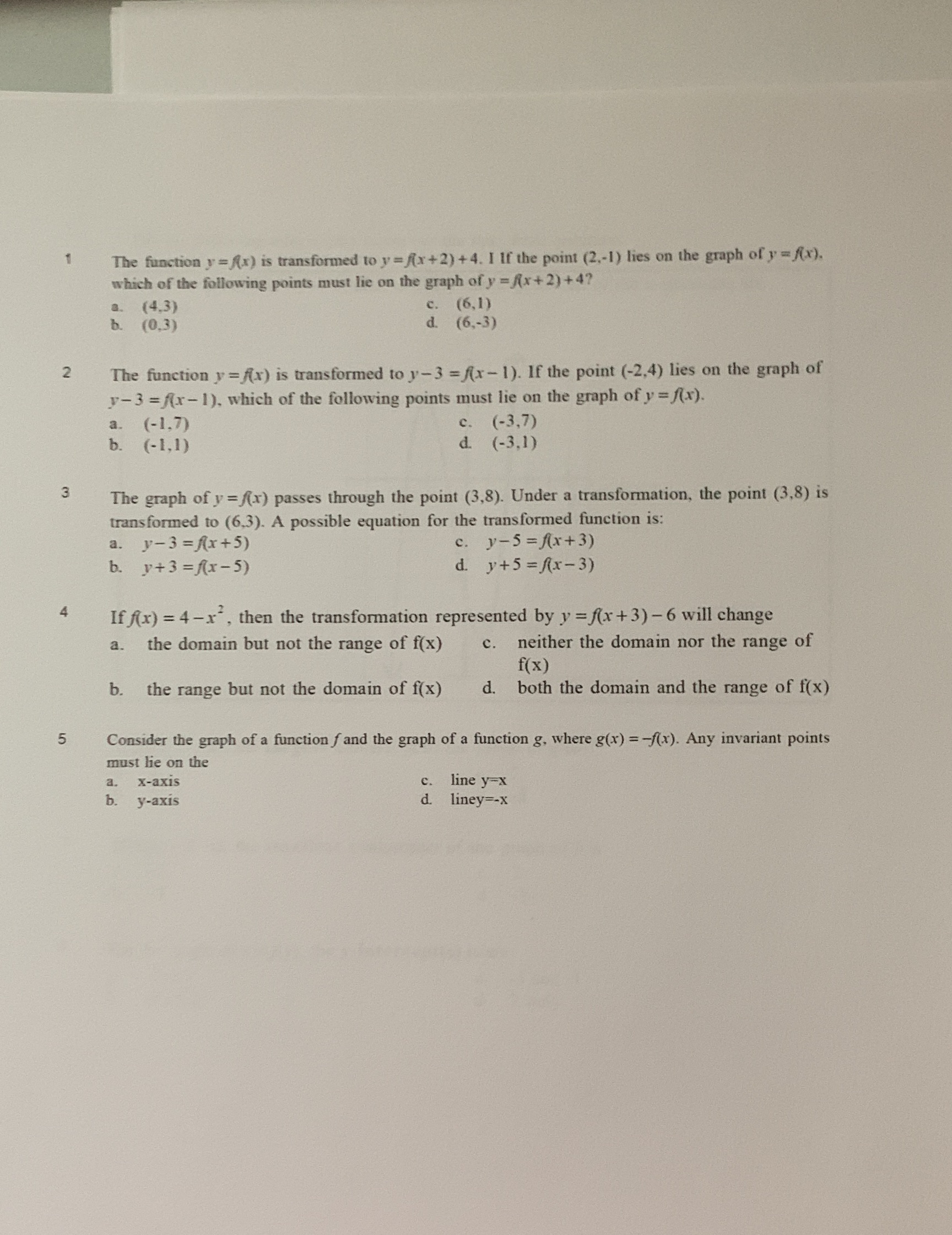
The function y = (x) is transformed to y = f(x+2) +4. I If the point (2.-1) lies on the graph of y = f(x). which of the following points must lie on the graph of y = f(x + 2) +4? a. (4.3) c. (6,1) b. (0.3) d. (6,-3) 2 The function y =f(x) is transformed to y-3 = f(x - 1). If the point (-2,4) lies on the graph of y-3 =A(x-1), which of the following points must lie on the graph of y = f(x). a. (-1,7) c. (-3,7) b. (-1,1) d. (-3,1) 3 The graph of y = f(x) passes through the point (3,8). Under a transformation, the point (3,8) is transformed to (6.3). A possible equation for the transformed function is: a. y- 3 =1(x+5) c. y- 5 = fx+3) b. y + 3 = 1(x-5) d. y+5 = fx-3) If f(x) = 4-x", then the transformation represented by y = f(x + 3) -6 will change a. the domain but not the range of f(x) c. neither the domain nor the range of f(x) b. the range but not the domain of f(x) d. both the domain and the range of f(x) 5 Consider the graph of a function f and the graph of a function g, where g(x) = -f(x). Any invariant points must lie on the a. x-axis C. line y=x b. y-axis d liney=-x
Step by Step Solution
There are 3 Steps involved in it

Get step-by-step solutions from verified subject matter experts
 Study Help