







Question: The In this problem we are dealing with keeping a tank with no oxygen in it before adding a liquid mixture. A way to do
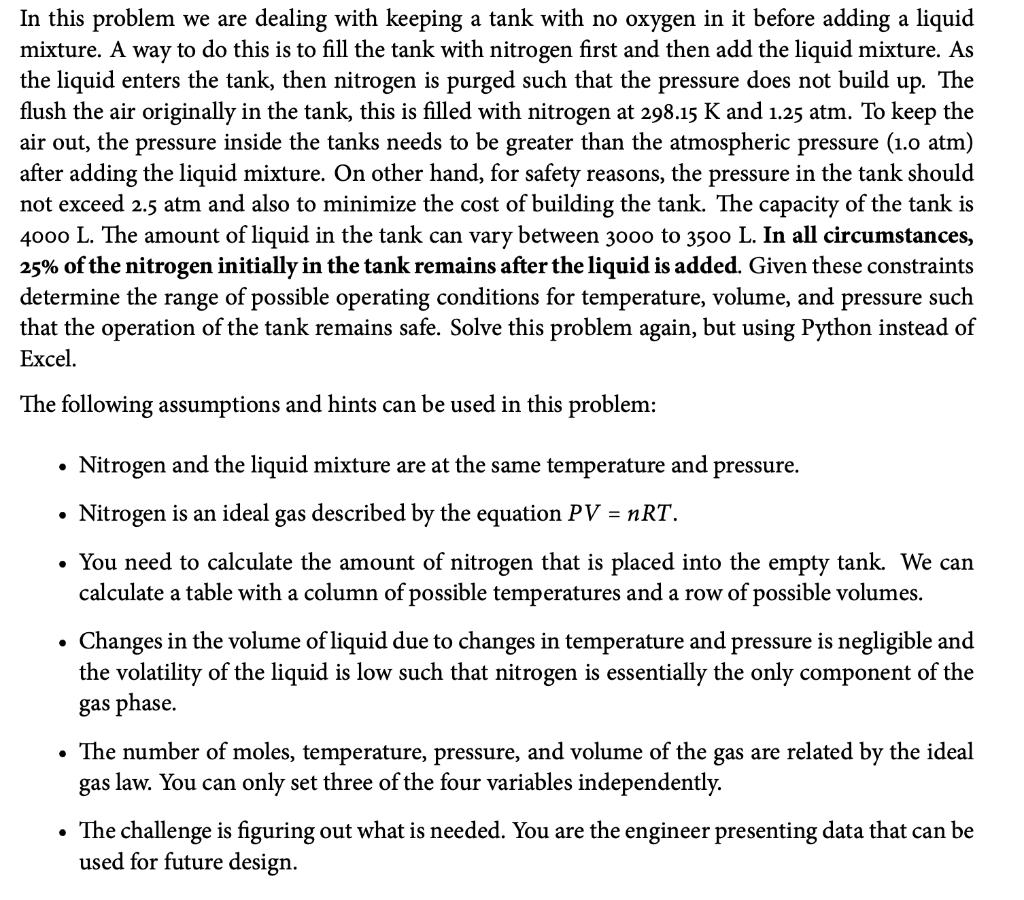
The In this problem we are dealing with keeping a tank with no oxygen in it before adding a liquid mixture. A way to do this is to fill the tank with nitrogen first and then add the liquid mixture. As the liquid enters the tank, then nitrogen is purged such that the pressure does not build up. flush the air originally in the tank, this is filled with nitrogen at 298.15 K and 1.25 atm. To keep the air out, the pressure inside the tanks needs to be greater than the atmospheric pressure (1.0 atm) after adding the liquid mixture. On other hand, for safety reasons, the pressure in the tank should not exceed 2.5 atm and also to minimize the cost of building the tank. The capacity of the tank is 4000 L. The amount of liquid in the tank can vary between 3000 to 3500 L. In all circumstances, 25% of the nitrogen initially in the tank remains after the liquid is added. Given these constraints determine the range of possible operating conditions for temperature, volume, and pressure such that the operation of the tank remains safe. Solve this problem again, but using Python instead of Excel. The following assumptions and hints can be used in this problem: Nitrogen and the liquid mixture are at the same temperature and pressure. Nitrogen is an ideal gas described by the equation PV = nRT. You need to calculate the amount of nitrogen that is placed into the empty tank. We can calculate a table with a column of possible temperatures and a row of possible volumes. Changes in the volume of liquid due to changes in temperature and pressure is negligible and the volatility of the liquid is low such that nitrogen is essentially the only component of the gas phase. . The number of moles, temperature, pressure, and volume of the gas are related by the ideal gas law. You can only set three of the four variables independently. The challenge is figuring out what is needed. You are the engineer presenting data that can be used for future design. The In this problem we are dealing with keeping a tank with no oxygen in it before adding a liquid mixture. A way to do this is to fill the tank with nitrogen first and then add the liquid mixture. As the liquid enters the tank, then nitrogen is purged such that the pressure does not build up. flush the air originally in the tank, this is filled with nitrogen at 298.15 K and 1.25 atm. To keep the air out, the pressure inside the tanks needs to be greater than the atmospheric pressure (1.0 atm) after adding the liquid mixture. On other hand, for safety reasons, the pressure in the tank should not exceed 2.5 atm and also to minimize the cost of building the tank. The capacity of the tank is 4000 L. The amount of liquid in the tank can vary between 3000 to 3500 L. In all circumstances, 25% of the nitrogen initially in the tank remains after the liquid is added. Given these constraints determine the range of possible operating conditions for temperature, volume, and pressure such that the operation of the tank remains safe. Solve this problem again, but using Python instead of Excel. The following assumptions and hints can be used in this problem: Nitrogen and the liquid mixture are at the same temperature and pressure. Nitrogen is an ideal gas described by the equation PV = nRT. You need to calculate the amount of nitrogen that is placed into the empty tank. We can calculate a table with a column of possible temperatures and a row of possible volumes. Changes in the volume of liquid due to changes in temperature and pressure is negligible and the volatility of the liquid is low such that nitrogen is essentially the only component of the gas phase. . The number of moles, temperature, pressure, and volume of the gas are related by the ideal gas law. You can only set three of the four variables independently. The challenge is figuring out what is needed. You are the engineer presenting data that can be used for future design
Step by Step Solution
There are 3 Steps involved in it

Get step-by-step solutions from verified subject matter experts
 Study Help