







Question: The question from 8 to 13. Please show the problem-solving process. Thank you very much. Jewelry manufacturing industries are mostly labor-intensive industries that need high
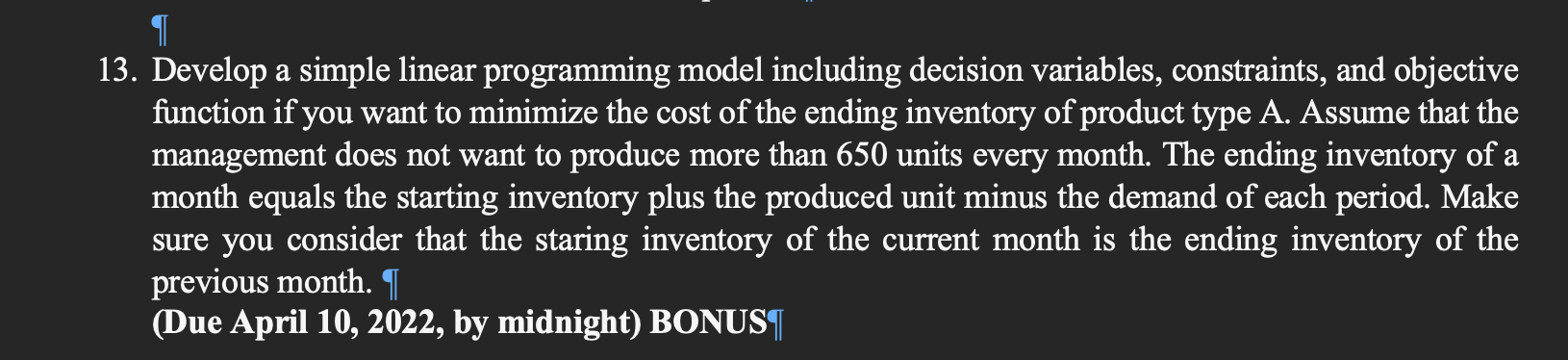
The question from 8 to 13. Please show the problem-solving process. Thank you very much.
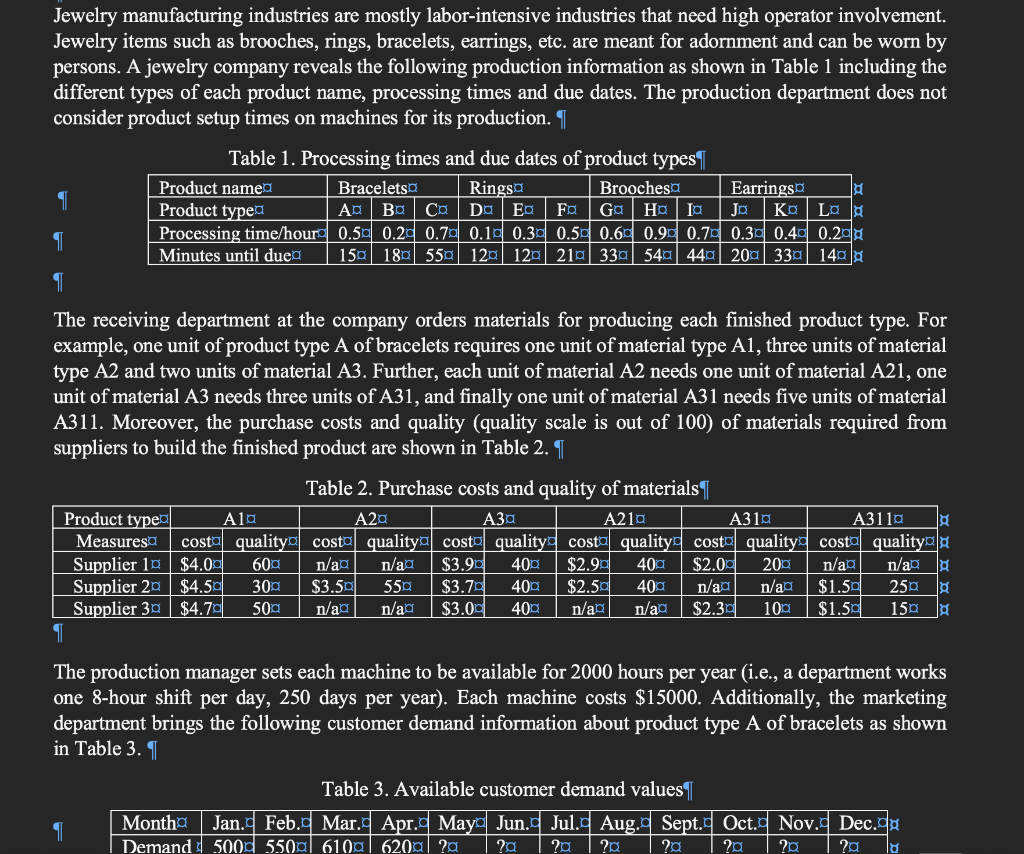
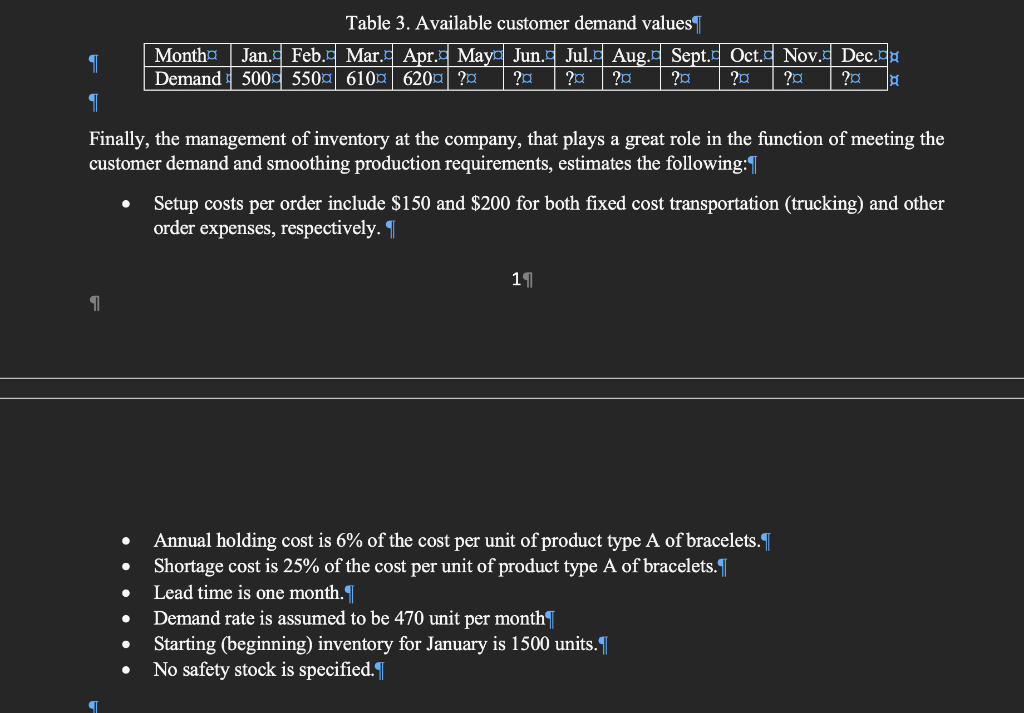
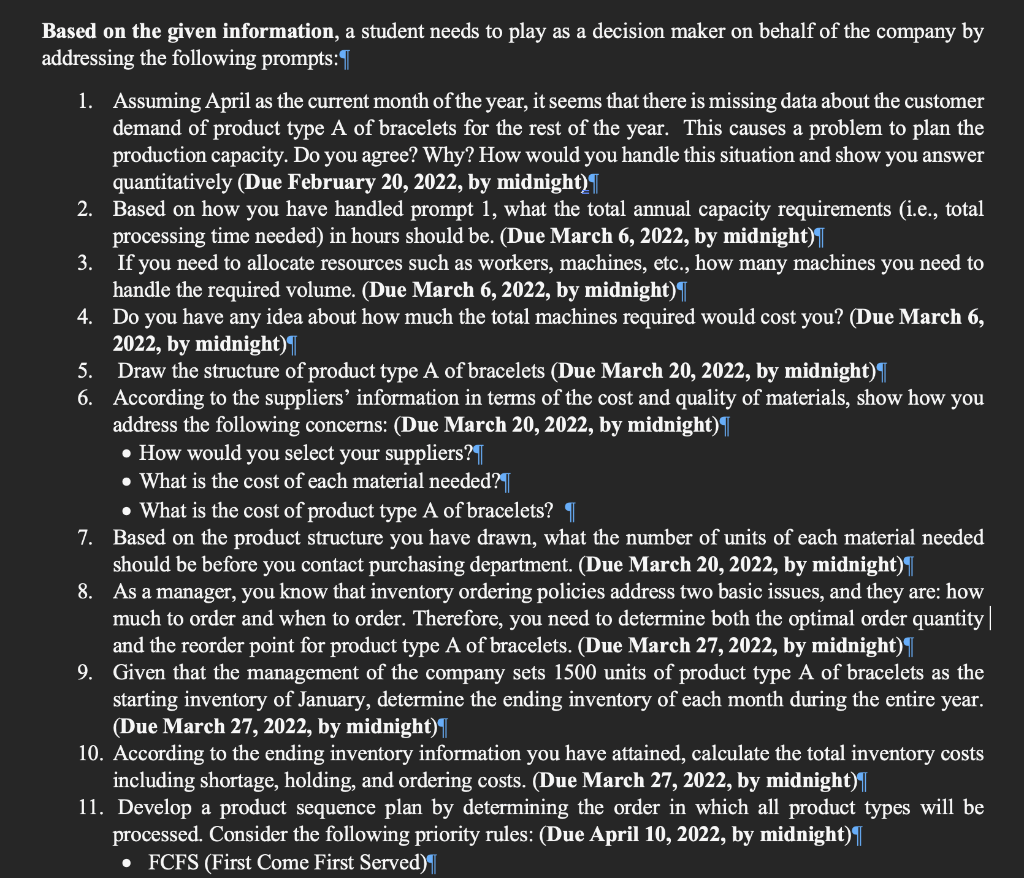
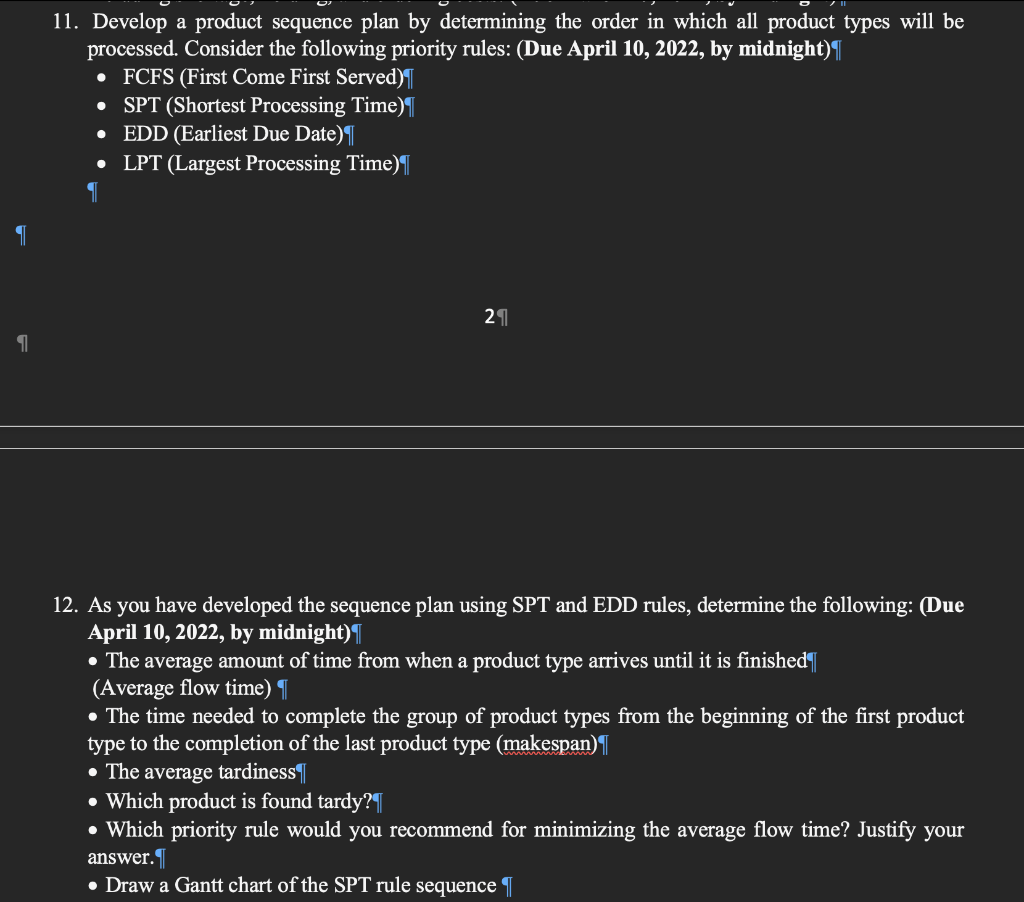
Jewelry manufacturing industries are mostly labor-intensive industries that need high operator involvement. Jewelry items such as brooches, rings, bracelets, earrings, etc. are meant for adornment and can be worn by persons. A jewelry company reveals the following production information as shown in Table 1 including the different types of each product name, processing times and due dates. The production department does not consider product setup times on machines for its production. I Table 1. Processing times and due dates of product types Product named Bracelets Ringsa Broochesa Earringsa Product types ADBO Co Da Ea Fo Go Hola Jo KOLO Processing time/houro 0.50 0.20 0.70 0.10 0.30 0.50 0.60 0.90 0.70 0.30 0.40 0.20g Minutes until due 150 180 550 120 120 210 330 540 440 200 33a 1400 18 The receiving department at the company orders materials for producing each finished product type. For example, one unit of product type A of bracelets requires one unit of material type A1, three units of material type A2 and two units of material A3. Further, each unit of material A2 needs one unit of material A21, one unit of material A3 needs three units of A31, and finally one unit of material A31 needs five units of material A311. Moreover, the purchase costs and quality (quality scale is out of 100) of materials required from suppliers to build the finished product are shown in Table 2. | Table 2. Purchase costs and quality of materials | Product type Ala A20 A3a A210 A310 A3110 Measures costo quality costo quality costo quality costo quality costo quality costo quality a Supplier 10 $4.00 600 n/a n/a $3.99 400 $2.90 $2.00 200 n/ao n/a Supplier 20 $4.50 300 $3.50 550 $3.78 400 $2.50 400 n/a n/a $1.50 250 Supplier 39 $4.70 500 n/a n/aa $3.00 400 n/a n/ap $2.39 100 $1.50 150 400 The production manager sets each machine to be available for 2000 hours per year (i.e., a department works one 8-hour shift per day, 250 days per year). Each machine costs $15000. Additionally, the marketing department brings the following customer demand information about product type A of bracelets as shown in Table 3.6. Table 3. Available customer demand values Month Jan. Feb. Mar. Apr. Mayo Jun. Jul. Aug. Sept. Oct. Nov. Dec.co Demand 5000 5500 6100 6200| ?a ?a ? ?a ?a ? ?g ?a 18 Table 3. Available customer demand values Montho Jan. Feb. Mar. Apr.. May Jun Jul Aug Sept. Oct. Nov. Dec.co Demand 5000 5500 6100 6200 ? ? ? ? ? ? ? ? Finally, the management of inventory at the company, that plays a great role in the function of meeting the customer demand and smoothing production requirements, estimates the following: Setup costs per order include $150 and $200 for both fixed cost transportation (trucking) and other order expenses, respectively. I 11 Annual holding cost is 6% of the cost per unit of product type A of bracelets. I Shortage cost is 25% of the cost per unit of product type A of bracelets. I Lead time is one month. I Demand rate is assumed to be 470 unit per month Starting (beginning) inventory for January is 1500 units. I No safety stock is specified. I . a Based on the given information, a student needs to play as a decision maker on behalf of the company by addressing the following prompts:| 1. Assuming April as the current month of the year, it seems that there is missing data about the customer demand of product type A of bracelets for the rest of the year. This causes a problem to plan the production capacity. Do you agree? Why? How would you handle this situation and show you answer quantitatively (Due February 20, 2022, by midnight) 2. Based on how you have handled prompt 1, what the total annual capacity requirements (i.e., total processing time needed) in hours should be. (Due March 6, 2022, by midnight) 3. If you need to allocate resources such as workers, machines, etc., how many machines you need to handle the required volume. (Due March 6, 2022, by midnight) 4. Do you have any idea about how much the total machines required would cost you? (Due March 6, 2022, by midnight) 5. Draw the structure of product type A of bracelets (Due March 20, 2022, by midnight)T 6. According to the suppliers' information in terms of the cost and quality of materials, show how you address the following concerns: (Due March 20, 2022, by midnight) How would you select your suppliers?| What is the cost of each material needed? What is the cost of product type A of bracelets? | 7. Based on the product structure you have drawn, what the number of units of each material needed should be before you contact purchasing department. (Due March 20, 2022, by midnight)T 8. As a manager, you know that inventory ordering policies address two basic issues, and they are: how much to order and when to order. Therefore, you need to determine both the optimal order quantity| and the reorder point for product type A of bracelets. (Due March 27, 2022, by midnight)T 9. Given that the management of the company sets 1500 units of product type A of bracelets as the starting inventory of January, determine the ending inventory of each month during the entire year. (Due March 27, 2022, by midnight) 10. According to the ending inventory information you have attained, calculate the total inventory costs including shortage, holding, and ordering costs. (Due March 27, 2022, by midnight)| 11. Develop a product sequence plan by determining the order in which all product types will be processed. Consider the following priority rules: (Due April 10, 2022, by midnight) [ FCFS (First Come First Served) 11. Develop a product sequence plan by determining the order in which all product types will be processed. Consider the following priority rules: (Due April 10, 2022, by midnight)| FCFS (First Come First Served) SPT (Shortest Processing Time) EDD (Earliest Due Date) LPT (Largest Processing Time) 21 12. As you have developed the sequence plan using SPT and EDD rules, determine the following: (Due April 10, 2022, by midnight) The average amount of time from when a product type arrives until it is finishedT (Average flow time) The time needed to complete the group of product types from the beginning of the first product type to the completion of the last product type (makespan) The average tardiness Which product is found tardy?I Which priority rule would you recommend for minimizing the average flow time? Justify your answer. Draw a Gantt chart of the SPT rule sequence 13. Develop a simple linear programming model including decision variables, constraints, and objective function if you want to minimize the cost of the ending inventory of product type A. Assume that the management does not want to produce more than 650 units every month. The ending inventory of a month equals the starting inventory plus the produced unit minus the demand of each period. Make sure you consider that the staring inventory of the current month is the ending inventory of the previous month. I (Due April 10, 2022, by midnight) BONUSTStep by Step Solution
There are 3 Steps involved in it
1 Expert Approved Answer
Step: 1 Unlock

Question Has Been Solved by an Expert!
Get step-by-step solutions from verified subject matter experts
Step: 2 Unlock
Step: 3 Unlock
 Study Help