







Question: The Work Breakdown Structure IT Acquisition Template 5 (the assignment topic is for a Church) Nature of This Template This template does not provide a
The Work Breakdown Structure
IT Acquisition Template 5
(the assignment topic is for a Church)
Nature of This Template
This template does not provide a standard form to be filled in. Instead, it provides guidance for the use of a standard approach for preparing work breakdown structures. A work breakdown structure (WBS) depicts the full scope of the project, including its phases and tasks. Since the great majority of projects are unique, there is no one-size-fits-all WBS template that can be used. However, the same general approach can be used to WBS for any proposed solution. The material below describes how to WBS and how to follow established standards for labeling its various parts.
A WBS is prepared for the two or three best alternative solutions. They will depict the scope and expected cost of each alternative. A WBS breaks the work down into tasks or work packages (the terms have the same meaning; we will refer to them as tasks). These tasks must be analyzed to determine the resources that will be required to successfully perform them. In preparing a WBS, it is very important to obtain good estimates of labor hours, labor costs, and the cost of other resources for the tasks in each phase. This makes it possible to make an informed estimate of the probable cost of a proposed solution. The cost information also serves as inputs into the Template 7 economic analysis software. The economic analysis enables the IPT to compare the two or three best alternative solutions from a financial standpoint.
The initial WBSes--in this case, one for each of the final alternative solutions--will be subject to detailed evaluation and critique by the integrated project team (IPT) members, with representatives from the business and technical areas affected by the project. The team will examine such things as:
- Accuracy of the WBS in depicting the solution
- Suitability and logic of the work breakdown
- Possible duplicate or overlapping tasks
- Omission of a needed task
- Unavailability of a critical resource
- Possible misuse of resources, resource conflicts, and other resource problems
- Task cost elements and total solution cost
This detailed examination generally results in revisions and improvements in the WBSes until each is believed to accurately and effectively encompass the complete proposed solution, its tasks, and the resources required. Although this examination will identify risks and a WBS may be modified because of this, each WBS will be subjected to a formal risk analysis in Template 6. A financial comparison will then be performed using the economic analysis worksheets provided in Template 7. The results of the economic analysis serve as inputs to a "comparative analysis" (Template 8) to determine which of the final alternatives is the best solution to the problem.
It is the WBS for the best solution, along with its supporting documentation, that becomes a major source of information for the preparation of the Gantt chart, which is a detailed project schedule that shows staffing and other resource usage over the life of the project.
There is a standard method of numerically coding the WBS boxes (phases, tasks, etc.) and these are the same codes that will be used to identify the phases and other parts of the WBS in the Gantt chart (project schedule) prepared with Microsoft Project. Microsoft Project actually assigns the WBS numeric codes in the Gantt chart when the WBS information is entered properly (how to is explained in instructrions provided by Microsoft Corp.). Having the same codes in the WBS and the Gantt chart enable ongoing coordination between the phases and tasks shown in the project management software and the phases and tasks shown in the related WBS. A change in one requires a change in the other.
Creating a Work Breakdown Structure (WBS)
A WBS is prepared for the two or three best candidate solutions to the problem. The process of preparing the WBS forces the integrated project team (IPT) to take a close look at each alternative solution because it must define all of the tasks required for its implementation and estimate the labor and resources costs of each task. As the WBS is being prepared, it will often reveal risks that need to be avoided or otherwise mitigated. For example, it may be found that the project costs more than would be acceptable to management, that it requires skill that is likely to be unavailable, that it assumes data required from others will be accurate when in fact the data are neither, that certain tasks overlap, and so on. If the alternative solution is to proceed to the next step, the risks identified need to be avoided, transferred, worked around, mitigated through various strategies, or in some cases simply accepted because they will have a low impact if they occur. This information developed in preparing the WBSes make it possible to later compare and evaluate (in Template 8) the costs, benefits, and risks associated with each alternative solution.
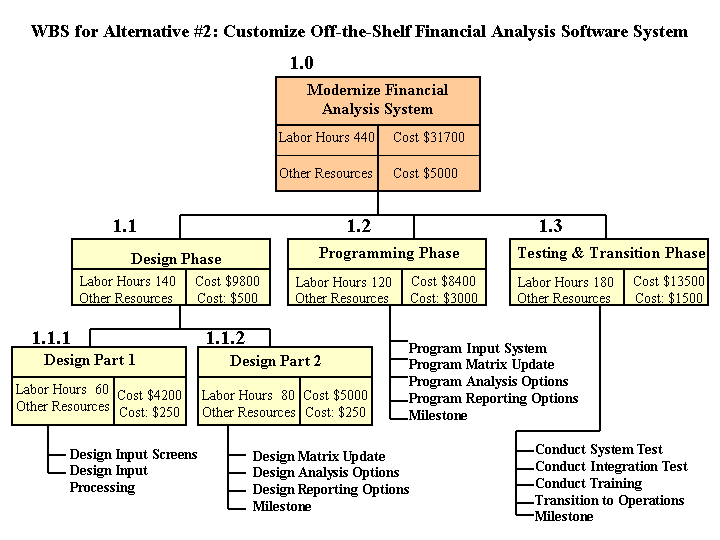
A WBS takes the form of a tree structure, as shown in the graphic below, Figure 5.1. Notice that the alternative solution to which the WBS applies is stated above the WBS. At the very top of the WBS structure is the name of the project (or possible project), over the box labeled "1.0." The objective now is to break the project down into smaller and smaller parts until the parts are equivalent to tasks that can be assigned to individuals or teams. This is referred to as "decomposition" of the work. Each task must be capable of being performed independent of other tasks, though it may require inputs from other tasks and provide outputs to other tasks.
Planners need to know how far down the decomposition process must go to reach the "task" level. A rule of thumb is that a task should take three to ten work days to perform by a single person. (There can be exceptions to this rule in certain cases.) Since the WBS represents work to be performed principally by the selected IT services contractor, the buyer organization needs to have or to obtain information about likely contractor staff costs. These prevailing staff costs must be taken into account in estimating the costs of performing each task. Also, the likely qualifications and skill of the person that may be assigned the task needs to be taken into account. It would be a mistake to estimate task completion times based on outstanding rather than average performers.
In Figure 5.1, we see a relatively simple WBS for a small project. The first breakdown of the project is into three phases, which are given names as well as identified with the WBS numerical codes of 1.1, 1.2, and 1.3. Then each of these phases is broken down to the next lower level. For phase 1.1, a further breakdown is necessary before the work is at a task level. For phases 1.2 and 1.3, the next breakdown is at the task level.
In a large project, the tree structure can be rather complex. A WBS for most small projects would be more along the lines of the example in Figure 5.1. Note that the tasks are listed under each phase, with a milestone indicating the end of each phase. It is an established standard that each task name begin with an action verb.
Step by Step Solution
There are 3 Steps involved in it

Get step-by-step solutions from verified subject matter experts
 Study Help