







Question: (this a whole case study you should read and answer the two questions mentioned in the first page .) You should explain and prhaprhase and
(this a whole case study you should read and answer the two questions mentioned in the first page .)
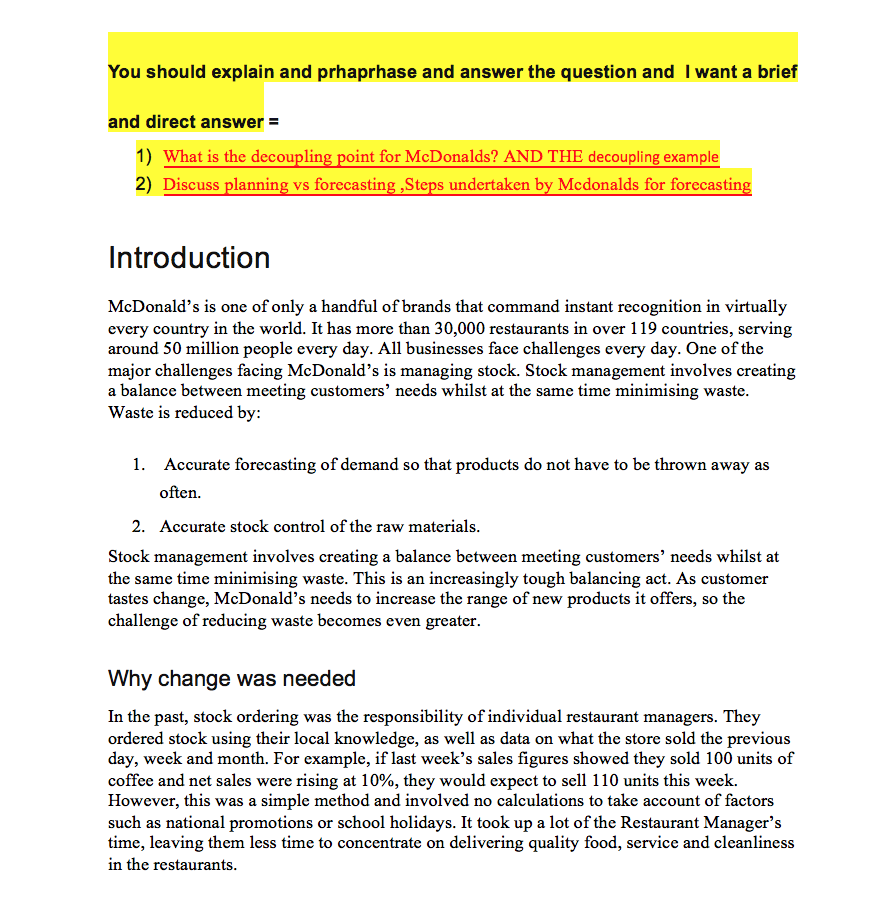
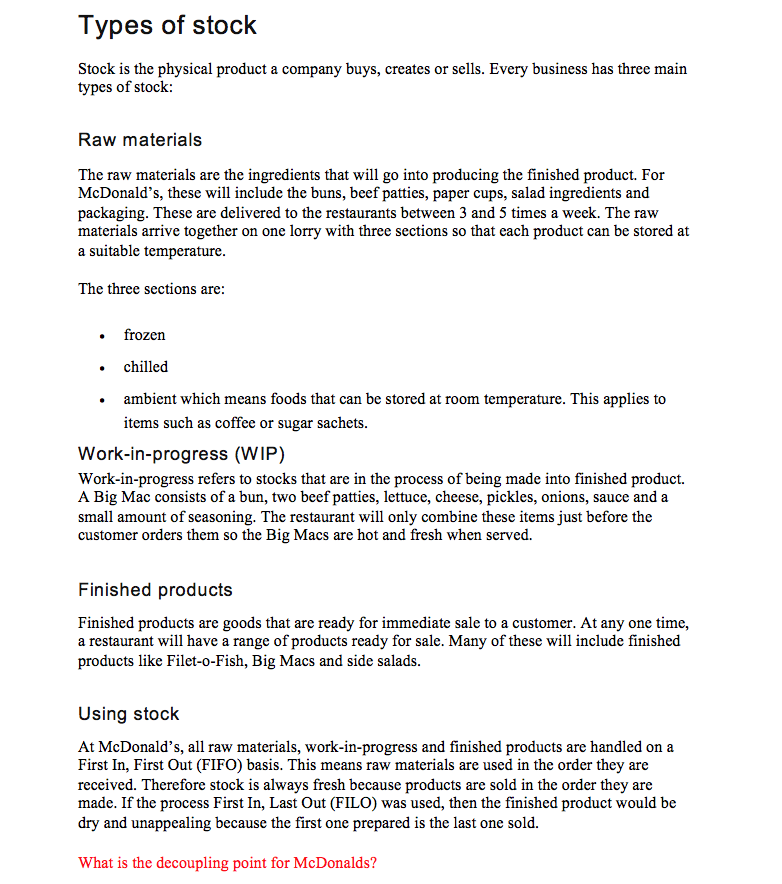
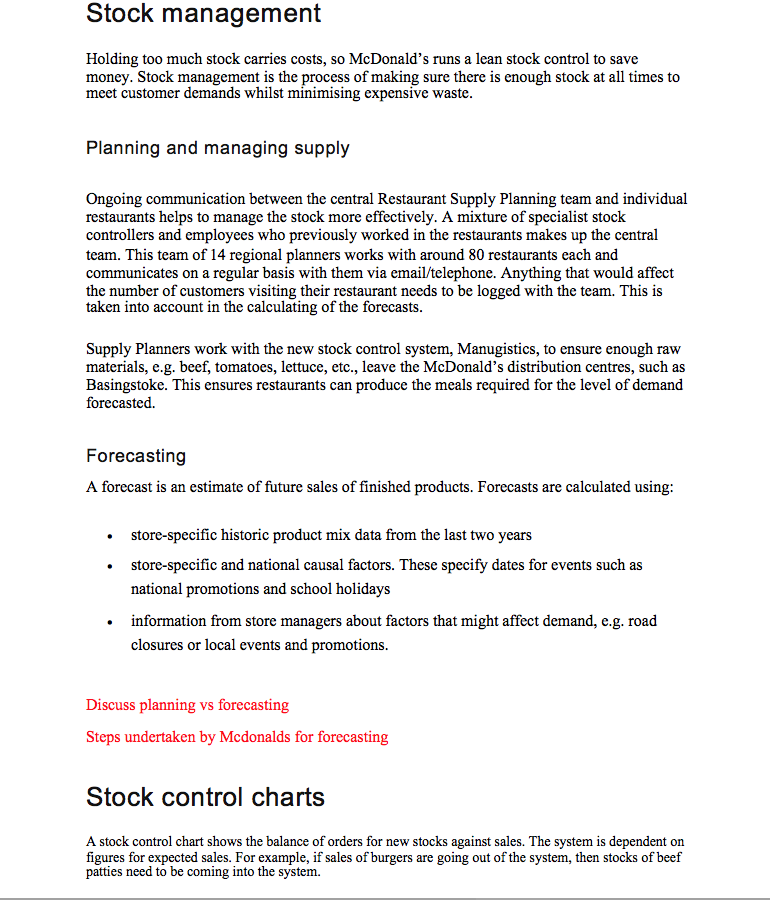
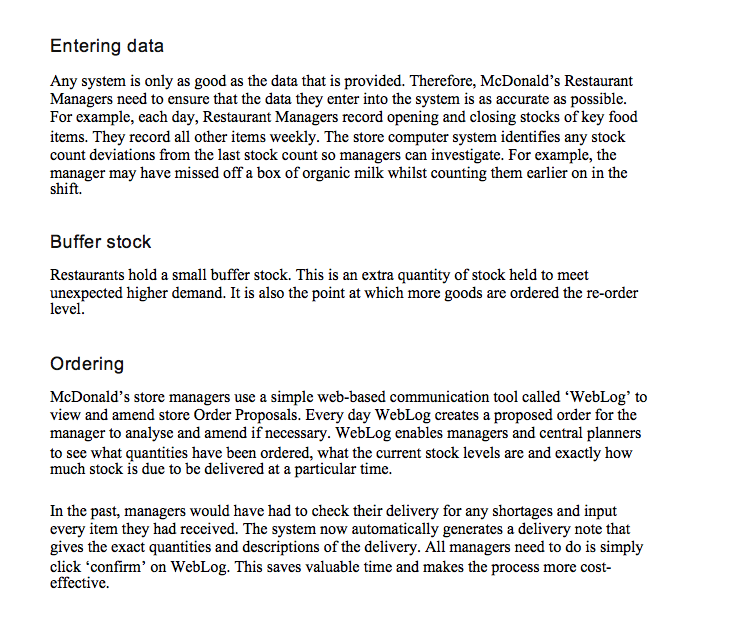
You should explain and prhaprhase and answer the question and I want a brief and direct answer = 1) What is the decoupling point for McDonalds? AND THE decoupling example 2) Discuss planning vs forecasting Steps undertaken by Mcdonalds for forecasting Introduction McDonald's is one of only a handful of brands that command instant recognition in virtually every country in the world. It has more than 30,000 restaurants in over 119 countries, serving around 50 million people every day. All businesses face challenges every day. One of the major challenges facing McDonald's is managing stock. Stock management involves creating a balance between meeting customers' needs whilst at the same time minimising waste. Waste is reduced by: 1. Accurate forecasting of demand so that products do not have to be thrown away as often. 2. Accurate stock control of the raw materials. Stock management involves creating a balance between meeting customers' needs whilst at the same time minimising waste. This is an increasingly tough balancing act. As customer tastes change, McDonald's needs to increase the range of new products it offers, so the challenge of reducing waste becomes even greater. Why change was needed In the past, stock ordering was the responsibility of individual restaurant managers. They ordered stock using their local knowledge, as well as data on what the store sold the previous day, week and month. For example, if last week's sales figures showed they sold 100 units of coffee and net sales were rising at 10%, they would expect to sell 110 units this week. However, this was a simple method and involved no calculations to take account of factors such as national promotions or school holidays. It took up a lot of the Restaurant Manager's time, leaving them less time to concentrate on delivering quality food, service and cleanliness in the restaurants. The new system In 2004, McDonald's introduced a specialist central stock management function known as the Restaurant Supply Planning Department. This team communicates with restaurant managers on a regular basis to find out local events. The team builds these factors into the new planning and forecasting system (called Manugistics) to forecast likely demand of finished menu items (e.g.Big Macs). This case study looks at how McDonald's manages its stock through its management systems and what benefits this brings. Types of stock Stock is the physical product a company buys, creates or sells. Every business has three main types of stock: Raw materials The raw materials are the ingredients that will go into producing the finished product. For McDonald's, these will include the buns, beef patties, paper cups, salad ingredients and packaging. These are delivered to the restaurants between 3 and 5 times a week. The raw materials arrive together on one lorry with three sections so that each product can be stored at a suitable temperature. The three sections are: frozen chilled ambient which means foods that can be stored at room temperature. This applies to items such as coffee or sugar sachets. Work-in-progress (WIP) Work-in-progress refers to stocks that are in the process of being made into finished product. A Big Mac consists of a bun, two beef patties, lettuce, cheese, pickles, onions, sauce and a small amount of seasoning. The restaurant will only combine these items just before the customer orders them so the Big Macs are hot and fresh when served. Finished products Finished products are goods that are ready for immediate sale to a customer. At any one time, a restaurant will have a range of products ready for sale. Many of these will include finished products like Filet-o-Fish, Big Macs and side salads. Using stock At McDonald's, all raw materials, work-in-progress and finished products are handled on a First In, First Out (FIFO) basis. This means raw materials are used in the order they are received. Therefore stock is always fresh because products are sold in the order they are made. If the process First In, Last Out (FILO) was used, then the finished product would be dry and unappealing because the first one prepared is the last one sold. What is the decoupling point for McDonalds? Stock management Holding too much stock carries costs, so McDonald's runs a lean stock control to save money. Stock management is the process of making sure there is enough stock at all times to meet customer demands whilst minimising expensive waste. Planning and managing supply Ongoing communication between the central Restaurant Supply Planning team and individual restaurants helps to manage the stock more effectively. A mixture of specialist stock controllers and employees who previously worked in the restaurants makes up the central team. This team of 14 regional planners works with around 80 restaurants each and communicates on a regular basis with them via email/telephone. Anything that would affect the number of customers visiting their restaurant needs to be logged with the team. This is taken into account in the calculating of the forecasts. Supply Planners work with the new stock control system, Manugistics, to ensure enough raw materials, e.g. beef, tomatoes, lettuce, etc., leave the McDonald's distribution centres, such as Basingstoke. This ensures restaurants can produce the meals required for the level of demand forecasted. Forecasting A forecast is an estimate of future sales of finished products. Forecasts are calculated using: store-specific historic product mix data from the last two years store-specific and national causal factors. These specify dates for events such as national promotions and school holidays information from store managers about factors that might affect demand, e.g. road closures or local events and promotions. Discuss planning vs forecasting Steps undertaken by Mcdonalds for forecasting Stock control charts A stock control chart shows the balance of orders for new stocks against sales. The system is dependent on figures for expected sales. For example, if sales of burgers are going out of the system, then stocks of beef patties need to be coming into the system. Entering data Any system is only as good as the data that is provided. Therefore, McDonald's Restaurant Managers need to ensure that the data they enter into the system is as accurate as possible. For example, each day, Restaurant Managers record opening and closing stocks of key food items. They record all other items weekly. The store computer system identifies any stock count deviations from the last stock count so managers can investigate. For example, the manager may have missed off a box of organic milk whilst counting them earlier on in the shift. Buffer stock Restaurants hold a small buffer stock. This is an extra quantity of stock held to meet unexpected higher demand. It is also the point at which more goods are ordered the re-order level. Ordering McDonald's store managers use a simple web-based communication tool called 'WebLog to view and amend store Order Proposals. Every day WebLog creates a proposed order for the manager to analyse and amend if necessary. WebLog enables managers and central planners to see what quantities have been ordered, what the current stock levels are and exactly how much stock is due to be delivered at a particular time. In the past, managers would have had to check their delivery for any shortages and input every item they had received. The system now automatically generates a delivery note that gives the exact quantities and descriptions of the delivery. All managers need to do is simply click 'confirm' on WebLog. This saves valuable time and makes the process more cost- effective
Step by Step Solution
There are 3 Steps involved in it
1 Expert Approved Answer
Step: 1 Unlock

Question Has Been Solved by an Expert!
Get step-by-step solutions from verified subject matter experts
Step: 2 Unlock
Step: 3 Unlock
 Study Help