Question: This exercise should be broken down into 4 categories and then site examples from the MIT project 1) Management process - 2) Problem solving and
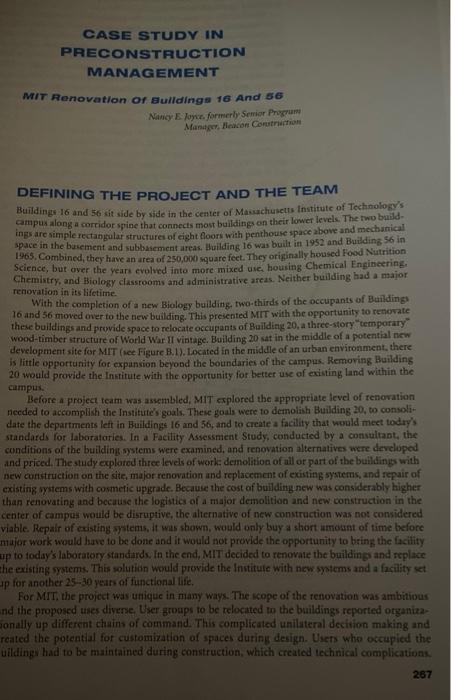
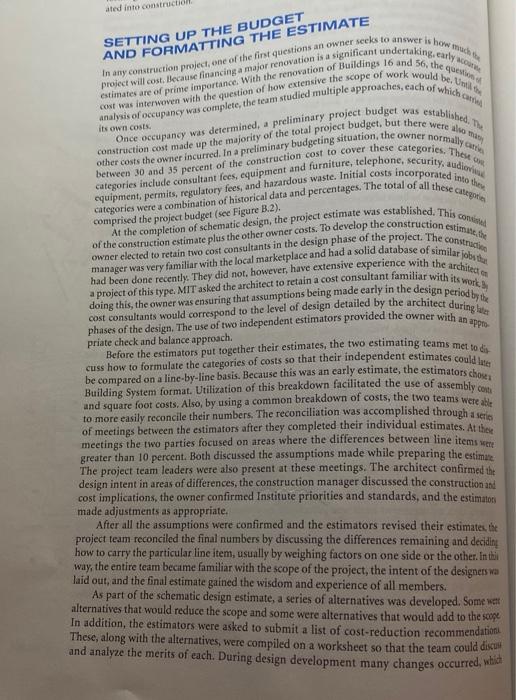
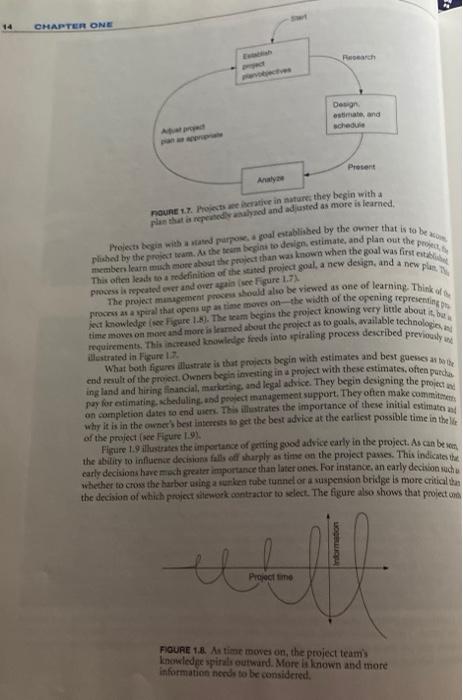
This exercise should be broken down into 4 categories and then site examples from the MIT project 1) Management process - 2) Problem solving and alternative solutions 3) Develop a detailed plan 4) Implement the plan and control the project How did the MIT Project team handle each of these topics & include examples 3. Reading the case study of the MIT 16/56 project in Appendix B, compare the work of the MIT project team with the Project Team section in this chapter, citing exam- ples in the case study that correspond to the description of the role of the project team in the textbook. CASE STUDY IN PRECONSTRUCTION MANAGEMENT MIT Renovation of Buildings 16 And 56 Nancy Joy.formerly Senior Program Manager, Beacon Construction DEFINING THE PROJECT AND THE TEAM Building 16 and 56 sit side by side in the center of Massachusetts Institute of Technology's ampus along a corridor spine that connects most building on their lower levels. The two build ings are simple rectangular structures of eight floors with penthouse space above and mechanical space in the basement and subbasement areas. Building 16 was built in 1952 and Building 56 in 1965. Combined, they have an area of 250,000 square feet. The originally housed Food Nutrition Science, but over the years evolved into more mixed use, housing Chemical Engineering, Chemistry, and Biology classrooms and administrative areas. Neither building had a major renovation in its lifetime. With the completion of a new Biology building, two-thirds of the occupants of Building 16 and 56 moved over to the new building. This presented MIT with the opportunity to renovate these buildings and provide space to relocate occupants of Building 20. a three-story-temporary wood-timber structure of World War II vintage. Building 20 sat in the middle of a potential new development site for MIT (see Figure B.1). Located in the middle of an urban environment, there is little opportunity for expansion beyond the boundaries of the campus. Removing Building 20 would provide the Institute with the opportunity for better use of existing land within the campus. Before a project team was assembled, MIT explored the appropriate level of renovation needed to accomplish the Institute's goals. These goals were to demolish Building 20. to consoli- date the departments left in Buildings 16 and 56, and to create a facility that would meet today's standards for laboratories. In a Facility Assessment Study, conducted by a consultant, the conditions of the building systems were examined, and renovation alternatives were developed and priced. The study explored three levels of work: demolition of all or part of the buildings with new construction on the site, major renovation and replacement of existing systems, and repair of existing systems with cosmetic upgrade. Because the cost of building new was considerably higher than renovating and because the logistics of a major demolition and new construction in the center of campus would be disruptive, the alternative of new construction was not considered viable. Repair of existing systems. It was shown, would only buy a short amount of time before mujor work would have to be done and it would not provide the opportunity to bring the facility up to today's laboratory standards. In the end, MIT decided to renovate the buildings and replace the existing systems. This solution would provide the Institute with new systems and a facility set ap for another 25-30 years of functional life, For MIT, the project was unique in many ways. The scope of the renovation was ambitious nd the proposed uses diverse User groups to be relocated to the buildings reported organiza- sonally up different chains of command. This complicated unilateral decision making and reated the potential for customization of spaces during design. Users who occupied the uilding had to be maintained during construction, which created technical complications 267 ated into construc SETTING UP THE BUDGET AND FORMATTING THE ESTIMATE project will cost. Because financing a major renovation is a significant undertaking carly co In any construction project, one of the first questions an owner seeks to answer is how to cost was interwoven with the question of how extensive the scope of work would be. U estimates are of prime importance. With the renovation of Buildings 16 and 56, the ques analysis of occupancy was complete the team studied multiple approaches, each of which its own costs. Once occupancy was determined, a preliminary project budget was established. The construction cost made up the majority of the total project budget, but there were between 30 and 35 percent of the construction cost to cover these categories. The other costs the owner incurred. In a preliminary budgeting situation, the owner normally categories include consultant fees, equipment and furniture, telephone, security, audier incorporated into the categories were a combination of historical data and percentages. The total of all these of the construction estimate plus the other owner costs. To develop the construction estimat, the At the completion of schematic design, the project estimate was established. This com manager was very familiar with the local marketplace and had a solid database of similar dostu owner elected to retain two cost consultants in the design phase of the project. The constrain a project of this type. MIT asked the architect to retain a cost consultant familiar with its work, had been done recently. They did not, however, have extensive experience with the architecten doing this, the owner was ensuring that assumptions being made early in the design period by the phases of the design. The use of two independent estimators provided the owner with an appro cost consultants would correspond to the level of design detailed by the architect during priate check and balance approach. Categories equipment, permits, regulatory fees, and hazardous waste. Initial costs comprised the project budget (see Figure 3.2). Before the estimators put together their estimates, the two estimating teams met so di be compared on a line-by-line basis. Because this was an early estimate the estimators chords cuss how to formulate the categories of costs so that their independent estimates could bare Building System format. Utilization of this breakdown facilitated the use of assembly com and square foot costs. Also, by using a common breakdown of costs, the two teams were able to more easily reconcile their numbers. The reconciliation was accomplished through a series of meetings between the estimators after they completed their individual estimates. At the meetings the two parties focused on areas where the differences between line items were greater than 10 percent. Both discussed the assumptions made while preparing the estimate The project team leaders were also present at these meetings. The architect confirmed the design intent in areas of differences, the construction manager discussed the construction and cost implications, the owner confirmed Institute priorities and standards, and the estimator made adjustments as appropriate. After all the assumptions were confirmed and the estimators revised their estimates, the project team reconciled the final numbers by discussing the differences remaining and deciding how to carry the particular line item, usually by weighing factors on one side or the other. In this way, the entire team became familiar with the scope of the project, the intent of the designers wa laid out, and the final estimate gained the wisdom and experience of all members. As part of the schematic design estimate, a series of alternatives was developed. Some wet alternatives that would reduce the scope and some were alternatives that would add to the scope In addition, the estimators were asked to submit a list of cost-reduction recommendation These, along with the alternatives were compiled on a worksheet so that the team could discus and analyze the merits of each. During design development many changes occurred, which THE CONSTRUCTION PROJECT A project is defined, whether it is in construction or not, by the following characteristics: 1. A defined goal or objective 2. Specific tasks not routinely performed 3. A defined beginning and end 4. Defined deliverables 5. Resources being consumed The goal of a construction project is simpleit is to build something. What differentiates the construction industry from other industries is that its projects are large, built on-site (the fac- tory is brought to the job site), and generally unique. There's only one Golden Gate Bridge, Sears Tower, and Alaskan pipeline. Every project can be clearly broken down into a series of logical, definable steps that become the road map for the project. The project team starts at the beginning of the list, and when it reaches the end the project is over. Projects are characterized as having a single starting and ending point with all the work in the middle. The uniqueness of each project characterizes the high-risk nature of project management. Because projects are generally one-time ventures, a bad road map can lead the team in the wrong direction, wasting time and money. Project starts and finishes are negotiable and totally dependent on the work that the owner decides to do and the money available. The defined deliverables are what the owner establishes as the program and what is fur- ther clarified in the contract documents by the design professional. A certain quantity of work will be completed according to certain specifications within a certain time frame. It is impera- tive that the project team clearly delineate the desired performance and think about how this performance will be measured and controlled. Construction projects consume tremendous quantities of resources, all of which are paid for by the owner. Time, money, labor, equipment, and materials are examples of the kinds of resources that are managed and controlled by the project team. Efficiently managed projects minimize, balance, and forecast resource consumption for the owner. 5 14 CHAPTER ONE Fearch Design estimate and schedule Present A POUR 1.2. Projects we have in nature they begin with pan that repeated sed and adjusted as more is learned, process is repeated over and over again (see Figure 171 Projects begin with and propoal established by the owner that is to be som ped by the project team. As the team begin to design, estimate and plan out the pote members learnisch more about the project than was known when the goal was first extil This often lead to a redefinition of the project goal, a new design, and a new path The project management proces should also be viewed as one of learning. Think in knowledge to gure 1.89. The team begins the project knowing very little about it Produs apera that opens up at moves on the width of the opening representing requirements. This increased nowine fonds into spiraling process described previously time moves on more and more is learned about the project as to goals, available technologies illustrated in Figure 1.7 What both figurlustrate is that project begin with estimates and best guess end result of the project Owners begin investing in a project with these estimates, often pada ing land and hiring financial marketing and legal advice. They begin designing the project in pay for otimating scheduling and project management support. They often make committe on completion dates to end users. This illustrates the importance of these initial estimates a why it is in the owner's best intereses to get the best advice at the earliest possible time in the of the project (see Figure 19) Figure 1.9 illustrates the importance of petting good advice early in the project. As can be seen the ability to influence decisions falls ed sharply as time on the project passes. This indicates the early decisions have much greater importance that later ones. For instance, an early decision suchu whether to cross the harbor using a sonken tube tunnel or a suspension bridge is more critical the the decision of which project sitework contractor to dect. The figure also shows that project on Mormon el Project time FIGURE 1.8. As time moves on the project teams knowledge spirals outward. More is known and more information needs to be considered









 Study Help