







Question: This is a computational physics question. It must be done on Python 3.5. Here are the questions and answers I have for part 1 and
This is a computational physics question. It must be done on Python 3.5.
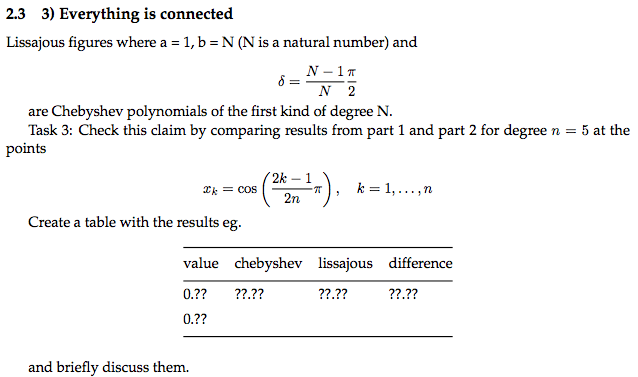
Here are the questions and answers I have for part 1 and part 2:
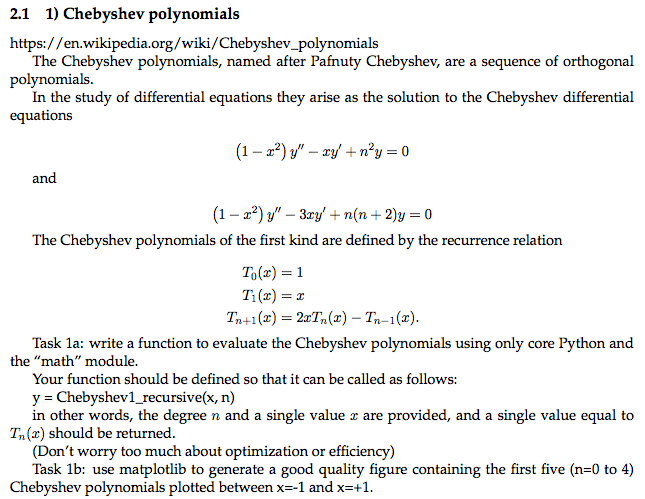
def Chebyshev1_recursive(x,n): if n == 0: return 1 elif n == 1: return x else: return 2*x*(Chebyshev1_recursive(x, n-1))-Chebyshev1_recursive(x,(n-2))
import matplotlib.pyplot as plt %matplotlib inline xlist = [] for x in range(-100,102,2): xlist.append(x/100)
for n in range(0,5): ylist = [] for x in range(0,101): ylist.append(Chebyshev1_recursive(xlist[x],n))
plt.plot(xlist, ylist,'-')
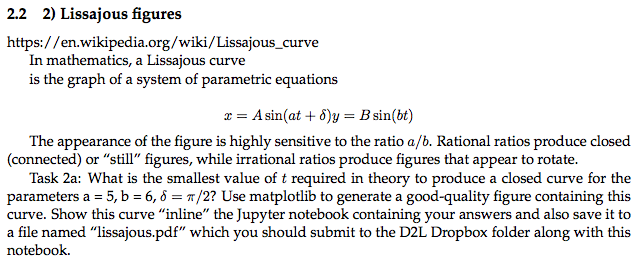
from numpy import sin,pi,linspace from pylab import plot,show,subplot
a = [1,3,5,3] # plotting the curves for b = [1,5,7,4] # different values of a/b delta = pi/2 t = linspace(-pi,pi,300)
for i in range(0,4): x = sin(a[i] * t + delta) y = sin(b[i] * t) subplot(2,2,i+1) plot(x,y)
show()
2.3 3) Everything is connected Lissajous figures where a 1, b N (N is a natural number) and N 2 are Chebyshev polynomials of the first kind of degree N Task 3: Check this claim by comparing results from part 1 and part 2 for degree n 5 at the points 2k -1 2n 1,..., n cos Create a table with the results eg. value chebyshev lissajous difference 0.?? 0.?? and briefly discuss them
Step by Step Solution
There are 3 Steps involved in it

Get step-by-step solutions from verified subject matter experts
 Study Help