







Question: This is a differential equation problem. Physiological systems are often modeled by dividing them into distinct interacting compart- ments. A simple two-compartment model used to
This is a differential equation problem.
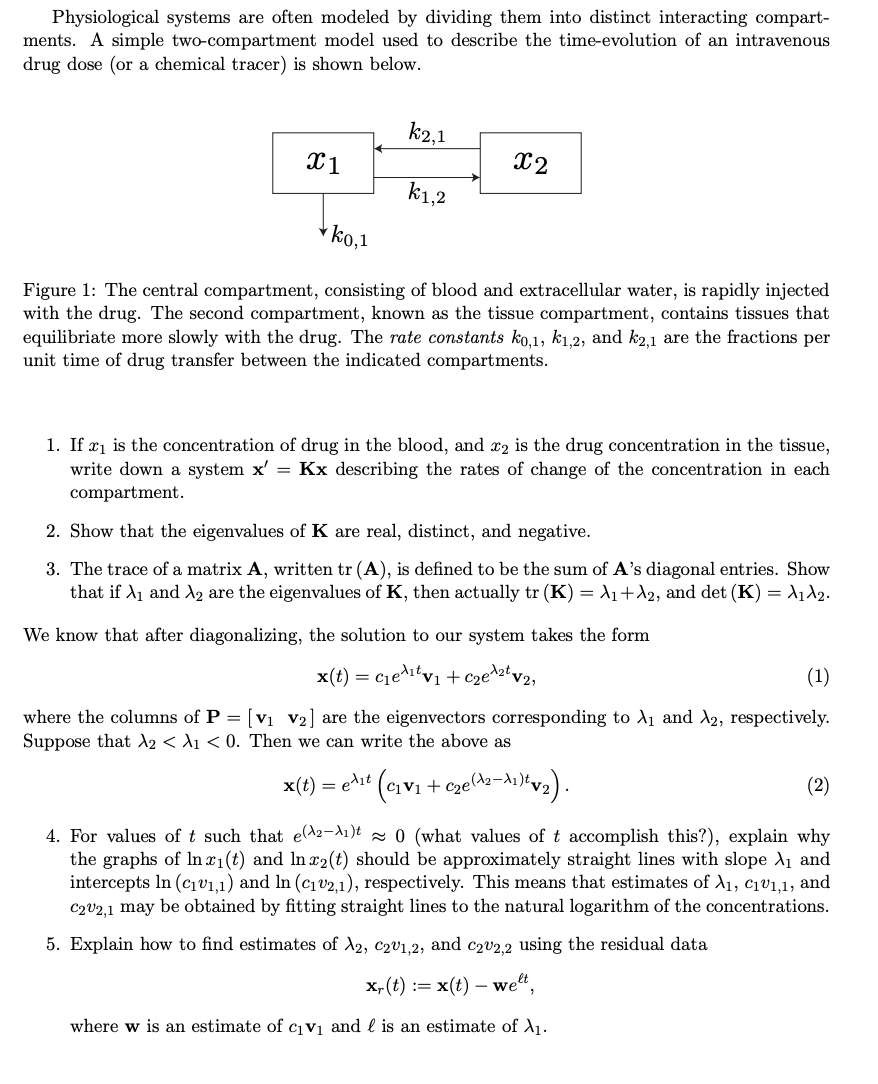
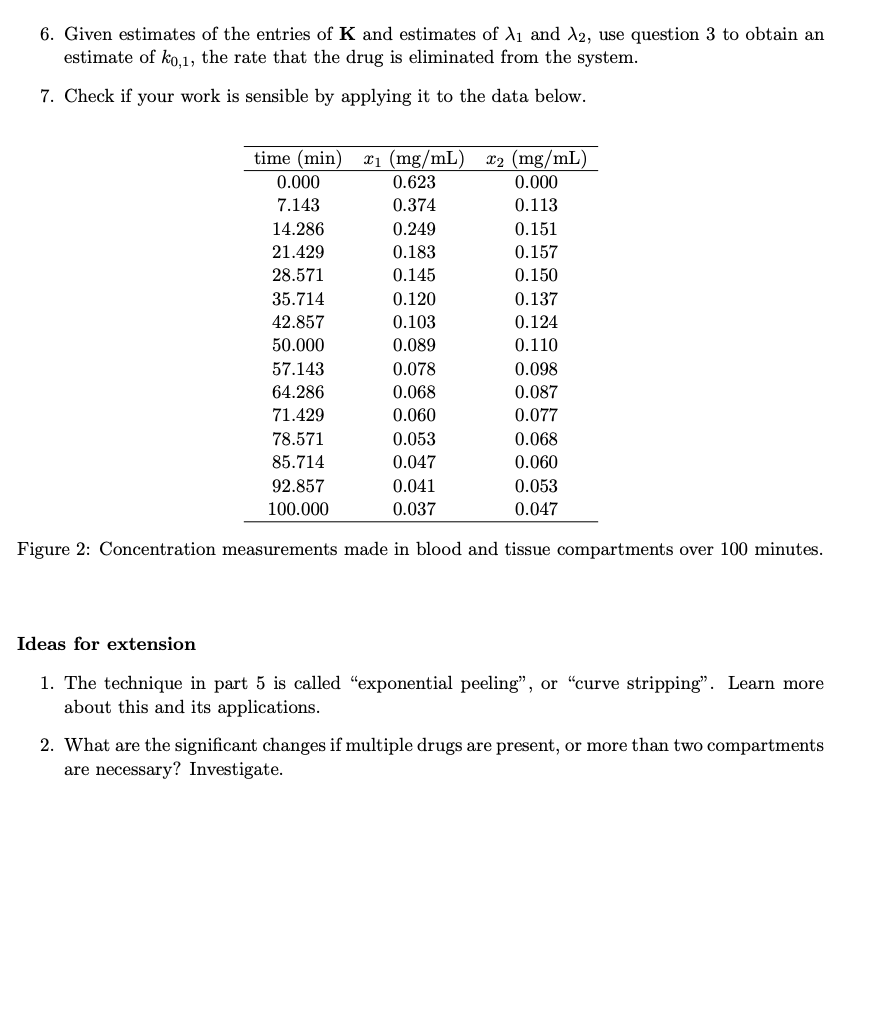
Physiological systems are often modeled by dividing them into distinct interacting compart- ments. A simple two-compartment model used to describe the time-evolution of an intravenous drug dose {or a chemical tracer) is shown below. Figure 1: The central compartment, consisting of blood and extracellular water, is rapidly injected with the drug. The second compartment, known as the tissue compartment, contains tissues that equibriate more slowly with the drug. The rate constants k0,], kl: and Ian are the fractions per unit time of drug transfer between the indicated compartments. 1. If 2:1 is the concentration of drug in the blood, and I2 is the drug concentration in the tissue, write down a system x' = Kx describing the rate; of change of the concentration in each compartment. 2. Show that the eigenvalues of K are real, distinct, and negative. 3. The trace of a matrix A, written tr (A) , is dened to be the sum of A's diagonal entries. Show that if )q and A; are the eigenvalues of K, then actually tr (K) = A1 +A2, and det (K) = A] A2. We know that after diagonalizing, the solution to our system takes the form A x(t) = cle 1tvl +cge'xatvz, (1) where the columns of P = [v1 v2] are the eigenvectors corresponding to A1 and M, respectively. Suppose that A2
Step by Step Solution
There are 3 Steps involved in it

Get step-by-step solutions from verified subject matter experts
 Study Help