







Question: this is case study and please solve this case study by these question following: please solve each part clearly and saparete INTRODUCTION John Gabbert's unique
this is case study 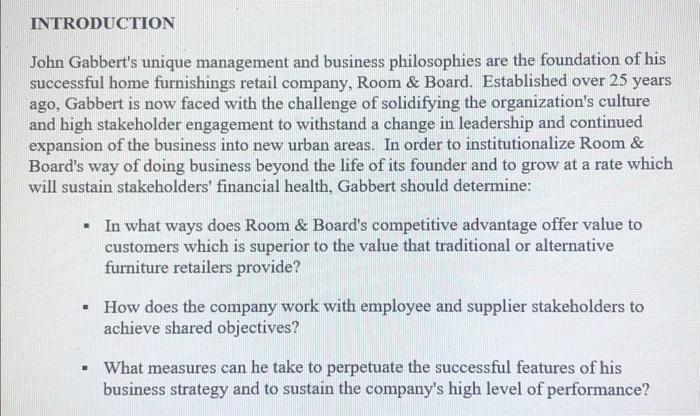
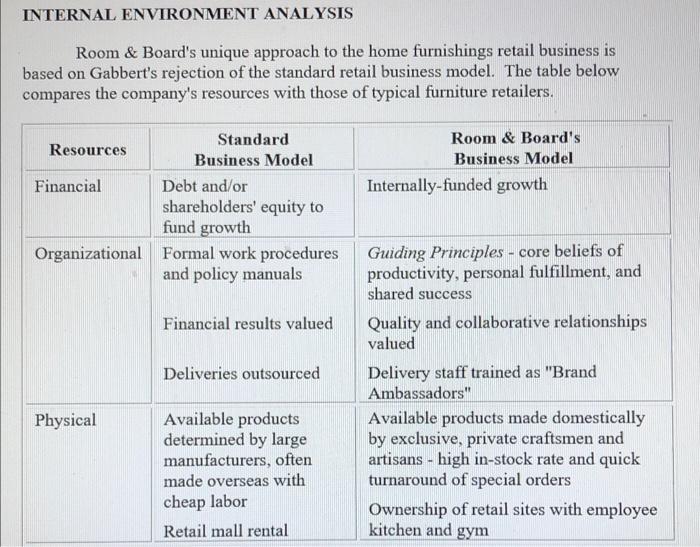
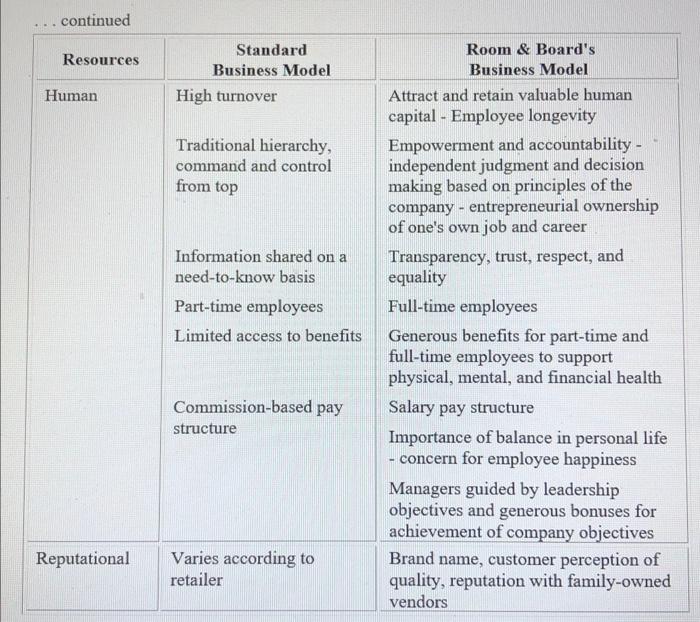
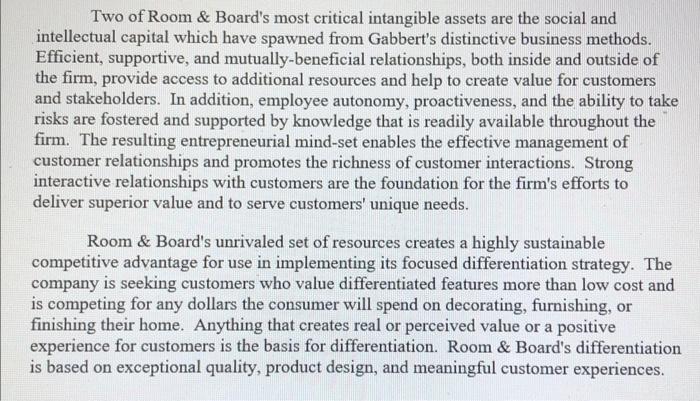
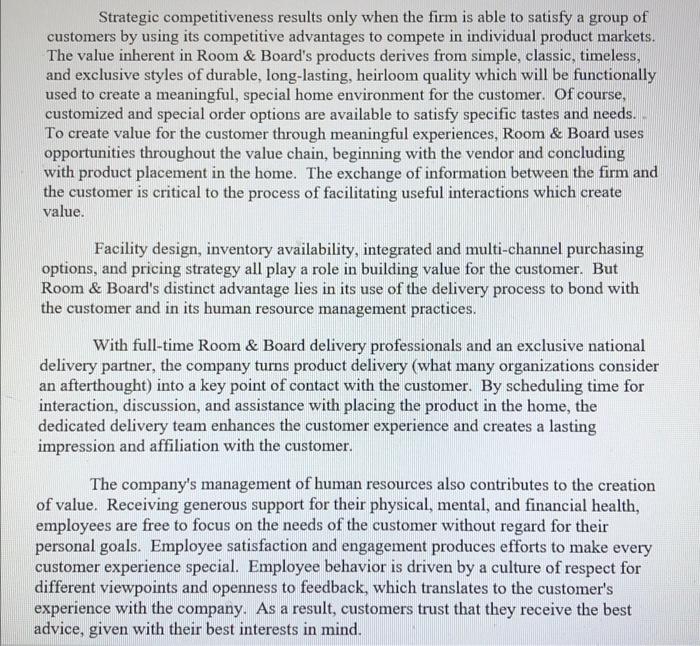
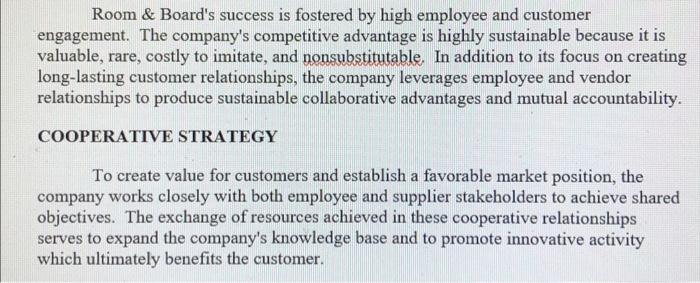
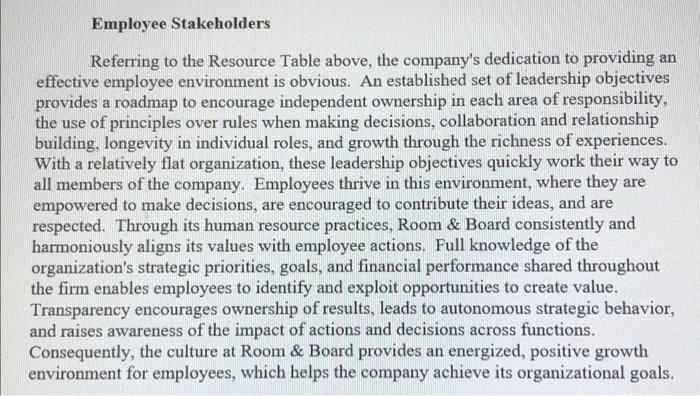
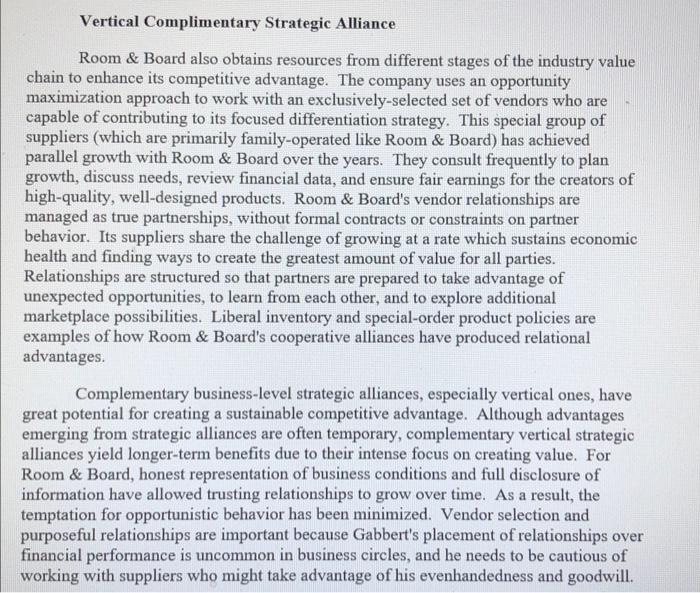
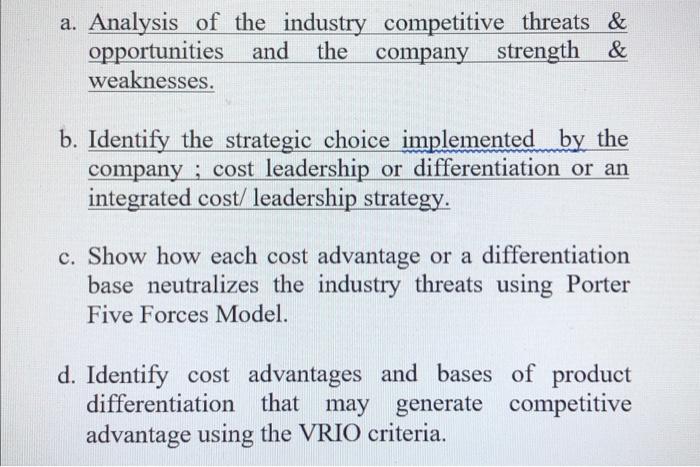
INTRODUCTION John Gabbert's unique management and business philosophies are the foundation of his successful home furnishings retail company, Room & Board. Established over 25 years ago, Gabbert is now faced with the challenge of solidifying the organization's culture and high stakeholder engagement to withstand a change in leadership and continued expansion of the business into new urban areas. In order to institutionalize Room & Board's way of doing business beyond the life of its founder and to grow at a rate which will sustain stakeholders' financial health, Gabbert should determine: . In what ways does Room & Board's competitive advantage offer value to customers which is superior to the value that traditional or alternative furniture retailers provide? How does the company work with employee and supplier stakeholders to achieve shared objectives? . . What measures can he take to perpetuate the successful features of his business strategy and to sustain the company's high level of performance? INTERNAL ENVIRONMENT ANALYSIS Room & Board's unique approach to the home furnishings retail business is based on Gabbert's rejection of the standard retail business model. The table below compares the company's resources with those of typical furniture retailers. Room & Board's Business Model Internally-funded growth Standard Resources Business Model Financial Debt and/or shareholders' equity to fund growth Organizational Formal work procedures and policy manuals Financial results valued Deliveries outsourced Guiding Principles - core beliefs of productivity, personal fulfillment, and shared success Quality and collaborative relationships valued Delivery staff trained as "Brand Ambassadors" Available products made domestically by exclusive, private craftsmen and artisans - high in-stock rate and quick turnaround of special orders Ownership of retail sites with employee kitchen and gym Physical Available products determined by large manufacturers, often made overseas with cheap labor Retail mall rental continued Resources Standard Business Model High turnover Human Traditional hierarchy, command and control from top Information shared on a need-to-know basis Part-time employees Limited access to benefits Room & Board's Business Model Attract and retain valuable human capital - Employee longevity Empowerment and accountability - independent judgment and decision making based on principles of the company - entrepreneurial ownership of one's own job and career Transparency, trust, respect, and equality Full-time employees Generous benefits for part-time and full-time employees to support physical, mental, and financial health Salary pay structure Importance of balance in personal life concern for employee happiness Managers guided by leadership objectives and generous bonuses for achievement of company objectives Brand name, customer perception of quality, reputation with family-owned vendors Commission-based pay structure - Reputational Varies according to retailer Two of Room & Board's most critical intangible assets are the social and intellectual capital which have spawned from Gabbert's distinctive business methods. Efficient, supportive, and mutually-beneficial relationships, both inside and outside of the firm, provide access to additional resources and help to create value for customers and stakeholders. In addition, employee autonomy, proactiveness, and the ability to take risks are fostered and supported by knowledge that is readily available throughout the firm. The resulting entrepreneurial mind-set enables the effective management of customer relationships and promotes the richness of customer interactions. Strong interactive relationships with customers are the foundation for the firm's efforts to deliver superior value and to serve customers' unique needs. Room & Board's unrivaled set of resources creates a highly sustainable competitive advantage for use in implementing its focused differentiation strategy. The company is seeking customers who value differentiated features more than low cost and is competing for any dollars the consumer will spend on decorating, furnishing, or finishing their home. Anything that creates real or perceived value or a positive experience for customers is the basis for differentiation. Room & Board's differentiation is based on exceptional quality, product design, and meaningful customer experiences. Strategic competitiveness results only when the firm is able to satisfy a group of customers by using its competitive advantages to compete in individual product markets. The value inherent in Room & Board's products derives from simple, classic, timeless, and exclusive styles of durable, long-lasting, heirloom quality which will be functionally used to create a meaningful, special home environment for the customer. Of course, customized and special order options are available to satisfy specific tastes and needs. To create value for the customer through meaningful experiences, Room & Board uses opportunities throughout the value chain, beginning with the vendor and concluding with product placement in the home. The exchange of information between the firm and the customer is critical to the process of facilitating useful interactions which create value. a Facility design, inventory availability, integrated and multi-channel purchasing options, and pricing strategy all play a role in building value for the customer. But Room & Board's distinct advantage lies in its use of the delivery process to bond with the customer and in its human resource management practices. With full-time Room & Board delivery professionals and an exclusive national delivery partner, the company turns product delivery (what many organizations consider an afterthought) into a key point of contact with the customer. By scheduling time for interaction, discussion, and assistance with placing the product in the home, the dedicated delivery team enhances the customer experience and creates a lasting impression and affiliation with the customer. The company's management of human resources also contributes to the creation of value. Receiving generous support for their physical, mental, and financial health, employees are free to focus on the needs of the customer without regard for their personal goals. Employee satisfaction and engagement produces efforts to make every customer experience special. Employee behavior is driven by a culture of respect for different viewpoints and openness to feedback, which translates to the customer's experience with the company. As a result, customers trust that they receive the best advice, given with their best interests in mind. Room & Board's success is fostered by high employee and customer engagement. The company's competitive advantage is highly sustainable because it is valuable, rare, costly to imitate, and nonsubstitutable. In addition to its focus on creating long-lasting customer relationships, the company leverages employee and vendor relationships to produce sustainable collaborative advantages and mutual accountability. COOPERATIVE STRATEGY To create value for customers and establish a favorable market position, the company works closely with both employee and supplier stakeholders to achieve shared objectives. The exchange of resources achieved in these cooperative relationships serves to expand the company's knowledge base and to promote innovative activity which ultimately benefits the customer. Employee Stakeholders Referring to the Resource Table above, the company's dedication to providing an effective employee environment is obvious. An established set of leadership objectives provides a roadmap to encourage independent ownership in each area of responsibility, the use of principles over rules when making decisions, collaboration and relationship building, longevity in individual roles, and growth through the richness of experiences. With a relatively flat organization, these leadership objectives quickly work their way to all members of the company. Employees thrive in this environment, where they are empowered to make decisions, are encouraged to contribute their ideas, and are respected. Through its human resource practices, Room & Board consistently and harmoniously aligns its values with employee actions. Full knowledge of the organization's strategic priorities, goals, and financial performance shared throughout the firm enables employees to identify and exploit opportunities to create value. Transparency encourages ownership of results, leads to autonomous strategic behavior, and raises awareness of the impact of actions and decisions across functions. Consequently, the culture at Room & Board provides an energized, positive growth environment for employees, which helps the company achieve its organizational goals. Vertical Complimentary Strategic Alliance Room & Board also obtains resources from different stages of the industry value chain to enhance its competitive advantage. The company uses an opportunity maximization approach to work with an exclusively-selected set of vendors who are capable of contributing to its focused differentiation strategy. This special group of suppliers (which are primarily family-operated like Room & Board) has achieved parallel growth with Room & Board over the years. They consult frequently to plan growth, discuss needs, review financial data, and ensure fair earnings for the creators of high-quality, well-designed products. Room & Board's vendor relationships are managed as true partnerships, without formal contracts or constraints on partner behavior. Its suppliers share the challenge of growing at a rate which sustains economic health and finding ways to create the greatest amount of value for all parties. Relationships are structured so that partners are prepared to take advantage of unexpected opportunities, to learn from each other, and to explore additional marketplace possibilities. Liberal inventory and special-order product policies are examples of how Room & Board's cooperative alliances have produced relational advantages. Complementary business-level strategic alliances, especially vertical ones, have great potential for creating a sustainable competitive advantage. Although advantages emerging from strategic alliances are often temporary, complementary vertical strategic alliances yield longer-term benefits due to their intense focus on creating value. For Room & Board, honest representation of business conditions and full disclosure of information have allowed trusting relationships to grow over time. As a result, the temptation for opportunistic behavior has been minimized. Vendor selection and purposeful relationships are important because Gabbert's placement of relationships over financial performance is uncommon in business circles, and he needs to be cautious of working with suppliers who might take advantage of his evenhandedness and goodwill. RECOMMENDATIONS The internal analysis identifies critical aspects of Room & Board's employee environment and business strategy which need to be preserved and protected for the company's long-term growth and success. Given the needs of the organization, Gabbert should evaluate the composition of his top management team and determine a succession plan for filling his leadership role upon retirement. In addition, reinforcing. the company's culture of collaboration and engagement is perhaps the best way ensuring that the organization's value-based philosophies are carried into new locations and into the future. of Managerial Succession Despite the advantages of a heterogeneous top management team, this is one case where a homogenous top management team is warranted. The firm is performing well and is seeking strategic and cultural continuity. For these reasons, using an internal managerial labor market to establish a succession plan is also preferred. To sustain the success of high-performing firms and continue commitment to a winning strategy, experience with the firm and industry and familiarity with its proprietary culture and methods are important considerations when selecting the organization's next leader. Gabbert should use a leadership screening system to assess the capabilities and a potential of his top managers and to establish the criteria he'll use to qualify his replacement at some point. The assessment should be followed by training and development for pre-selected candidates to shape their skills for the nature and rigors of the position. Upon a quick glance at members of the company's top leadership team, Kimberly Ruthenbeck stands out as a person of interest. With 15 years' experience at Room & Board and as vice president of Retail Customer Experience and Vendor Management, she surely models the ideals and values of the company's culture. Her integrated work with two key constituency groups (customers and vendors) should fully equip her to carry the organization into the next generation. Sustaining Organizational Culture Organizational culture is revealed in the values and principles espoused by the company's founder and leaders. Once beliefs and routines become embedded in company culture, they can be difficult to alter. Room & Board has a long-standing commitment to operating the business according to principles of engagement and collaborative relationships. The consistent, seamless, self-reinforcing culture is entrenched in the company's structure, strategy, and human resource practices. It is shaped and reinforced by Room & Board's: Guiding Principles - a communication tool to help employees understand their connection to the business, guide behavior, and relate individual roles to the broader business objectives and success, o emphasis on collaborative problem solving, o indoctrinated employees capable of applying the organization's principles to situations requiring judgment and independent decision making, O reward systems which go beyond salary to influence job satisfaction personal fulfillment, and strategic leaders who consistently display desired qualities, inspire cultural alignment, and actively support organizational principles through their behavior. o The likelihood of perpetuating Room & Board's high-performance culture is heightened by these factors. To further contribute to this goal, the company should establish ways to assess the magnitude of core cultural values. A balanced scorecard incorporates strategic controls with financial measures to promote or drive future behavior. The company should identify additional factors (related to customers, internal processes, and learning and growth) which influence long-term, value-creating potential and enable autonomous behavior and flexibility. Then these measures can be communicated and included in performance appraisals. The company clearly has a genuine concern for the well-being of its biggest constituencies (customers, employees, and supplier-partners). Room & Board already monitors customer satisfaction, loyalty, and referrals. And it measures employee satisfaction by monitoring job referrals and participation in the company's 401(k) program, which Gabbert believes are indicators of long-term employee engagement. Additionally, the company can identify ways to gauge other priorities which advance the interests of the company and strengthen the business climate to achieve: > increased supplier satisfaction, > expansion of the company's knowledge base, > stronger cooperative relationships, and > the marriage of complementary skills and compatible strategic goals in the company's social network. Even stable cultures evolve over time. Events such as internal crises, new technological forces, turnover of key staff, expansion into new geographical areas, rapid growth, and the arrival of new leaders can precipitate a change in the organization's value-based culture. To minimize pressures which could threaten the culture's sustainability, the company must vigilantly watch for the signs and effects of these types of events. In addition, Gabbert needs to seek continuity of leadership, controlled group size and membership, geographic concentration, and successful performance to protect his legacy. a. Analysis of the industry competitive threats & opportunities and the company strength & weaknesses. b. Identify the strategic choice implemented by the company ; cost leadership or differentiation or an integrated cost/ leadership strategy. c. Show how each cost advantage or a differentiation base neutralizes the industry threats using Porter Five Forces Model. d. Identify cost advantages and bases of product differentiation that may generate competitive advantage using the VRIO criteria and please solve this case study by these question following:
please solve each part clearly and saparete
Step by Step Solution
There are 3 Steps involved in it
1 Expert Approved Answer
Step: 1 Unlock

Question Has Been Solved by an Expert!
Get step-by-step solutions from verified subject matter experts
Step: 2 Unlock
Step: 3 Unlock
 Study Help