







Question: This problem is based on the hanging scaffold in Figure 1 , with two working decks. Assume medium duty loading. There are two outrigger beams
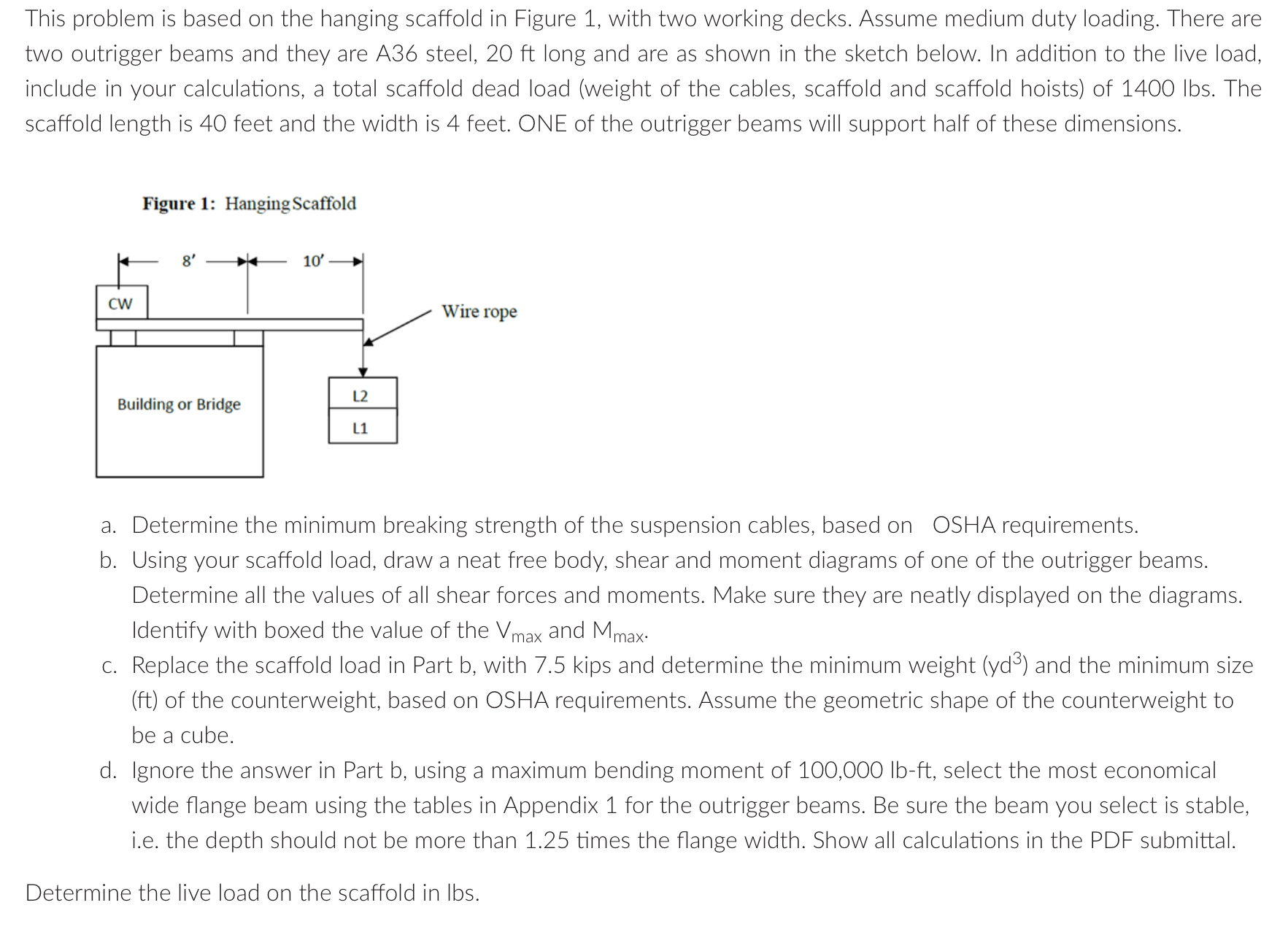
This problem is based on the hanging scaffold in Figure with two working decks. Assume medium duty loading. There are two outrigger beams and they are A steel, ft long and are as shown in the sketch below. In addition to the live load, include in your calculations, a total scaffold dead load weight of the cables, scaffold and scaffold hoists of Ibs. The scaffold length is feet and the width is feet. ONE of the outrigger beams will support half of these dimensions.
Figure : Hanging Scaffold
a Determine the minimum breaking strength of the suspension cables, based on OSHA requirements.
b Using your scaffold load, draw a neat free body, shear and moment diagrams of one of the outrigger beams. Determine all the values of all shear forces and moments. Make sure they are neatly displayed on the diagrams. Identify with boxed the value of the and
c Replace the scaffold load in Part b with kips and determine the minimum weight and the minimum size ft of the counterweight, based on OSHA requirements. Assume the geometric shape of the counterweight to be a cube.
d Ignore the answer in Part b using a maximum bending moment of select the most economical wide flange beam using the tables in Appendix for the outrigger beams. Be sure the beam you select is stable, ie the depth should not be more than times the flange width. Show all calculations in the PDF submittal.
Determine the live load on the scaffold in Ibs.
Step by Step Solution
There are 3 Steps involved in it
1 Expert Approved Answer
Step: 1 Unlock

Question Has Been Solved by an Expert!
Get step-by-step solutions from verified subject matter experts
Step: 2 Unlock
Step: 3 Unlock
 Study Help