Question: TONE CE Section The COMPULSORY and we Uhr The demand the one . USA Www www. TEATS Sport S. . Win where WSP way S2000
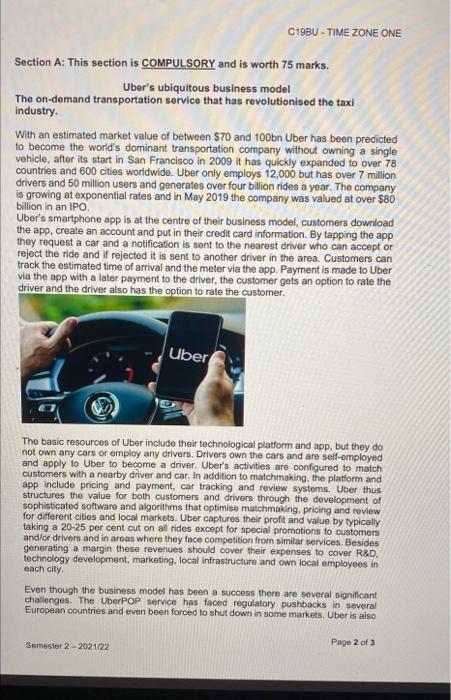
TONE CE Section The COMPULSORY and we Uhr The demand the one . USA Www www. TEATS Sport S. . Win where WSP way S2000 1000000 dow www over Po Awwwww www Wap ng Uber www. Www wand MIRROR werd . 11 C19BU - TIME ZONE ONE Section A: This section is COMPULSORY and is worth 75 marks. Uber's ubiquitous business model The on-demand transportation service that has revolutionised the taxi industry. With an estimated market value of between $70 and 100bn Uber has been predicted to become the world's dominant transportation company without owning a single vehicle, after its start in San Francisco in 2009 it has quickly expanded to over 78 countries and 600 cities worldwide. Uber only employs 12,000 but has over 7 million drivers and 50 million users and generates over four billion rides a year. The company is growing at exponential rates and in May 2019 the company was valued at over $80 billion in an IPO Uber's smartphone app is at the centre of their business model, customers download the app, create an account and put in their credit card information. By tapping the app they request a car and a notification is sent to the nearest driver who can accept or reject the ride and if rejected it is sent to another driver in the area. Customers can track the estimated time of arrival and the meter via the app. Payment is made to Uber via the app with a later payment to the driver, the customer gets an option to rate the driver and the driver also has the option to rate the customer. Uber The basic resources of Uber include their technological platform and app, but they do not own any cars or employ any drivers, Drivers own the cars and are self-employed and apply to Uber to become a driver. Uber's activities are configured to match customers with a nearby driver and car. In addition to matchmaking, the platform and app include pricing and payment, car tracking and review systems. Uber thus structures the value for both customers and drivers through the development of sophisticated software and algorithms that optimise matchmaking, pricing and review for different cities and local markets. Uber captures their profit and value by typically taking a 20-25 per cent cut on all rides except for special promotions to customers and/or drivers and in areas where they face competition from similar services. Besides generating a margin these revenues should cover their expenses to cover R&D. technology development, marketing, local infrastructure and own local employees in each city Even though the business model has been a success there are several significant challenges. The UberPOP service has faced regulatory pushbacks in several European countries and even been forced to shut down in some markets. Uber is also Semester 2-202122 Page 2 of 3 C19BU - TIME ZONE ONE facing an increasing number of competitors with similar business models; Lyft is a significant competitor in the USA and in China they were defeated by Didi Chuxing, which acquired their operations. However, the CEO Dara Khosrowshahi has expanded their food delivery UberEATS further and entered into new services such as bike- and scooter-sharing with a vision to be present in all the different ways people move within an urban environment: 'we want to be the Amazon of transportation". Source: Whittington, R., Regner, P., Angwin, D., Johnson, G., and Scholes, K. (2020). Uber's ubiquitous business model: the on-demand transportation service that has revolutionised the taxi industry, case study in Exploring Strategy: 12th ed. Harlow: Pearson, Pg 222. Answer the following questions: 1. Using the Ansoff matrix analyse Uber's growth over time. What do you notice about its pattern of expansion? (20 marks) 2. Using evidence from the case examine the reasons for the success of Uber, Use relevant theories to support your answer. (25 marks) Examine the challenges facing Uber in expanding using market development and product development as a strategy. (30 marks) 3