Question: True or False Questions stated in the boxes Case 1: State of Connecticut v. Cardwell, 718 A.2d 954 (Conn. Sup. Ct. 1998) (Mallor, 16th Ed.,
True or False Questions stated in the boxes 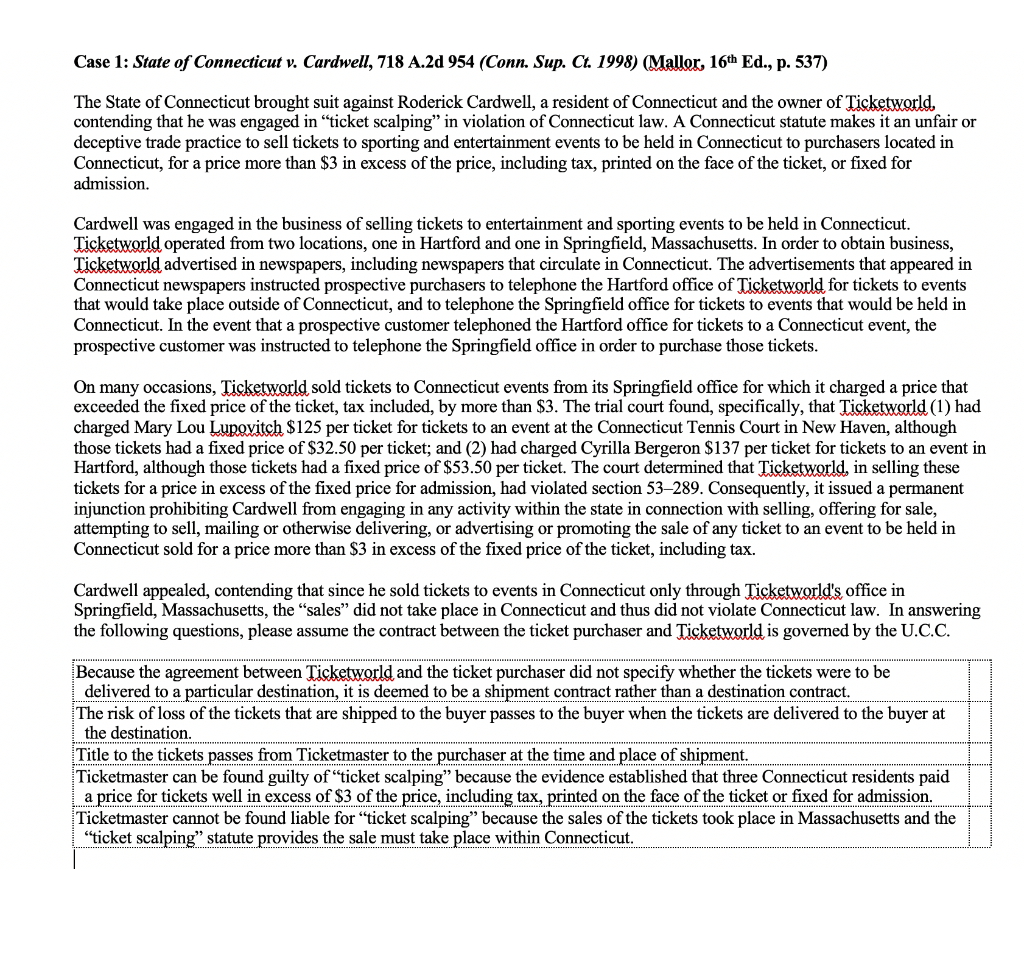
Case 1: State of Connecticut v. Cardwell, 718 A.2d 954 (Conn. Sup. Ct. 1998) (Mallor, 16th Ed., p. 537) The State of Connecticut brought suit against Roderick Cardwell, a resident of Connecticut and the owner of Ticketworld, contending that he was engaged in "ticket scalping" in violation of Connecticut law. A Connecticut statute makes it an unfair or deceptive trade practice to sell tickets to sporting and entertainment events to be held in Connecticut to purchasers located in Connecticut, for a price more than $3 in excess of the price, including tax, printed on the face of the ticket, or fixed for admission. Cardwell was engaged in the business of selling tickets to entertainment and sporting events to be held in Connecticut. Ticketworld operated from two locations, one in Hartford and one in Springfield, Massachusetts. In order to obtain business, Ticketworld advertised in newspapers, including newspapers that circulate in Connecticut. The advertisements that appeared in Connecticut newspapers instructed prospective purchasers to telephone the Hartford office of Ticketworld for tickets to events that would take place outside of Connecticut, and to telephone the Springfield office for tickets to events that would be held in Connecticut. In the event that a prospective customer telephoned the Hartford office for tickets to a Connecticut event, the prospective customer was instructed to telephone the Springfield office in order to purchase those tickets. On many occasions, Ticketworld sold tickets to Connecticut events from its Springfield office for which it charged a price that exceeded the fixed price of the ticket, tax included, by more than $3. The trial court found, specifically, that Ticketworld (1) had charged Mary Lou Lupovitch $125 per ticket for tickets to an event at the Connecticut Tennis Court in New Haven, although those tickets had a fixed price of $32.50 per ticket; and (2) had charged Cyrilla Bergeron $137 per ticket for tickets to an event in Hartford, although those tickets had a fixed price of $53.50 per ticket. The court determined that Ticketworld, in selling these tickets for a price in excess of the fixed price for admission, had violated section 53289. Consequently, it issued a permanent injunction prohibiting Cardwell from engaging in any activity within the state in connection with selling, offering for sale, attempting to sell, mailing or otherwise delivering, or advertising or promoting the sale of any ticket to an event to be held in Connecticut sold for a price more than $3 in excess of the fixed price of the ticket, including tax. Cardwell appealed, contending that since he sold tickets to events in Connecticut only through Ticketworld's office in Springfield, Massachusetts, the sales" did not take place in Connecticut and thus did not violate Connecticut law. In answering the following questions, please assume the contract between the ticket purchaser and Ticketworld is governed by the U.C.C. Because the agreement between Ticketworld and the ticket purchaser did not specify whether the tickets were to be delivered to a particular destination, it is deemed to be a shipment contract rather than a destination contract. The risk of loss of the tickets that are shipped to the buyer passes to the buyer when the tickets are delivered to the buyer at the destination. Title to the tickets passes from Ticketmaster to the purchaser at the time and place of shipment. Ticketmaster can be found guilty of "ticket scalping" because the evidence established that three Connecticut residents paid a price for tickets well in excess of $3 of the price, including tax, printed on the face of the ticket or fixed for admission. Ticketmaster cannot be found liable for ticket scalping" because the sales of the tickets took place in Massachusetts and the "ticket scalping" statute provides the sale must take place within Connecticut









 Study Help