







Question: Two parallel, metal plates with separation distance d = 1.00 cm carry charges of equal magnitude but opposite sign. The plates are oriented horizontally.
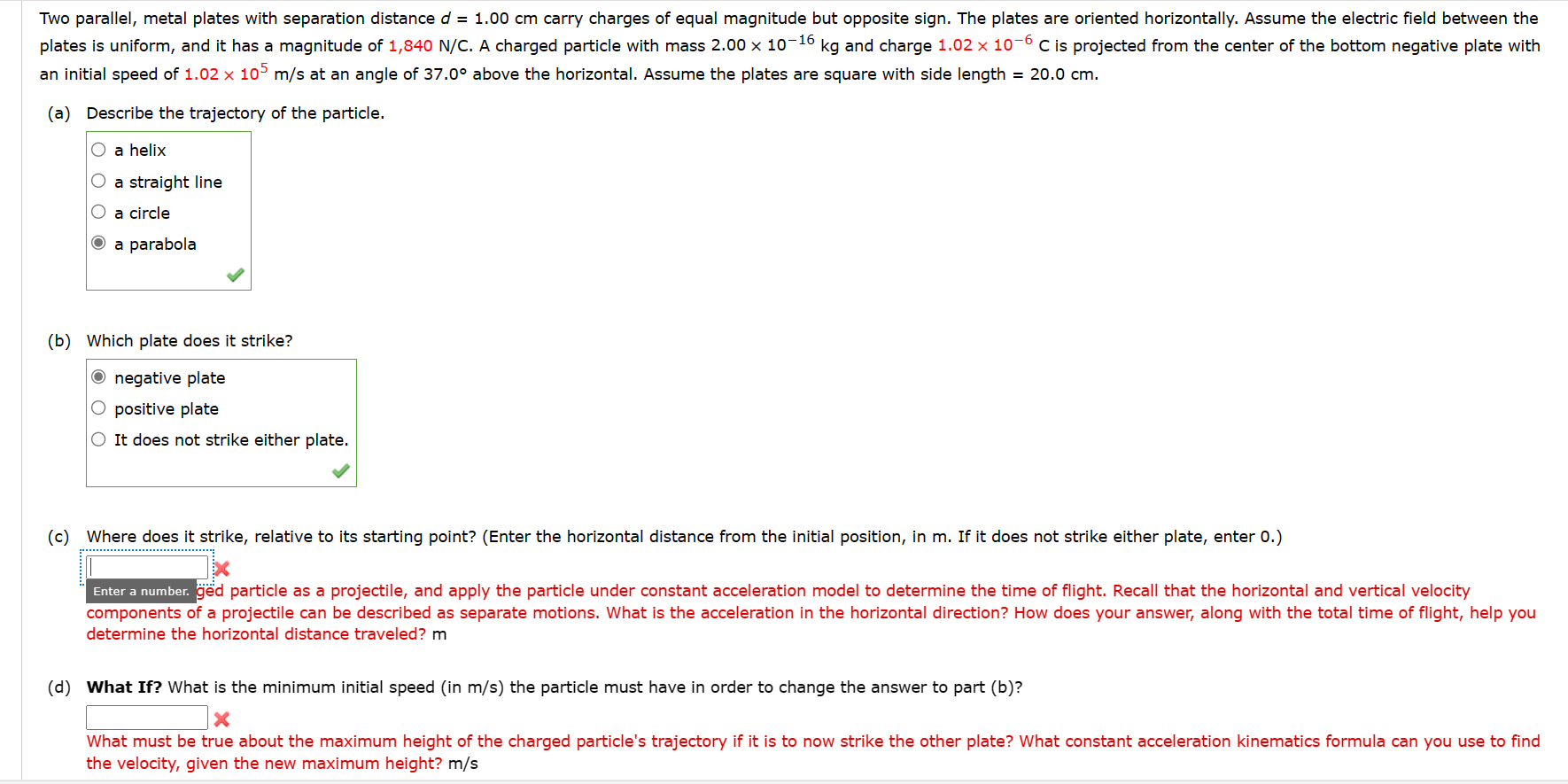
Two parallel, metal plates with separation distance d = 1.00 cm carry charges of equal magnitude but opposite sign. The plates are oriented horizontally. Assume the electric field between the plates is uniform, and it has a magnitude of 1,840 N/C. A charged particle with mass 2.00 10-16 kg and charge 1.02 x 10⁻⁶ C is projected from the center of the bottom negative plate with an initial speed of 1.02 x 10⁵ m/s at an angle of 37.0 above the horizontal. Assume the plates are square with side length = 20.0 cm. (a) Describe the trajectory of the particle. O a helix O a straight line O a circle O a parabola (b) Which plate does it strike? O negative plate O pos late O It does not strike either plate. (c) Where does it strike, relative to its starting point? (Enter the horizontal distance from the initial position, in m. If it does not strike either plate, enter 0.) Enter a number. ged particle as a projectile, and apply the particle under constant acceleration model to determine the time of flight. Recall that the horizontal and vertical velocity components of a projectile can be described as separate motions. What is the acceleration in the horizontal direction? How does your answer, along with the total time of flight, help you determine the horizontal distance traveled? m (d) What If? What is the minimum initial speed (in m/s) the particle must have in order to change the answer to part (b)? X What must be true about the maximum height of the charged particle's trajectory if it is to now strike the other plate? What constant acceleration kinematics formula can you use to find the velocity, given the new maximum height? m/s
Step by Step Solution
There are 3 Steps involved in it

Get step-by-step solutions from verified subject matter experts
 Study Help