Question: Uber and Lyft Drivers Go on Strike This activity is important because fairness gives employees observable evidence of trustworthiness of a manager, company or other
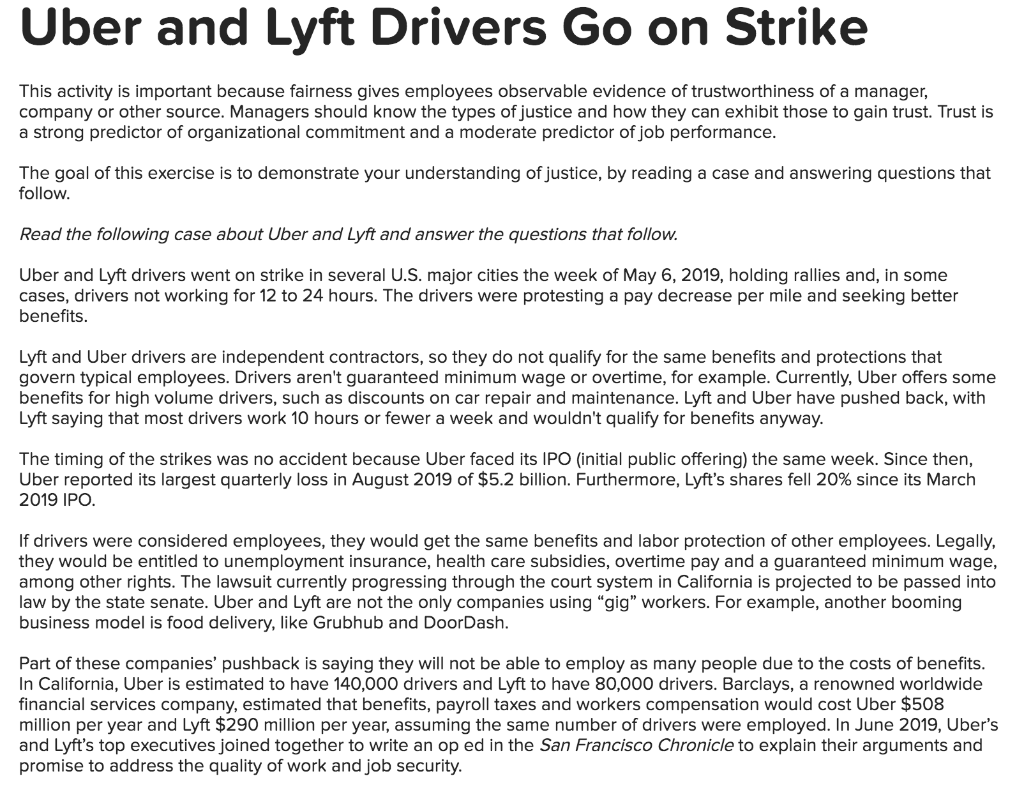
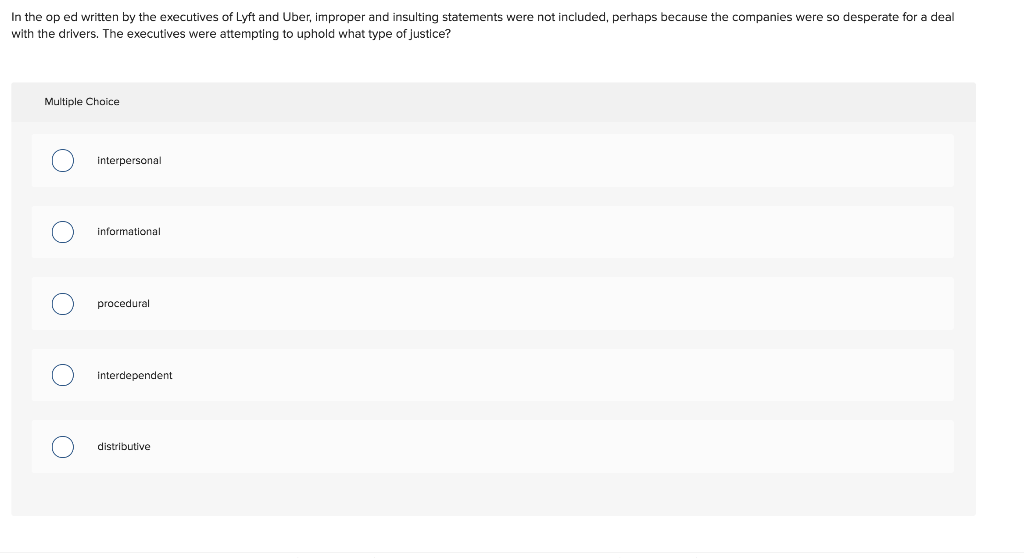
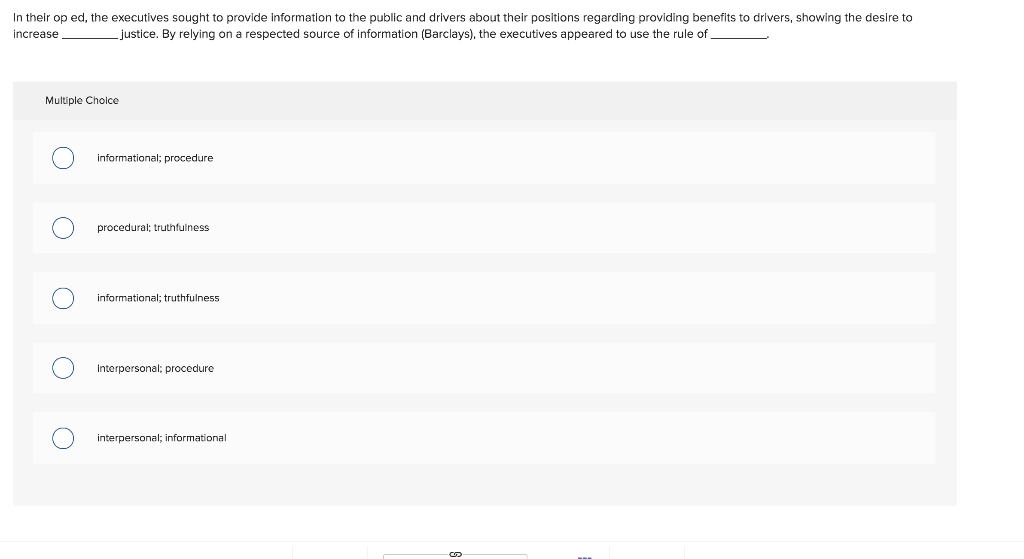
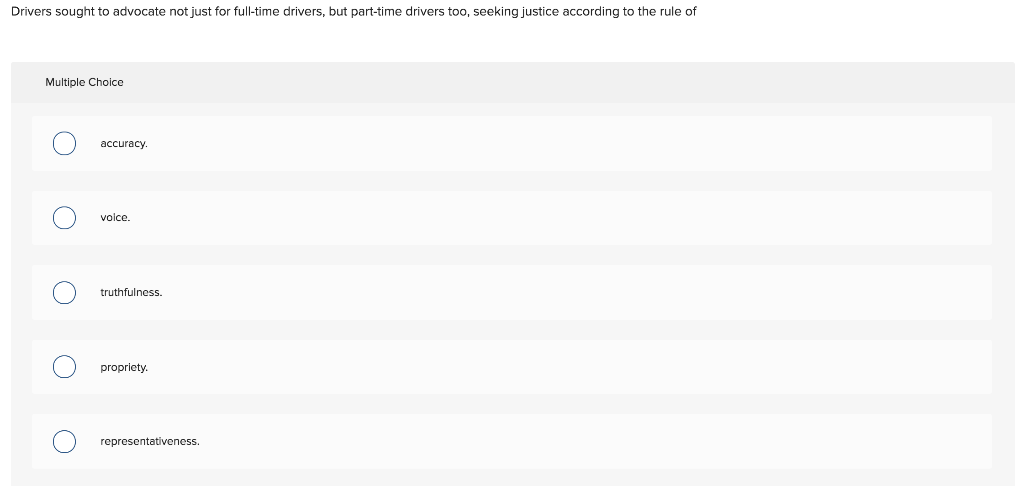
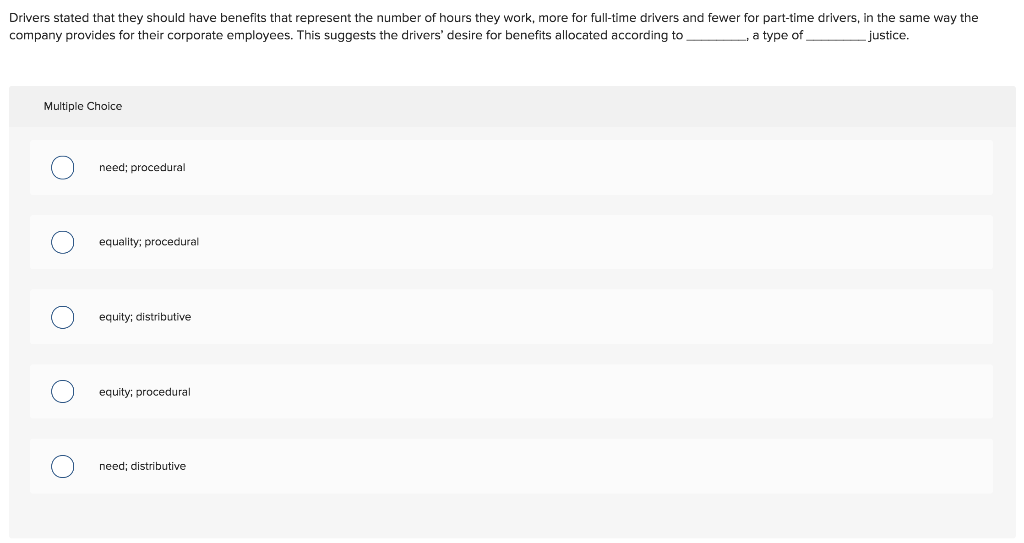
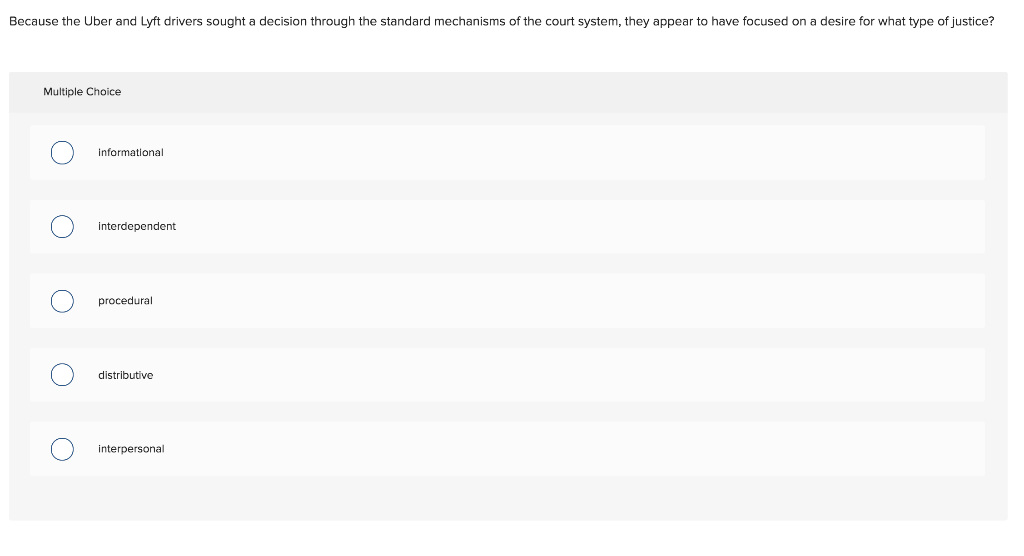
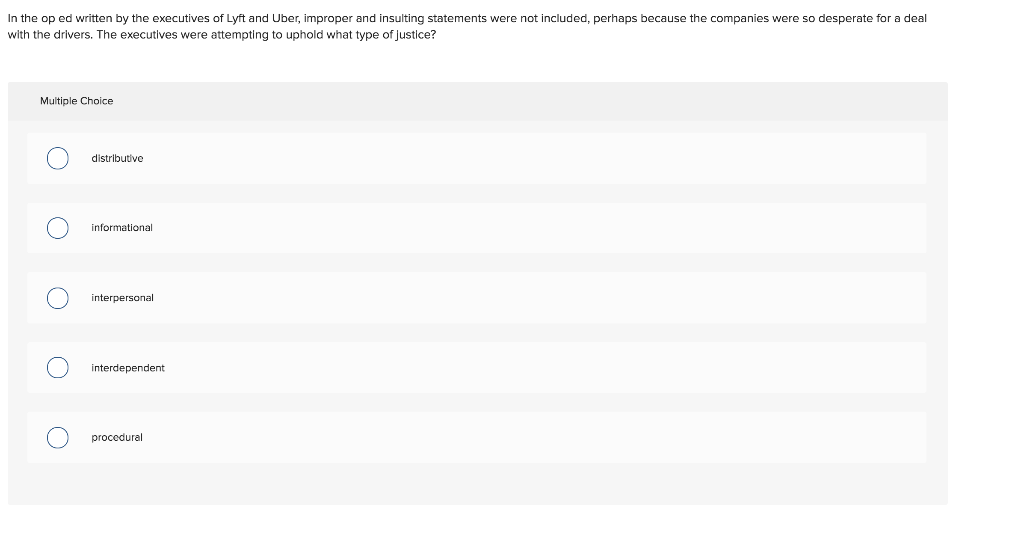
Uber and Lyft Drivers Go on Strike This activity is important because fairness gives employees observable evidence of trustworthiness of a manager, company or other source. Managers should know the types of justice and how they can exhibit those to gain trust. Trust is a strong predictor of organizational commitment and a moderate predictor of job performance. The goal of this exercise is to demonstrate your understanding of justice, by reading a case and answering questions that follow. Read the following case about Uber and Lyft and answer the questions that follow. Uber and Lyft drivers went on strike in several U.S. major cities the week of May 6, 2019, holding rallies and, in some cases, drivers not working for 12 to 24 hours. The drivers were protesting a pay decrease per mile and seeking better benefits. Lyft and Uber drivers are independent contractors, so they do not qualify for the same benefits and protections that govern typical employees. Drivers aren't guaranteed minimum wage or overtime, for example. Currently, Uber offers some benefits for high volume drivers, such as discounts on car repair and maintenance. Lyft and Uber have pushed back, with Lyft saying that most drivers work 10 hours or fewer a week and wouldn't qualify for benefits anyway. The timing of the strikes was no accident because Uber faced its IPO (initial public offering) the same week. Since then, Uber reported its largest quarterly loss in August 2019 of $5.2 billion. Furthermore, Lyft's shares fell 20% since its March 2019 IPO. If drivers were considered employees, they would get the same benefits and labor protection of other employees. Legally, they would be entitled to unemployment insurance, health care subsidies, overtime pay and a guaranteed minimum wage, among other rights. The lawsuit currently progressing through the court system in California is projected to be passed into law by the state senate. Uber and Lyft are not the only companies using "gig" workers. For example, another booming business model is food delivery, like Grubhub and DoorDash. Part of these companies' pushback is saying they will not be able to employ as many people due to the costs of benefits. In California, Uber is estimated to have 140,000 drivers and Lyft to have 80,000 drivers. Barclays, a renowned worldwide financial services company, estimated that benefits, payroll taxes and workers compensation would cost Uber $508 million per year and Lyft $290 million per year, assuming the same number of drivers were employed. In June 2019, Uber's and Lyft's top executives joined together to write an op ed in the San Francisco Chronicle to explain their arguments and promise to address the quality of work and job security. In the op ed written by the executives of Lyft and Uber, improper and insulting statements were not included, perhaps because the companies were so desperate for a deal with the drivers. The executives were attempting to uphold what type of justice? Multiple Choice interpersonal O informational procedural interdependent O O distributive distributive In their op ed, the executives sought to provide information to the public and drivers about their positions regarding providing benefits to drivers, showing the desire to increase justice. By relying on a respected source of information (Barclays), the executives appeared to use the rule of Multiple Choice informational; procedure procedural: truthfulness informational; truthfulness interpersonal procedure interpersonal; informational Drivers sought to advocate not just for full-time drivers, but part-time drivers too, seeking justice according to the rule of Multiple Choice accuracy volce. O truthfulness. O propriety. representativeness. O Drivers stated that they should have benefits that represent the number of hours they work, more for full-time drivers and fewer for part-time drivers, in the same way the company provides for their corporate employees. This suggests the drivers' desire for benefits allocated according to - a type of justice. Multiple Choice need; procedural O equality, procedural O equity; distributive equity; procedural O need; distributive Because the Uber and Lyft drivers sought a decision through the standard mechanisms of the court system, they appear to have focused on a desire for what type of justice? Multiple Choice Informational O O interdependent O procedural O O distributive interpersonal In the op ed written by the executives of Lyft and Uber, improper and insulting statements were not included, perhaps because the companies were so desperate for a deal with the drivers. The executives were attempting to uphold what type of justice? Multiple Choice distributive O informational O O interpersonal O O interdependent procedural Uber and Lyft Drivers Go on Strike This activity is important because fairness gives employees observable evidence of trustworthiness of a manager, company or other source. Managers should know the types of justice and how they can exhibit those to gain trust. Trust is a strong predictor of organizational commitment and a moderate predictor of job performance. The goal of this exercise is to demonstrate your understanding of justice, by reading a case and answering questions that follow. Read the following case about Uber and Lyft and answer the questions that follow. Uber and Lyft drivers went on strike in several U.S. major cities the week of May 6, 2019, holding rallies and, in some cases, drivers not working for 12 to 24 hours. The drivers were protesting a pay decrease per mile and seeking better benefits. Lyft and Uber drivers are independent contractors, so they do not qualify for the same benefits and protections that govern typical employees. Drivers aren't guaranteed minimum wage or overtime, for example. Currently, Uber offers some benefits for high volume drivers, such as discounts on car repair and maintenance. Lyft and Uber have pushed back, with Lyft saying that most drivers work 10 hours or fewer a week and wouldn't qualify for benefits anyway. The timing of the strikes was no accident because Uber faced its IPO (initial public offering) the same week. Since then, Uber reported its largest quarterly loss in August 2019 of $5.2 billion. Furthermore, Lyft's shares fell 20% since its March 2019 IPO. If drivers were considered employees, they would get the same benefits and labor protection of other employees. Legally, they would be entitled to unemployment insurance, health care subsidies, overtime pay and a guaranteed minimum wage, among other rights. The lawsuit currently progressing through the court system in California is projected to be passed into law by the state senate. Uber and Lyft are not the only companies using "gig" workers. For example, another booming business model is food delivery, like Grubhub and DoorDash. Part of these companies' pushback is saying they will not be able to employ as many people due to the costs of benefits. In California, Uber is estimated to have 140,000 drivers and Lyft to have 80,000 drivers. Barclays, a renowned worldwide financial services company, estimated that benefits, payroll taxes and workers compensation would cost Uber $508 million per year and Lyft $290 million per year, assuming the same number of drivers were employed. In June 2019, Uber's and Lyft's top executives joined together to write an op ed in the San Francisco Chronicle to explain their arguments and promise to address the quality of work and job security. In the op ed written by the executives of Lyft and Uber, improper and insulting statements were not included, perhaps because the companies were so desperate for a deal with the drivers. The executives were attempting to uphold what type of justice? Multiple Choice interpersonal O informational procedural interdependent O O distributive distributive In their op ed, the executives sought to provide information to the public and drivers about their positions regarding providing benefits to drivers, showing the desire to increase justice. By relying on a respected source of information (Barclays), the executives appeared to use the rule of Multiple Choice informational; procedure procedural: truthfulness informational; truthfulness interpersonal procedure interpersonal; informational Drivers sought to advocate not just for full-time drivers, but part-time drivers too, seeking justice according to the rule of Multiple Choice accuracy volce. O truthfulness. O propriety. representativeness. O Drivers stated that they should have benefits that represent the number of hours they work, more for full-time drivers and fewer for part-time drivers, in the same way the company provides for their corporate employees. This suggests the drivers' desire for benefits allocated according to - a type of justice. Multiple Choice need; procedural O equality, procedural O equity; distributive equity; procedural O need; distributive Because the Uber and Lyft drivers sought a decision through the standard mechanisms of the court system, they appear to have focused on a desire for what type of justice? Multiple Choice Informational O O interdependent O procedural O O distributive interpersonal In the op ed written by the executives of Lyft and Uber, improper and insulting statements were not included, perhaps because the companies were so desperate for a deal with the drivers. The executives were attempting to uphold what type of justice? Multiple Choice distributive O informational O O interpersonal O O interdependent procedural









 Study Help