







Question: Unified versus Split cache a) Use go.ss benchmark to simulate an 8KB direct-mapped L1 data cache with 32 byte blocks, b) Include the content of
Unified versus Split cache a) Use go.ss benchmark to simulate an 8KB direct-mapped L1 data cache with 32 byte blocks, b) Include the content of the configuration settings in your assignment report c) Include the command to perform this task in the assignment report, and capture the screen shot and include it in the report. d) Record the miss, replacement, and writeback rates of the data cache in a table like the one below for each of the replacement algorithms. Analyze the result and elaborate on which of the following replacement policy is the best for this configuration.
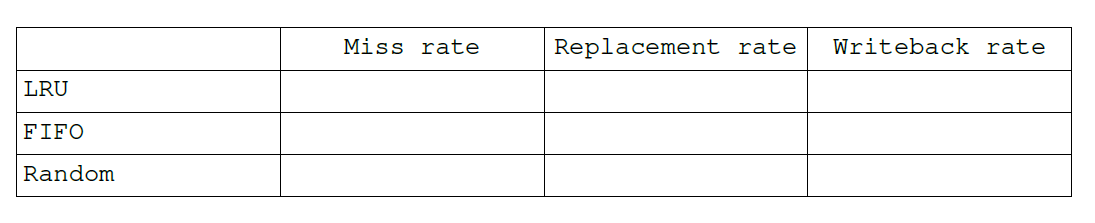 e) For LRU replacement policy ONLY, use 1K, 2K, 4K, 8K, 16K, 32K, 64K, 128K as line size and 8, 16, 32, 64 as block size, find the miss ratios. Compare and plot the miss ratio against the block size for the given line sizes. f) Use the same benchmark, simulate both unified and split 2-way set associative 4k cache and 32 block. Then change the cache size to 8k, 16k, 32k, 64k, 128k and plot the cache miss rates for data and instruction memory access. Compare the results and record your observation.
\begin{tabular}{|l|c|l|l|} \hline & Miss rate & Replacement rate & Writeback rate \\ \hline LRU & & & \\ \hline FIFO & & & \\ \hline Random & & & \\ \hline \end{tabular}
Step by Step Solution
There are 3 Steps involved in it

Get step-by-step solutions from verified subject matter experts
 Study Help