







Question: Use numpy, matplotlib.pyplot, itertools only For this part, we will analyze via simulation, the effect of probability of error in a binary symmetric channel (BSC)
Use numpy, matplotlib.pyplot, itertools only
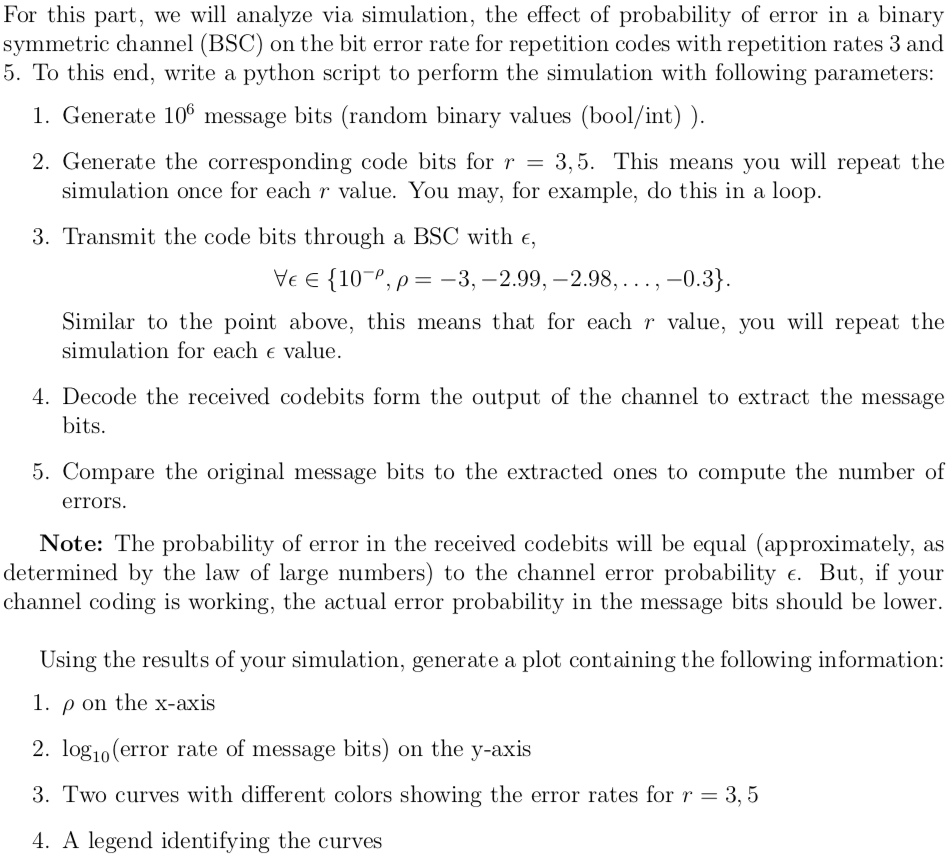
For this part, we will analyze via simulation, the effect of probability of error in a binary symmetric channel (BSC) on the bit error rate for repetition codes with repetition rates 3 and 5. To this end, write a python script to perform the simulation with following parameters 1. Generate 106 message bits (random binary values (bool/int)) 2. Generate the corresponding code bits for r - 3,5. This means you will repeat the simulation once for each r value. You may, for example, do this in a loop 3. Transmit the code bits through a BSC with e, Ye E { 10%, =-3.-2.99.-2.98. . . . ,-0.3 Similar to the point above, this means that for each r value, you will repeat the simulation for each evalue. 4. Decode the received codebits form the output of the channel to extract the message bits. 5. Compare the original message bits to the extracted ones to compute the number of errorS Note: The probability of error in the received codebits will be equal (approximately, as determined by the law of large numbers) to the channel error probability e. But, if your channel coding is working, the actual error probability in the message bits should be lower. Using the results of your simulation, generate a plot containing the following information on the x-axis 2. log1o (error rate of message bits) on the y-axis 3. Two curves with different colors showing the error rates for r-3, 5 4. A legend identifying the curves 1. For this part, we will analyze via simulation, the effect of probability of error in a binary symmetric channel (BSC) on the bit error rate for repetition codes with repetition rates 3 and 5. To this end, write a python script to perform the simulation with following parameters 1. Generate 106 message bits (random binary values (bool/int)) 2. Generate the corresponding code bits for r - 3,5. This means you will repeat the simulation once for each r value. You may, for example, do this in a loop 3. Transmit the code bits through a BSC with e, Ye E { 10%, =-3.-2.99.-2.98. . . . ,-0.3 Similar to the point above, this means that for each r value, you will repeat the simulation for each evalue. 4. Decode the received codebits form the output of the channel to extract the message bits. 5. Compare the original message bits to the extracted ones to compute the number of errorS Note: The probability of error in the received codebits will be equal (approximately, as determined by the law of large numbers) to the channel error probability e. But, if your channel coding is working, the actual error probability in the message bits should be lower. Using the results of your simulation, generate a plot containing the following information on the x-axis 2. log1o (error rate of message bits) on the y-axis 3. Two curves with different colors showing the error rates for r-3, 5 4. A legend identifying the curves 1
Step by Step Solution
There are 3 Steps involved in it

Get step-by-step solutions from verified subject matter experts
 Study Help