







Question: Use the Lagrange method to find a function u(x, y) that solves the problem uux + uy = 1 u (3x, 0) = -x
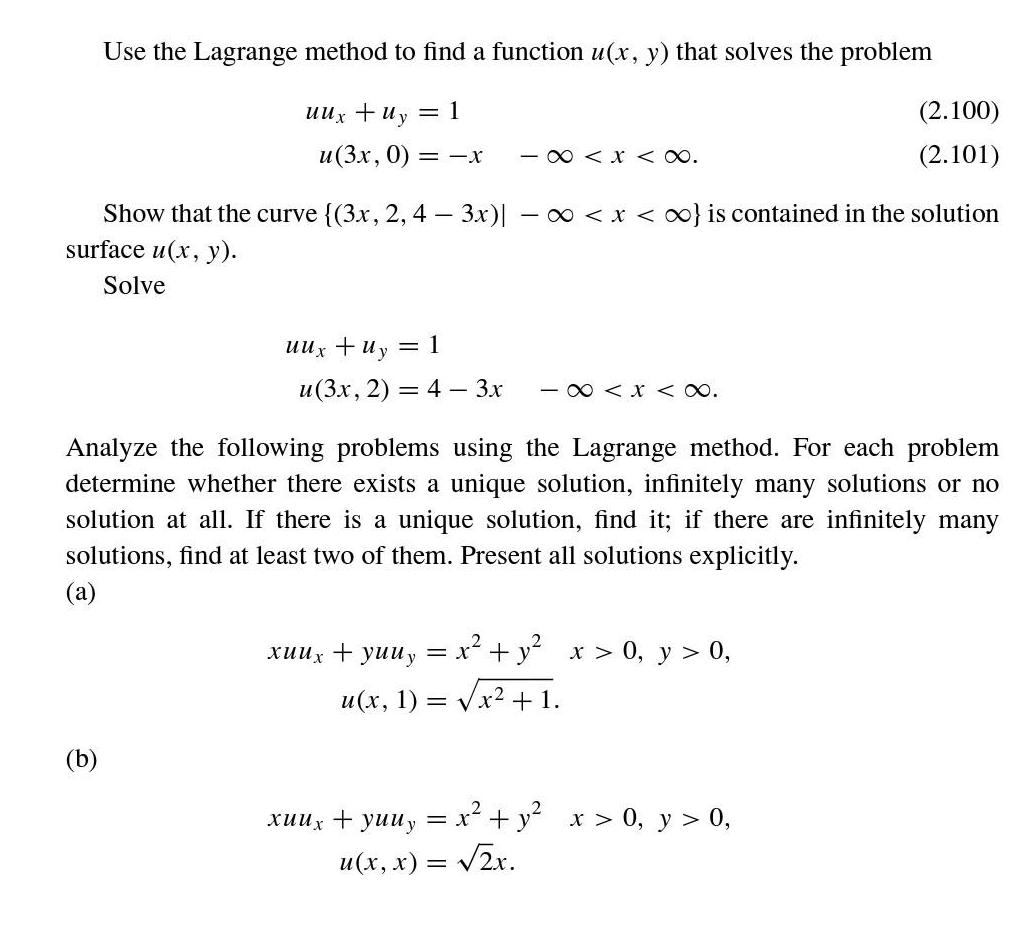
Use the Lagrange method to find a function u(x, y) that solves the problem uux + uy = 1 u (3x, 0) = -x (b) Show that the curve {(3x, 2, 4 - 3x)| < x < } is contained in the solution surface u(x, y). Solve uux +uy = 1 u(3x, 2) = 4 - 3x - < x < . - < x < . Analyze the following problems using the Lagrange method. For each problem determine whether there exists a unique solution, infinitely many solutions or no solution at all. If there is a unique solution, find it; if there are infinitely many solutions, find at least two of them. Present all solutions explicitly. (a) xuux + yuuy = = x + y x>0, y > 0, (2.100) (2.101) u(x, 1) = x + 1. V xuux + yuuy = x + y x > 0, y > 0, u(x, x) = 2x.
Step by Step Solution
There are 3 Steps involved in it
The image displays a collection of firstorder partial differential equations to be solved using the method of characteristics which is also known as t... View full answer

Get step-by-step solutions from verified subject matter experts
 Study Help