







Question: using Matlab Problem Statement: The classical predator-prey problem gexecued by the Latka- Xolterxa predator-prey system of equations: where x & x, are the prey (pest)
using Matlab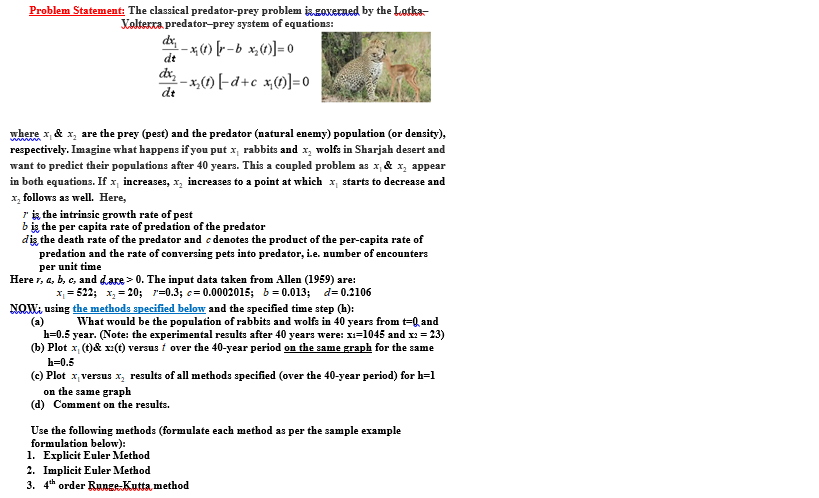
Problem Statement: The classical predator-prey problem gexecued by the Latka- Xolterxa predator-prey system of equations: where x & x, are the prey (pest) and the predator (natural enemy) population (or density), respectively. Imagine what happens if you put x, rabbits and x, wolfs in Sharjah desert and want to predict their populations after 40 years. This a coupled problem as x, & x, appear in both equations. If x, increases, x2 increases to a point at which x, starts to decrease and x2 follows as w Here, 7' is the intrinsic growth rate of pest 01the per capita rate of predation of the predator dlthe death rate of the predator and c denotes the product of the per-capita rate of predation and the rate of conversing pets into predator, i.e. number of encounters per unit time Here r, a, b, c, and dare>0. The input data taken from Allen (1959) are: x,=522; x,-20; 7-03;c= 0.0002015; b= 0.013; d=0.2106 NQWi uzing the methods below and the specified time step (h): What would be the population of rabbits and wolfs in 40 years fron t=0,and h=0.5 year. (Note: the experimental results after 40 years were: x1=1045 and X2-23) (b) Plot x, (t)& t) versus f over the 40-year period on the same graph for the same h=0.5 (c) Plot x versus x2 results of all methods specified (over the 40-year period) for h-l on the same graph (d) Comment on the results. Use the following methods (formulate each method as per the sample example formulation below): 1. Explicit Euler Method 2. Implicit Euler Method 3. 4th order Runge.Kutta method Problem Statement: The classical predator-prey problem gexecued by the Latka- Xolterxa predator-prey system of equations: where x & x, are the prey (pest) and the predator (natural enemy) population (or density), respectively. Imagine what happens if you put x, rabbits and x, wolfs in Sharjah desert and want to predict their populations after 40 years. This a coupled problem as x, & x, appear in both equations. If x, increases, x2 increases to a point at which x, starts to decrease and x2 follows as w Here, 7' is the intrinsic growth rate of pest 01the per capita rate of predation of the predator dlthe death rate of the predator and c denotes the product of the per-capita rate of predation and the rate of conversing pets into predator, i.e. number of encounters per unit time Here r, a, b, c, and dare>0. The input data taken from Allen (1959) are: x,=522; x,-20; 7-03;c= 0.0002015; b= 0.013; d=0.2106 NQWi uzing the methods below and the specified time step (h): What would be the population of rabbits and wolfs in 40 years fron t=0,and h=0.5 year. (Note: the experimental results after 40 years were: x1=1045 and X2-23) (b) Plot x, (t)& t) versus f over the 40-year period on the same graph for the same h=0.5 (c) Plot x versus x2 results of all methods specified (over the 40-year period) for h-l on the same graph (d) Comment on the results. Use the following methods (formulate each method as per the sample example formulation below): 1. Explicit Euler Method 2. Implicit Euler Method 3. 4th order Runge.Kutta method
Step by Step Solution
There are 3 Steps involved in it

Get step-by-step solutions from verified subject matter experts
 Study Help