







Question: Using the notation: overstated (+), understated (-) or no effect (0), and the amount involved to indicate the effects of the following transactions on each
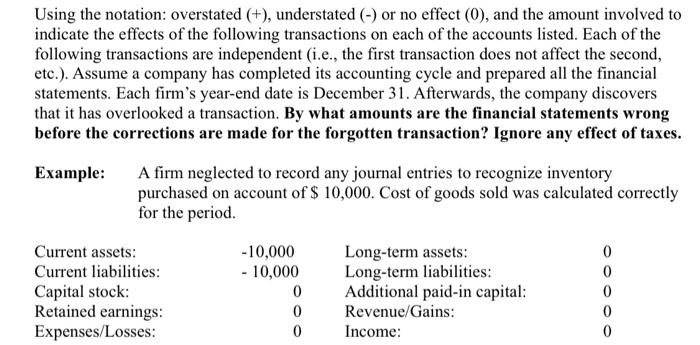
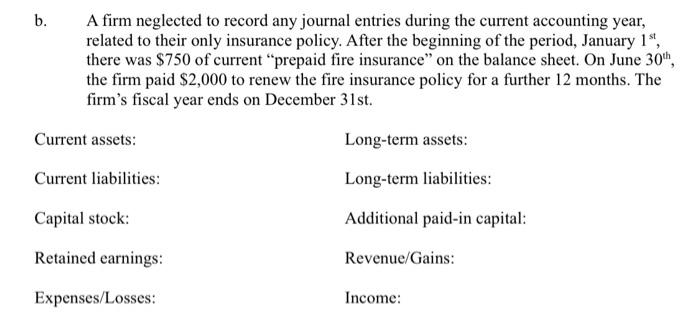
Using the notation: overstated (+), understated (-) or no effect (0), and the amount involved to indicate the effects of the following transactions on each of the accounts listed. Each of the following transactions are independent (i.e., the first transaction does not affect the second, etc.). Assume a company has completed its accounting cycle and prepared all the financial statements. Each firm's year-end date is December 31. Afterwards, the company discovers that it has overlooked a transaction. By what amounts are the financial statements wrong before the corrections are made for the forgotten transaction? Ignore any effect of taxes. Example: A firm neglected to record any journal entries to recognize inventory purchased on account of $ 10,000. Cost of goods sold was calculated correctly for the period. 0 Current assets: Current liabilities: Capital stock: Retained earnings: Expenses/Losses: -10,000 - 10,000 0 0 0 Long-term assets: Long-term liabilities: Additional paid-in capital: Revenue/Gains: Income: OOOOO b. A firm neglected to record any journal entries during the current accounting year, related to their only insurance policy. After the beginning of the period, January 1", there was $750 of current "prepaid fire insurance" on the balance sheet. On June 30th, the firm paid $2,000 to renew the fire insurance policy for a further 12 months. The firm's fiscal year ends on December 31st. Current assets: Long-term assets: Current liabilities: Long-term liabilities: Capital stock: Additional paid-in capital: Retained earnings: Revenue/Gains: Expenses/Losses: Income
Step by Step Solution
There are 3 Steps involved in it

Get step-by-step solutions from verified subject matter experts
 Study Help