







Question: Using the probit equations provided below: Determine the explosion overpressure (in psi) where 50% fatalities due to lung hemorrhage are expected. Determine the explosion overpressure
Using the probit equations provided below:
-
Determine the explosion overpressure (in psi) where 50% fatalities due to lung hemorrhage
are expected.
-
Determine the explosion overpressure (in psi) where 50% of the structures are damaged.
-
Compare the results of parts a and b. Why is the overpressure of part b frequently used as
the minimum overpressure for fatalities?
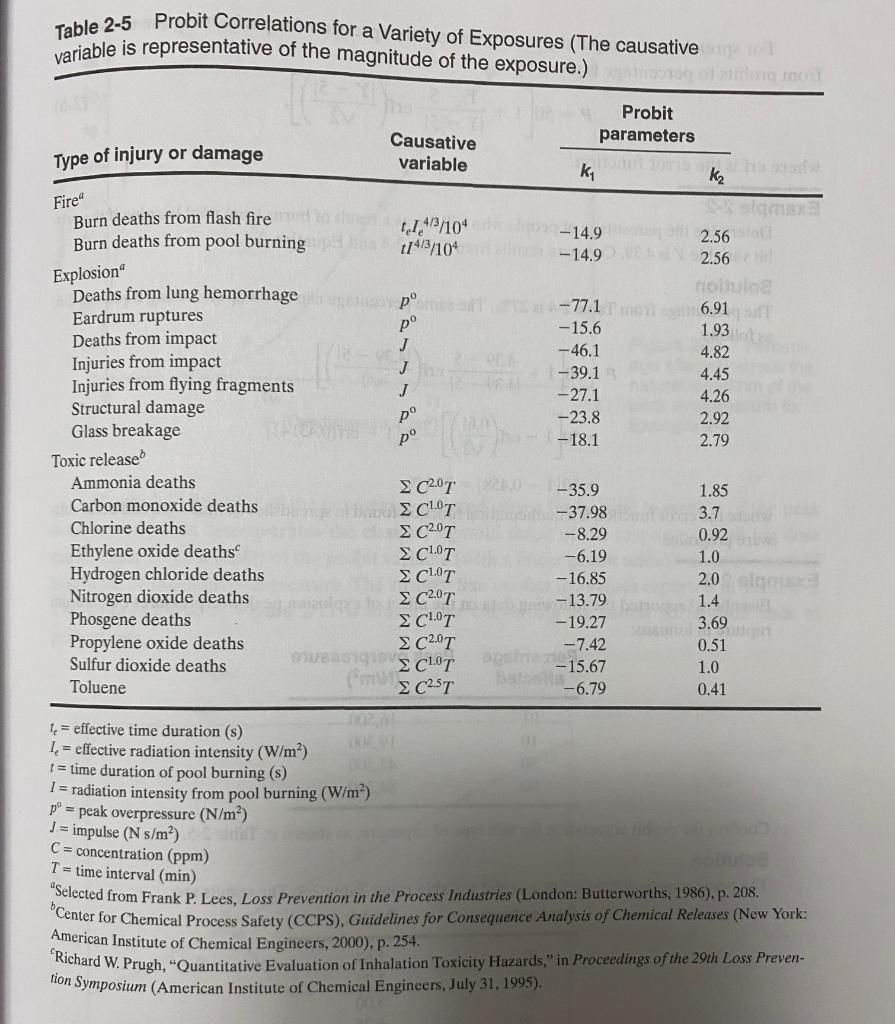
Table 2-5 Probit Correlations for a variety of Exposures (The causative variable is representative of the magnitude of the exposure.) Probit parameters Type of injury or damage Causative variable ky kg hasnode 11.43/10* 2.56 tI4/3/10 p p J J J G - 14.9 - 14.9 2.56 nolla - 77.16.91 - 15.6 -46.1 -39.1 4.45 -27.1 4.26 -23.8 2.92 -18.1 1.93 4.82 Fire" Burn deaths from flash fire Burn deaths from pool burning Explosion Deaths from lung hemorrhage Eardrum ruptures Deaths from impact Injuries from impact Injuries from flying fragments Structural damage Glass breakage Toxic release Ammonia deaths Carbon monoxide deaths Chlorine deaths Ethylene oxide deaths Hydrogen chloride deaths Nitrogen dioxide deaths Phosgene deaths Propylene oxide deaths Sulfur dioxide deaths Toluene po po 2.79 C2.0T C1.0T C2.0T ECLOT C1.0T C2.0T C1.0T C2.0T 1.85 3.7 0.92 1.0 -35.9 -37.98 -8.29 -6.19 -16.85 -13.79 -19.27 -7.42 -15.67 -6.79 2.0 1.4 80 C10T 3.69 0.51 1.0 0.41 C2.5T 1. = effective time duration (S) 1. = effective radiation intensity (W/m) 1 = time duration of pool burning () 1 = radiation intensity from pool burning (W/m) p = peak overpressure (N/m) J = impulse (N s/m?) C = concentration (ppm) T = time interval (min) "Selected from Frank P. Lees, Loss Prevention in the Process Industries (London: Butterworths, 1986), p. 208. Center for Chemical Process Safety (CCPS), Guidelines for Consequence Analysis of Chemical Releases (New York: American Institute of Chemical Engineers, 2000), p. 254. Richard W. Prugh, "Quantitative Evaluation of Inhalation Toxicity Hazards," in Proceedings of the 29th Loss Preven- tion Symposium (American Institute of Chemical Engineers, July 31, 1995)
Step by Step Solution
There are 3 Steps involved in it

Get step-by-step solutions from verified subject matter experts
 Study Help