







Question: Using this solutions to write a formal report (a) The given transformer turn ratio, Np:Ns, of 6:1. The rms value secondary voltage is calculated as
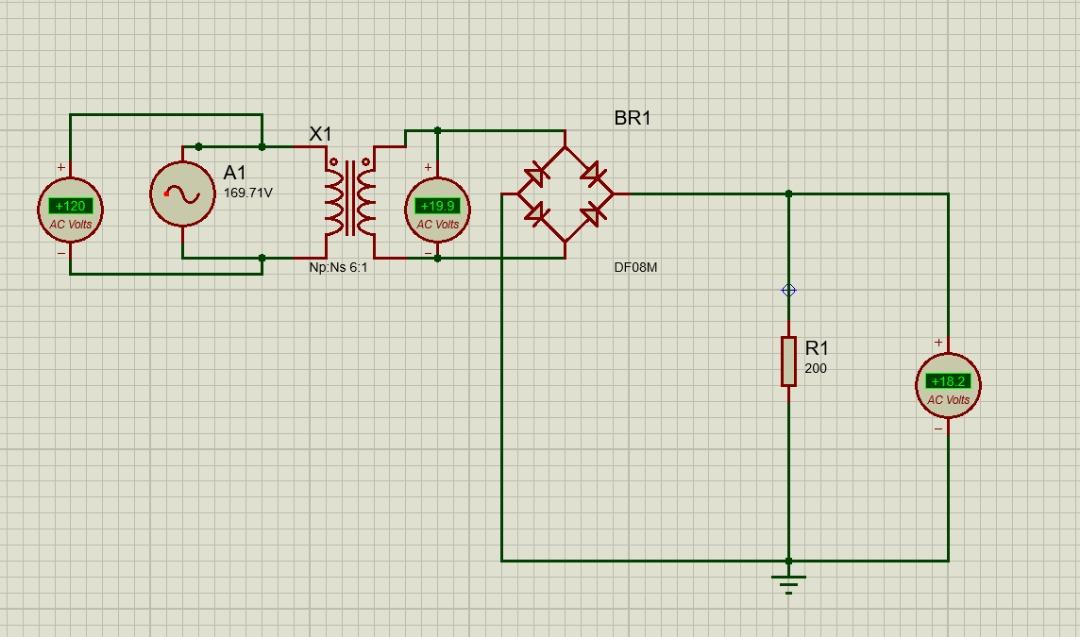
Using this solutions to write a formal report
(a)
The given transformer turn ratio, Np:Ns, of 6:1. The rms value secondary voltage is calculated as Vs= (Ns/Np)*Vp
Vs =(1/6) *120 = 20 vac
So, the secondary voltage, Vs = 20vac
Now calculate peak values for the secondary voltage, Vout(pk), is V(pk)= Vs * 1.414
V(pk)= 20 * 1.414
V(pk) = 28.28 V
Vout(pk) = 28.28 – 1.4
Vout(pk) = 26.88 V
So, peak value of the secondary voltage Vout(pk)=28.28 V (b)
To calculate dc output voltage, Vdc, using this formula. Vdc = 0.636 * Vout(pk)
Vdc = 0.636 * 26.88
Vdc = 17.1 v
So, the dc output voltage is 17.1v
(c)
To calculate load current, I, using this formula. I = Vdc / R
I = 17.1 / 200
I = 85.5mA
So, the load current is 85.5mA
(d)
To calculate dc diode current,I(diode), using this formula. I(diode) = I / 2
I(diode) = 85.5 / 2
I(diode) = 42.75mA
So, the dc diode current is 42.75mA
(e)
The PIV = Vout(pk) – 0.7
PIV = 28.28 – 0.7
PIV = 27.58 V
So, the PIV for each diode is 27.58 V
(f)
The frequency of output in a full wave bridge rectifier twice the input frequency expressed as Fout = 2 * Fin
Fout = 2 * 60
Fout = 120 Hz
So, the frequency of output in a full wave bridge rectifier is 120Hz
Use this procedure please
i. Problem Description/Formulatio
ii. Solution Approach and Calculations
iii. Results and Discussion
BR1 X1 A1 169.71V +120 +19.9 AC Volts AC Volts Np:Ns 6:1 DF08M R1 200 +18.2 AC Volts
Step by Step Solution
There are 3 Steps involved in it
IProblem DescriptionFormulation Some devices oparate on DC Thus AC mains is to be converted into appropriate value of DC eg consider a situation in wh... View full answer

Get step-by-step solutions from verified subject matter experts
 Study Help