







Question: What do we mean when we say that strategy formation is situational or contingent in nature? Why is this important to understand? CHAPTER 2: FORMULATING
What do we mean when we say that strategy formation is situational or contingent in nature? Why is this important to understand? 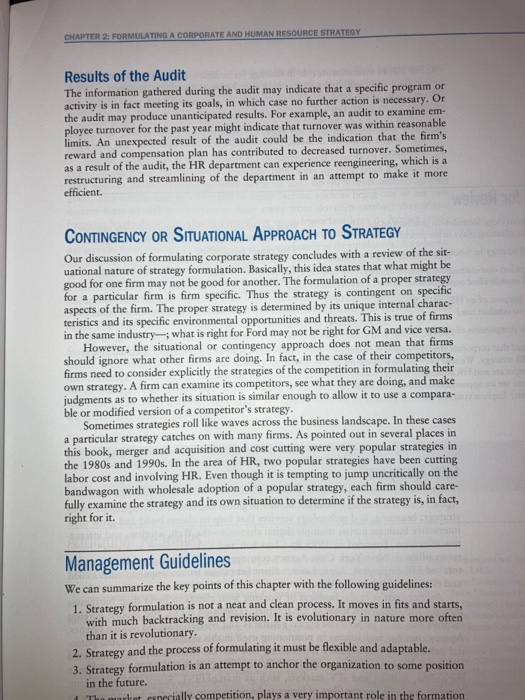
CHAPTER 2: FORMULATING A CORPORATE AND HUMAN RESOURCE STRATEGY Results of the Audit The information gathered during the audit may indicate that a specific program or activity is in fact meeting its goals, in which case no further action is necessary. Or the audit may produce unanticipated results. For example, an audit to examine em- ployee turnover for the past year might indicate that turnover was within reasonable limits. An unexpected result of the audit could be the indication that the firm's reward and compensation plan has contributed to decreased turnover. Sometimes, as a result of the audit, the HR department can experience reengineering, which is a restructuring and streamlining of the department in an attempt to make it more efficient. CONTINGENCY OR SITUATIONAL APPROACH TO STRATEGY Our discussion of formulating corporate strategy concludes with a review of the sit- uational nature of strategy formulation. Basically, this idea states that what might be good for one firm may not be good for another. The formulation of a proper strategy for a particular firm is firm specific. Thus the strategy is contingent on specific aspects of the firm. The proper strategy is determined by its unique internal charac- teristics and its specific environmental opportunities and threats. This is true of firms in the same industry what is right for Ford may not be right for GM and vice versa. However, the situational or contingency approach does not mean that firms should ignore what other firms are doing. In fact, in the case of their competitors, firms need to consider explicitly the strategies of the competition in formulating their own strategy. A firm can examine its competitors, see what they are doing, and make judgments as to whether its situation is similar enough to allow it to use a compara- ble or modified version of a competitor's strategy. Sometimes strategies roll like waves across the business landscape. In these cases a particular strategy catches on with many firms. As pointed out in several places in this book, merger and acquisition and cost cutting were very popular strategies in the 1980s and 1990s. In the area of HR, two popular strategies have been cutting labor cost and involving HR. Even though it is tempting to jump uncritically on the bandwagon with wholesale adoption of a popular strategy, each firm should care- fully examine the strategy and its own situation to determine if the strategy is, in fact, right for it. Management Guidelines We can summarize the key points of this chapter with the following guidelines: 1. Strategy formulation is not a neat and clean process. It moves in fits and starts, with much backtracking and revision. It is evolutionary in nature more often than it is revolutionary. 2. Strategy and the process of formulating it must be flexible and adaptable. 3. Strategy formulation is an attempt to anchor the organization to some position in the future. The market especially competition, plays a very important role in the formation
Step by Step Solution
There are 3 Steps involved in it
1 Expert Approved Answer
Step: 1 Unlock

Question Has Been Solved by an Expert!
Get step-by-step solutions from verified subject matter experts
Step: 2 Unlock
Step: 3 Unlock
 Study Help