



Question: what is the difference between directional and nondirectional hypothesis Directional and nondirectional hypotheses Mon stating the relationship between two variables or comparing two groups, terms
what is the difference between directional and nondirectional hypothesis 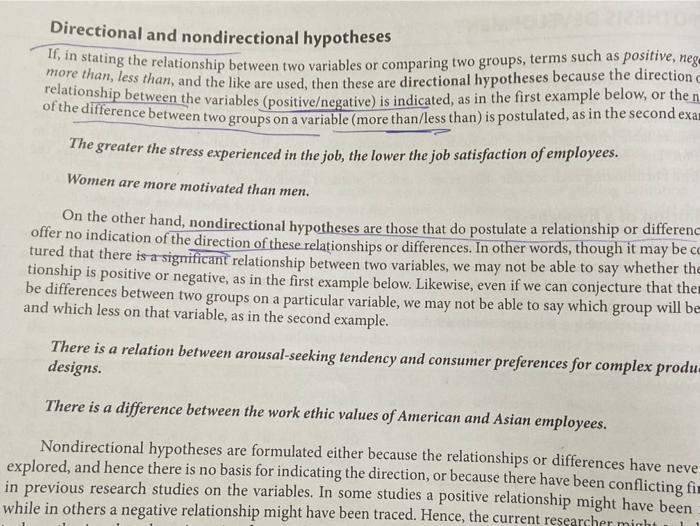
Directional and nondirectional hypotheses Mon stating the relationship between two variables or comparing two groups, terms such as positive , neg- refore than, less than, and the like are used, then these are directional hypotheses because the direction of the difference between two groups on a variable (more than/less than) is postulated, as in the second exam The greater the stress experienced in the job, the lower the job satisfaction of employees. Women are more motivated than men. On the other hand, nondirectional hypotheses are those that do postulate a relationship or differenc offer no indication of the direction of these relationships or differences. In other words, though it may be ce tured that there is a significant relationship between two variables, we may not be able to say whether the tionship is positive or negative, as in the first example below. Likewise, even if we can conjecture that the be differences between two groups on a particular variable, we may not be able to say which group will be and which less on that variable, as in the second example. There is a relation between arousal-seeking tendency and consumer preferences for complex produ- designs. There is a difference between the work ethic values of American and Asian employees. Nondirectional hypotheses are formulated either because the relationships or differences have neve explored, and hence there is no basis for indicating the direction, or because there have been conflicting fi- in previous research studies on the variables. In some studies a positive relationship might have been while in others a negative relationship might have been traced. Hence, the current researcher might
Step by Step Solution
There are 3 Steps involved in it
1 Expert Approved Answer
Step: 1 Unlock

Question Has Been Solved by an Expert!
Get step-by-step solutions from verified subject matter experts
Step: 2 Unlock
Step: 3 Unlock