







Question: When there are coefficients in the reaction formula, how does that change the integrated rate law? For example I know that in a 2nd-order reaction
When there are coefficients in the reaction formula, how does that change the integrated rate law? For example I know that in a 2nd-order reaction of 2A->B, the integrated rate law becomes 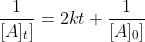 but what about when the coefficients are A->2B? What about reactions of other orders?
Step by Step Solution
There are 3 Steps involved in it
1 Expert Approved Answer
Step: 1 Unlock

Question Has Been Solved by an Expert!
Get step-by-step solutions from verified subject matter experts
Step: 2 Unlock
Step: 3 Unlock
 Study Help