







Question: When walking on a flat surface, all the mechanical energy developed to move arms and legs is eventually dissipated into heat through various friction mechanisms
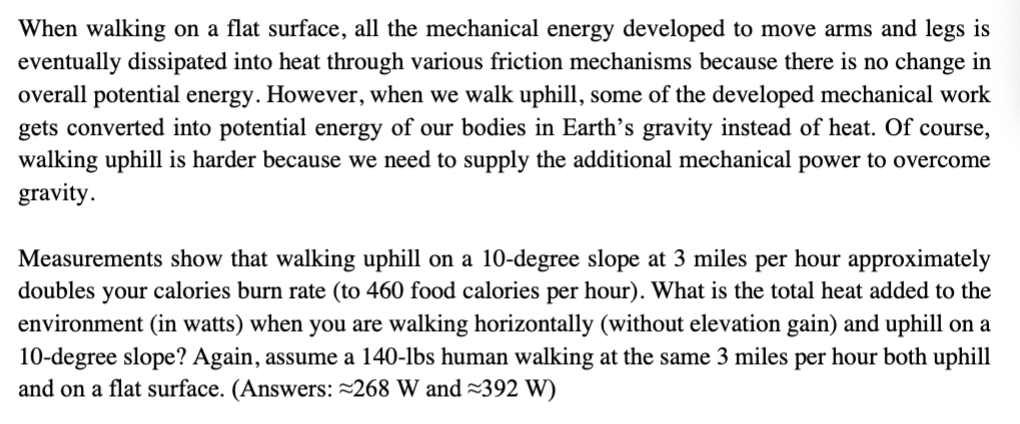
When walking on a flat surface, all the mechanical energy developed to move arms and legs is
eventually dissipated into heat through various friction mechanisms because there is no change in
overall potential energy. However, when we walk uphill, some of the developed mechanical work
gets converted into potential energy of our bodies in Earth's gravity instead of heat. Of course,
walking uphill is harder because we need to supply the additional mechanical power to overcome
gravity.
Measurements show that walking uphill on a degree slope at miles per hour approximately
doubles your calories burn rate to food calories per hour What is the total heat added to the
environment in watts when you are walking horizontally without elevation gain and uphill on a
degree slope? Again, assume a lbs human walking at the same miles per hour both uphill
and on a flat surface. Answers: ~~ and ~~
Step by Step Solution
There are 3 Steps involved in it
1 Expert Approved Answer
Step: 1 Unlock

Question Has Been Solved by an Expert!
Get step-by-step solutions from verified subject matter experts
Step: 2 Unlock
Step: 3 Unlock
 Study Help