







Question: Why does Aristotle say that, even if the actively maintained condition is present it is possible for it to accomplish no good? What point
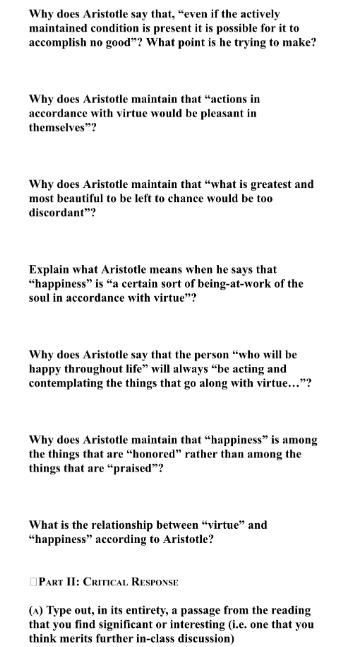
Why does Aristotle say that, "even if the actively maintained condition is present it is possible for it to accomplish no good"? What point is he trying to make? Why does Aristotle maintain that "actions in accordance with virtue would be pleasant in themselves"? Why does Aristotle maintain that "what is greatest and most beautiful to be left to chance would be too discordant"? Explain what Aristotle means when he says that "happiness" is "a certain sort of being-at-work of the soul in accordance with virtue"? Why does Aristotle say that the person "who will be happy throughout life" will always "be acting and contemplating the things that go along with virtue..."? Why does Aristotle maintain that "happiness" is among the things that are "honored" rather than among the things that are "praised"? What is the relationship between "virtue" and "happiness" according to Aristotle? PART II: CRITICAL RESPONSE (A) Type out, in its entirety, a passage from the reading that you find significant or interesting (i.e. one that you think merits further in-class discussion)
Step by Step Solution
3.27 Rating (165 Votes )
There are 3 Steps involved in it
Aristotle was convinced that a happy life required fulfilment of a broad range of conditions including physical and mental well being In this way he introduced the idea of a science of happiness in cl... View full answer

Get step-by-step solutions from verified subject matter experts
 Study Help